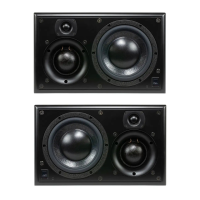
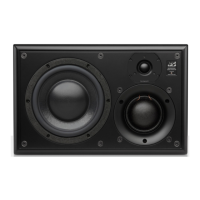
Diagram 1 – R1-300 LED and signal wiring
distance z
distance x
distance y
Distance x = Distance y = Distance z
DIAGRAM 1 DIAGRAM 2
Position loudspeaker with acoustic
axis at or up to 5º above ear level
Acoustic axis
The room in which a loudspeaker is placed can be thought of as a lter, altering the acoustic response at the listening position from that of the
loudspeaker. The position of the loudspeaker in a room will inuence how it interacts with the space and therefore is often critical to achieving the
best performance at the listening position.
Speaker positioning is important because at low frequencies the room will have a strong inuence due to room modes/resonances. Room modes
manifest themselves as an uneven distribution of acoustic energy within the room, which can lead to either too much or too little bass at the listening
position.
A room with a well-controlled low frequency response (controlled reverb time) will have a far smaller inuence on the performance of the
loudspeaker and will be less sensitive to positioning. Applying acoustic treatment in a domestic setting is not always possible or desirable but
if considered it should be noted that, typically, a combination of resonant membrane traps and porous absorbers are needed to control the low
frequency. The resonant membrane traps are eective at treating the low bass, typically below 80Hz and the porous absorbers frequencies above
this. Porous absorbers such as those made from foams, breglass or rockwool are not eective at absorbing low bass energy without a very large
air space between them and the wall behind which reduces usable space within a room.
To minimise problems a free-standing loudspeaker should be kept away from corners where possible. Avoid placing the loudspeaker mid-way
between any two parallel walls.
Typically, best results come from mounting stand-mount speakers on suitable speaker stands. Stands should be heavy, rigid, and non-resonant.
Ensure that the stand can support the weight of the speaker and that the top-plate is large enough that the cabinet is stable. Ensure that the bottom-
plate is large enough so that the stand is stable with the load of the speaker on it. The stand height should be selected so that the speaker acoustic
centre is at, or just above ear level (see diagram 1). Floor-standing ‘Tower’ speakers do not need stands.
Position the loudspeakers so they form an equilateral triangle with the listening position (see diagram 2). With this layout, the distance between
the loudspeakers will be equal to the distance from one speaker to the listening position.
The ear and brain tend to interpret distorted sound as loudness and thus underestimate the actual level of undistorted sound. The SCM20PSL
and SCM20ASL, like all ATC monitors, demonstrate much lower levels of distortion than conventional systems of a similar size and it is therefore
advisable to begin listening at an articially low level and carefully increase the volume. It is also possible for the monitors to produce sucient
sound pressure levels for your ears themselves to become a source of distortion and make the sound appear harsh. Any audible distortion indicates
that either the system or your ears are being overloaded, and that the volume level should be reduced.
Room Interaction
Listening
2.3
2.4
SECTION TWO
L. Sub-Out
Pre-Amplier
L. Spk
In
R. Pre-Out
R. Sub
In
L. Pre-Out
L. Sub
In
R. Spk
In
R. Sub-Out


 To Next Page
 Loading...