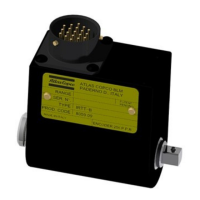
The Atlas Copco Analog Rotary Transducer (IRTT-B) is a device designed for torque measurement, with an optional angle reading capability. It is suitable for various industrial applications requiring precise torque and angle data.
Function Description
The IRTT-B transducer measures torque using a precise extensometer bridge. The signal from the rotating shaft is transferred to the housing via special brushes, which are designed for high reliability and require no maintenance throughout their lifespan. For models with angle reading capability, a rotating magnetic sensor provides 1024 pulses per revolution. The transducer also incorporates a built-in memory (EEPROM) that stores identification and calibration data, allowing for automatic reading by the measurement instrument. This eliminates the need for manual data entry when used with compatible Atlas Copco ACTA instruments.
Important Technical Specifications
Torque Measurement Range: The IRTT-B offers a wide torque measurement range from 1 Nm up to 5000 Nm, depending on the specific model.
Angle Reading (Optional): For models equipped with angle reading, it provides 1024 pulses per turn.
Static Accuracy: The transducer boasts a static accuracy of ± 0.25% of its rated maximum transducer capacity.
Overload Capacity: It can withstand an overload of up to 125% of its rated maximum transducer capacity.
Temperature Stability: The temperature stability is 0.1% of capacity per °C.
Bridge Resistance: The bridge resistance is 350 Ohm.
Operation Humidity: The device operates in humidity conditions of 10-75% non-condensing.
Operating Temperature: The recommended operating temperature range is 5 to 40°C.
Built-in Memory (EEPROM) Data:
- Identification
- Calibration (Nm)
- Full scale value (% of cal. Value)
- Sensitivity (2mV/V)
- Pulses / rev
- Serial Number
- Date of latest calibration
- Next Calibration date
Connector Pin Out:
- A: Excitation +
- B: Excitation -
- C: Signal +
- D: Signal -
- F: Angle encoder cw trail (for versions with angle)
- G: Eeprom Clock
- H: Angle encoder cw lead (for versions with angle)
- J: Eeprom data
- P: Ground (angle and eeprom)
- R: + 5V for angle reading (for versions with angle)
- T: + 8/12V eeprom power supply
Model Variations:
The IRTT-B is available in two main categories: "Torque Only Models" and "Torque and Angle Models." Each category offers various capacities (Nm) and drive sizes (e.g., 1/4" hex, 1/4" square, 3/8" square, 1/2" square, 3/4" square, 1" square, 1 1/2" square).
Torque Only Models (Examples):
- 5-106 (5 Nm, 1/4" hex)
- 20-06 (20 Nm, 1/4" square)
- 750-25 (750 Nm, 1" square)
- 5000-38 (5000 Nm, 1 1/2" square)
Torque and Angle Models (Examples):
- 1A-106 (1 Nm, 1/4" hex)
- 5A-06 (5 Nm, 1/4" square)
- 75A-10 (75 Nm, 3/8" square)
- 3000A-38 (3000 Nm, 1 1/2" square)
Dimensions and Weight:
Dimensions (A, B, C, D, E, F, G, H, J) vary by model and drive type (square or hexagon). Weights range from approximately 215 grams (for 5A-106 without angle) to 4550 grams (for 3000A-38 with angle).
Maximum RPM and Minimum Radial Position (for Torque and Angle Models):
The maximum continuous and intermittent RPM, along with the minimum radial position (R in mm), are specified for each model. For instance, a 1 Nm, 1/4" hex model has a continuous RPM of 5000, intermittent RPM of 5000, and a minimum radial position of 50 mm. Larger capacity models like the 5000 Nm, 1 1/2" square have lower RPMs (1000 continuous, 4400 intermittent) and larger radial positions (600 mm).
Usage Features
Ease of Use: The built-in memory simplifies setup by automatically loading calibration data when connected to compatible Atlas Copco ACTA instruments. For other measuring instruments, shunt calibration values and angle pulses must be entered manually.
Tool Compatibility: Users should select a transducer with a torque capacity not less than the maximum capacity of the tool being used. Proper securing of the tool output spindle to the transducer input socket and the correct socket to the transducer output square drive is crucial for accurate measurement.
Alignment: It is important to align the tool and transducer to avoid side forces, which can affect measurement accuracy.
Reaction Bar Considerations: When testing with a reaction bar, the effective radial position of the reaction bar point should meet specified minimum values to prevent permanent damage to the transducer. Using a straight reaction bar at a 90° angle to the IRTT-B is the ideal solution to minimize the risk of large side forces.
Maintenance Features
Scheduled Maintenance: The IRTT-B transducer does not require critical maintenance activities. However, annual calibration is required to ensure continued accuracy.
Troubleshooting Guide: A troubleshooting guide is provided to address common issues:
- Shaft stiff to turn: This could be due to bearing defects caused by torsional or flexural vibration, high axial or radial loads, worn bearings, or a bent shaft. The recommended solution is to send the unit for repair/replacement.
- Zero shift less than 2%: Often caused by torsional vibration, the zero reading can be readjusted at the display.
- Zero shift between approx. 2 and 5% of full scale: This may result from torsional shock, an overloaded torquemeter, or torsional vibration. The zero reading can be readjusted at the display.
- Hysteresis between clockwise and counterclockwise torque: This indicates an overloaded torquemeter due to high alternating loads or torsional vibration. The unit should be sent for repair/replacement.
No User Serviceable Parts: The product contains no user-serviceable parts. Opening or attempting to repair the product will invalidate all warranties. All service needs should be referred to local Atlas Copco service personnel.
WEEE Directive Compliance: The product complies with the WEEE Directive (2002/96/EC). At the end of its life, the transducer must be disposed of separately from unsorted municipal waste and handled according to local regulations for proper recycling and environmental protection. Instructions for dismantling wasted items include removing the cover and separating the connector, electronic board, and brushes for appropriate disposal.


 To Next Page
 General