Booster seats and safety belts
Properly used booster seats can help protect
children weighing between about 40 lbs. and
80 lbs. (18 kg and 36 kg) who are less than 4
ft. 9 in. (57 inches/1 .45 meters) tall.
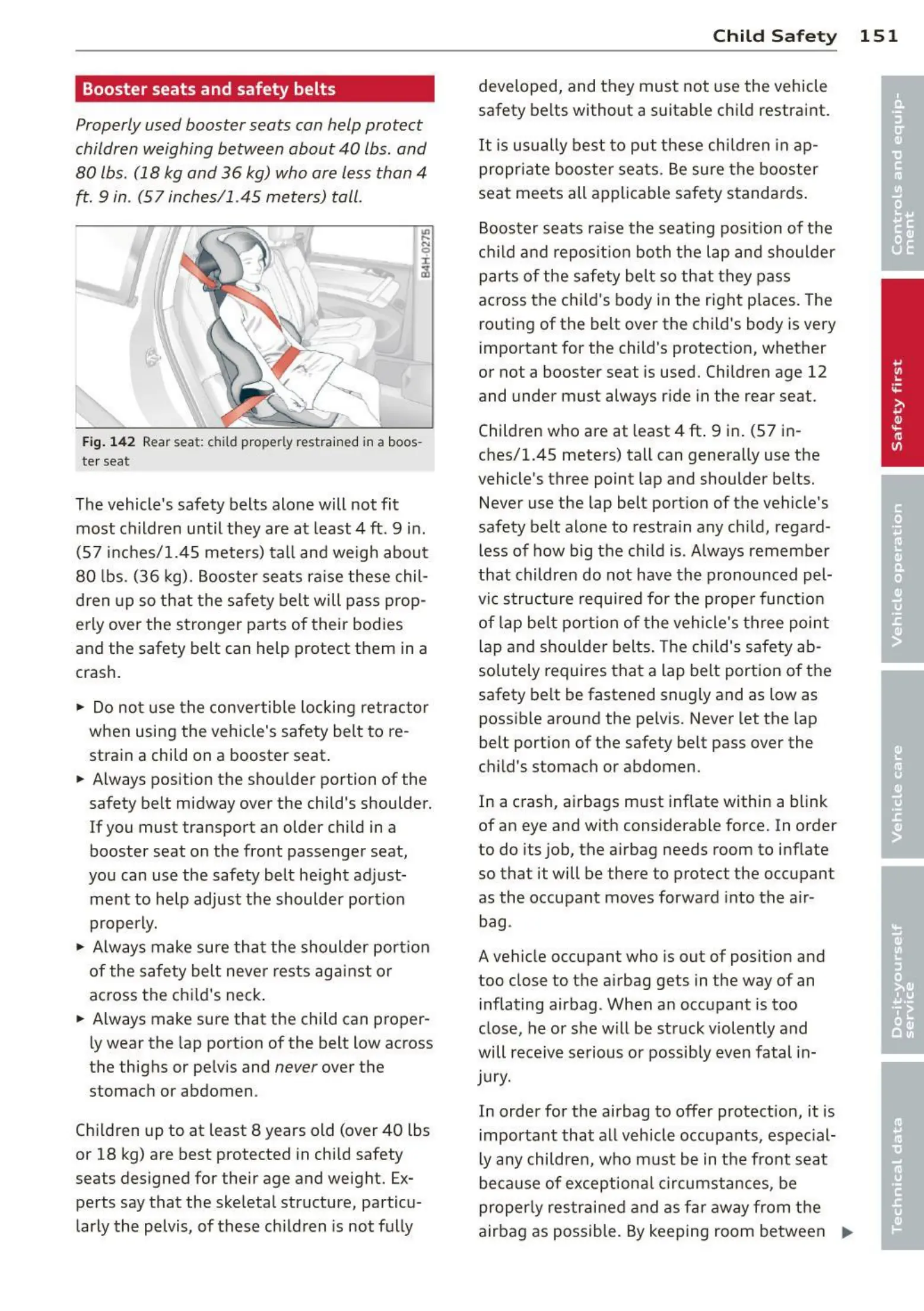
Fig. 142 Rear seat: child properly restrained in a boos-
ter seat
The vehicle's safety belts alone will not fit
most children until they are at least 4
ft. 9 in.
(57 inches/1.45 meters) tall and weigh about
80 lbs. (36 kg). Booster seats raise these chil-
dren up so that the safety belt will pass prop-
erly over the stronger parts of their bodies
and the safety belt can help protect them in a
crash.
.,. Do not use the convertible locking retractor
when using the vehicle's safety belt to re-
strain a child on a booster seat .
.. Always position the shou lder portion of the
safety belt midway over the child's shoulder.
If you must transport an older child in a
booster seat on the front passenger seat,
you can use the safety belt height adjust-
ment to help adjust the shoulder portion
properly .
.. Always make sure t hat the shoulder port ion
of the safety belt neve r rests against or
across the child's neck.
.. Always make sure that the child can proper-
ly wear the lap portion of the belt low across
the thighs or pelvis and
never over the
stomac h or abdomen.
Children up to at least 8 years old (over 40 lbs
or 18 kg) are best protected in child safety
seats designed for their age and weight. Ex-
perts say that the skeletal structure, particu-
larly the pelvis, of these children is not fully
Child Safety 15 1
developed, and they must not use the vehicle
safety belts without a suitable child restraint.
It is usually best to put these children in ap-
propriate booster seats. Be sure the booster
seat meets all applicable safety standa rds.
Booster seats raise the seat ing pos ition of the
child and reposition both the lap and shoulder
parts of the safety belt so that they pass
across the child's body in the right places. The
routing of the belt over the child's body is very
important for the child's protect ion, whether
or not a booster seat is used. Children age 12
and under must always ride in the rear seat.
Children who are at least 4
ft . 9 in. (57 in-
ches/1.45 meters) tall can generally use the
vehicle 's three point lap and shoulder belts.
Never use the lap belt portion of the vehicle's
safety belt alo ne to restrain any child, regard -
less of how big t he child is. Always remember
that children do not have the pronounced pel-
vic structure required for the prope r function
of lap belt portion of the vehicle 's th ree point
lap and shoulde r belts. The child's safety ab-
solutely requires that a lap belt portion of the
safety belt be fastened snugly and as low as
possible around the pelvis. Never let the lap
belt portion of the safety belt pass over the
child's stomach or abdomen .
In a crash, airbags must inflate within a blink
of an eye and with considerable force. In order
to do its job, the airbag needs room to inflate
so that it will be there to protect the occupant
as the occupant moves forward into the air-
bag.
A vehicle occupant who is out of position and
too close to the airbag gets in the way of an
inflating airbag . When an occupant is too
close, he or she will be st ruck violently and
will receive serious or possibly even fatal in-
jury.
In order for the airbag to offer protection, it is
important that all veh icle occupants, especial-
ly any children, who must be in the front seat
because of exceptiona l circumstances, be
properly restraine d and as fa r away from the
airbag as possible. By keeping room between ..,_


 To Next Page