3
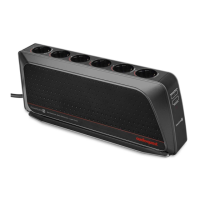
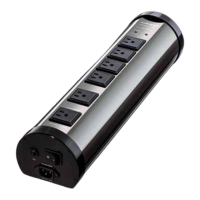
PowerQuest 707 EU Features
¡ 45 Amps peak Transient Power Correction (up to 25 mS)
¡ Ultra-Linear Dierential Filter: 8kHz – 1GHz (well in excess of 22dB)
¡ Ultra-Linear Common-Mode Filter: 30kHz – 100MHz (well in excess of 22dB)
¡ Both lters linearized for (rising) line impedance with frequency from 0.05 Ohms (source) and
10 to 50 Ohms load (system current dependent)
¡ Non-Sacricial Surge Suppression (will withstand multiple strikes of 6000V or 3000A
without damage)
¡ Extreme Voltage Shutdown: 270VAC. Will activate main circuit relay in under 0.25 seconds.
Automatically resets once incoming voltage is within a safe range
¡ (3) High-Current spec-grade outlets; (4) Ultra-Linear Filtered Source outlets
¡ Detachable 2-meter PowerQuest PQ-716 AC cord featuring ZERO-Tech and RF/ND-Tech
¡ Ultra-low impedance magnetic circuit breaker/power switch
¡ Maximum Input Current Capacity: 10A RMS
¡ 2RU rack mountable metal chassis (rack ears included)
Introduction
The science of AC power is not simple; it demands focus, and the devil is in the details. In fact, the mammoth
increase in airborne and AC-line-transmitted radio signals, combined with overtaxed utility lines and the
ever-increasing demands from high-denition audio/video components, has rendered our utilities’ AC power
an antiquated technology.
Where Alternating Current (AC) is concerned, we’re relying on a century-old technology created for
incandescent lights and electric motors—technology that was certainly never meant to power the
sophisticated analog and digital circuits used in premium audio/video systems. To properly accommodate the
promise of today’s ever-increasing bandwidth and dynamic range, we must achieve extraordinarily low noise
across a wide range of frequencies.
Further, today’s power ampliers are being taxed for instantaneous peak-current demand, even when they’re
driven at modest volumes. Although we have seen a substantial increase in both dynamics and bass content
from our audio software, the loudspeakers we employ to reproduce them are no more ecient than they
were two to four decades ago. This places great demands on an amplier’s power supply, as well as the
source AC power supplying it.
Our systems’ sensitive components need better alternating current—a fact that has resulted in a host of AC
power conditioning, isolation transformers, regeneration ampliers, and battery back-up system topologies.
Through dierential sample tests and spectrum analysis, it can be proven that up to a third of a high-
resolution (low-level) audio signal can be lost, masked, or highly distorted by the vast levels of noise riding
along the AC power lines that feed our components. This noise couples into the signal circuitry as current
noise and through AC ground, permanently distorting and/or masking the source signal.
All sincere attempts to solve this problem must be applauded since once the audio/video signal is gone, it’s
gone forever...
For AudioQuest, honoring the source is never a matter of simply using premium “audiophile-grade parts” or
relying on a proprietary technology—common approaches used within the audiophile market. For years, we
have all been witness to the same, seemingly endless audiophile debates: Valves versus transistors. Analog
versus digital. Can cables really make a dierence? The debates go on and on. While we, too, can brag


 To Next Page