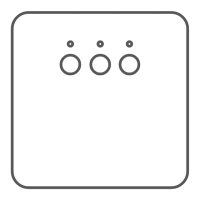
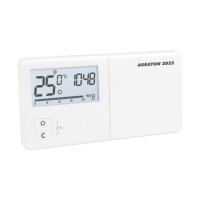
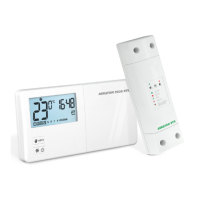
A) Manual setting - associating the T-1 controller with the RTH receiver we
have a possibility to manually set the temperature and control it in the
place of fastening the T-1 controller.
B) Remote setting - if to the same RTH receiver we additionally associate
the T-2 thermometer, the T-1 controller will retain the ability to set the
temperature, however, its control will be implemented only by the
associated T-2 thermometer. This enables controlling the temperature in
a room other than the one in which the T-1 controller is placed.
Example: We want the "baby room" to always have the temperature of
22°C, while we do not want the children to have a possibility to change the
temperature, we install the T-2 thermometer in the "baby room" and the
T-1 controller for instance in the kitchen. Thanks to such solution the
"baby room" will always have a temperature of 22°C regardless of the
temperature fluctuations that occur in the kitchen.
C) factory setting (20°C) - If with the RTH receiver we associate only the T-2
thermometer it is not possible to manually set the temperature and the
RTH receiver will maintain the factory setting of 20°C.
9
ATTENTION!
1. The order of associating the T-1controller and T-2 thermometer is very
important. If we want to pursue a remote setting , in the first place
associate the T-1 controller with RTH receiver and then the T-2
thermometer. Reverse association will result in automatic signing out of
the previously associated T-2 thermometer.
2. The RTH receiver may work only with one T-1 controller and/or one T-2
thermometer. Associating a new T-1controller will result in signing out of
the previously associated T-1controller and T-2 thermometer. Associating a
new T-2 thermometer will result in signing out of the previously associated
T-2 thermometer.



 To Next Page
 Loading...