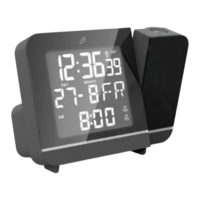
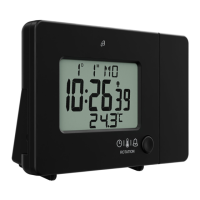
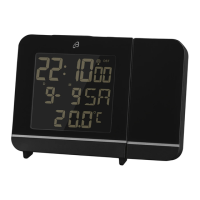
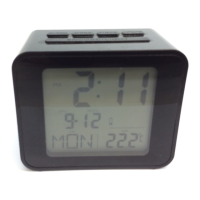
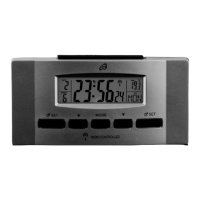
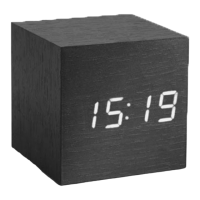
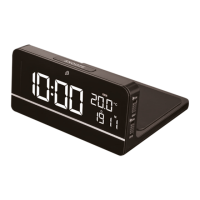
This document describes the AURIOL Radio-Controlled Alarm Clock, model numbers Z31481A, Z31481C, and Z31481D, version 03/2015.
The AURIOL Radio-Controlled Alarm Clock is designed for household use and displays time, date, and indoor temperature. It is not suitable for commercial use.
Technical Specifications:
- Operating voltage: 3V
- Batteries: 2 x LR03 (type AAA, 1.5V)
- Temperature range: approx. 0–50°C (32–122°F)
Scope of Delivery:
The package includes:
- 1 Radio-controlled alarm clock
- 2 LR03 batteries (inserted)
- 1 Set of operating instructions
Control Panel (Fig. A):
- 1 ALARM button: Used to access, activate, deactivate, and shut off the alarm function.
- 2 MODE button: Used to access general settings and confirm selections. In alarm activation mode, pressing this button returns to clock mode.
- 3 +/RCC button: Activates/deactivates DCF signal reception. In time mode, it selects 24 or 12-hour format. In settings mode, it increases values.
- 4 –/°C/°F button: Selects the temperature display unit (°C or °F). In settings mode, it decreases values.
- 5 SNOOZE/LIGHT button: When the alarm sounds, press to snooze for 10 minutes. Otherwise, press to activate the backlight for approximately 5 seconds.
Display (Fig. B):
- 6 Time field: Shows time in 24 or 12-hour format. In 12-hour format, it also displays AM (ante meridiem) or PM (post meridiem).
- 7 Info field: Displays four different symbols:
- 8 DCF symbol: Indicates DCF reception status.
- 9 DST (Daylight Saving Time): Appears only during European daylight saving time; cannot be manually activated.
- 10 Alarm symbol: Indicates the alarm is activated.
- 11 Snooze symbol: Indicates the snooze function is activated.
- 12 Battery symbol: Indicates that batteries need to be replaced.
- 13 Temperature field: Displays temperature in °C or °F.
- 14 Weekday field: In clock mode, shows the day of the week under "DAY." When setting the language, it shows the selected language. In alarm activation and alarm modes, it displays "ALM."
- 15 Date field: Shows the day of the month under "DATE" and the month under "MONTH." Can also be set to show the year.
Rear of Device (Fig. C & D):
- 16 Battery compartment cover
- 17 Battery compartment
General Safety Instructions:
- Familiarize yourself with all safety information and instructions before use.
- When passing the product to others, include all documentation.
- DANGER TO LIFE AND RISK OF ACCIDENTS FOR INFANTS AND CHILDREN! This appliance can be used by children aged 8 and up, as well as by persons with reduced physical, sensory, or mental capacities, or lack of experience/knowledge, provided they are supervised or instructed in safe use and understand the risks. Children should not play with the appliance. Cleaning and maintenance should not be performed by children without supervision.
- DANGER TO LIFE! Batteries are not for children. If swallowed, seek immediate medical attention.
- CAUTION! EXPLOSION HAZARD! Never recharge non-rechargeable batteries, short-circuit, or open them.
- Never throw batteries into fire or water.
- Do not exert mechanical loads on batteries.
- Risk of battery leakage!
- If a battery leaks, immediately remove it from the device to prevent damage.
- Avoid contact with skin, eyes, and mucous membranes. If contact occurs with battery acid, thoroughly flush the affected area with clean water and seek immediate medical attention.
- Only use the same type of batteries. Do not mix used and new batteries.
- Avoid extreme conditions and temperatures (e.g., radiators).
- Remove batteries if the appliance will not be used for a long period.
- Risk of equipment damage!
- Only use the specified battery type.
- Ensure correct polarity when inserting batteries (shown in the battery compartment).
- If necessary, clean batteries and device contacts before insertion.
- Promptly remove drained batteries from the product.
Before Initial Use:
- Remove the protective film from the display.
- Pull out the plastic strip from the battery compartment.
The LC display will perform a quick function check and begin receiving the DCF signal. This process may take a few minutes, indicated by the flashing DCF symbol 7 in the info field. Once successful, the DCF symbol will stop flashing. The clock will then display the current time (CET), date, weekday (in German), and temperature in °C.
Note: If you are in a different time zone or wish to display the weekday in another language, you must set it manually (refer to "Changing basic settings"). If the clock fails to receive a signal after 7 minutes, the DCF symbol will turn off. In this case, change the clock's location and manually start signal reception. If a signal still cannot be received after changing location, the time must be set manually.
Initial Use:
Automatic or Manual DCF Signal Activation:
- Automatic: The DCF signal (time signal transmitter) consists of time pulses emitted by one of the world's most accurate clocks near Frankfurt/Main, Germany (accuracy: 1 second in 30,000 years). The alarm clock receives this signal under optimal conditions up to approximately 1,500 km from Frankfurt. Reception typically takes 3–10 minutes. Obstacles (e.g., concrete walls) or interference sources (e.g., other electrical devices) can impair reception. If problems occur, try moving the clock (e.g., near a window). The clock updates its time once daily via the DCF signal. Reception is indicated by an animated DCF symbol 8 in the info field 7. A static symbol means successful reception; a disappearing symbol means unsuccessful reception until the next attempt.
- Manual: Press and hold the +/RCC 3 button for 3 seconds. The flashing DCF symbol 7 indicates the clock is attempting to receive a signal. You can cancel reception by pressing the +/RCC 3 button again; the DCF symbol will stop flashing.
Changing Basic Settings:
- Press and hold the MODE 2 button for 3 seconds to enter settings mode.
- Use the +/RCC 3 or –/°C/°F 4 buttons to change values in each programming step.
- TIP: Holding these buttons down will quickly increase or decrease numbers.
- Press the MODE 2 button to confirm a setting and advance to the next step.
- Note: If no changes are made for 20 seconds, the clock will automatically return to clock mode.
Settings (in order):
- 1. Setting the time zone: Default is 0. Set your time difference from Central European Time, ranging from +12 to -12 hours.
- 2. Set hour: The hour display in the clock field 6 flashes. (Only adjust if DCF reception failed; DCF signal corrects deviations).
- 3. Set minutes: The minute display in the clock field 6 flashes. (Only adjust if DCF reception failed).
- 4. Set year: The year display in the date field 15 flashes. Can be set up to 2099. (Only adjust if DCF reception failed).
- 5. Set month: The month display in the date field 15 flashes. (Only adjust if DCF reception failed).
- 6. Set day: The day display in the date field 15 flashes. (Only adjust if DCF reception failed).
- 7. Set language: The acronym for the current language flashes in the weekday field 14. Choose from: GER (German), ITA (Italian), FRE (French), NET (Dutch), ESP (Spanish), DAN (Danish), ENG (English).
- In program step 7, press the MODE 2 button to confirm the language. The clock will return to clock mode.
Setting the Alarm:
- Press and hold the ALARM 1 button for 3 seconds to switch from clock mode to alarm mode. "ALM" will appear at the bottom left of the weekday field 14. The alarm symbol 10 will appear in the info field 7, and the hour display will flash.
- Use the +/RCC 3 or –/°C/°F 4 buttons to adjust the hour.
- TIP: Holding these buttons down will quickly increase or decrease numbers.
- Press the ALARM button again to confirm the hour; the minute display will flash.
- Use the +/RCC 3 or –/°C/°F 4 buttons to adjust the minutes.
- TIP: Holding these buttons down will quickly increase or decrease numbers.
- Press the ALARM button again to confirm the minutes. The "ALM" indicator will return to the weekday display, and the clock will return to clock mode.
Turning the Alarm ON/OFF:
- Briefly press the ALARM 1 button. The clock will enter alarm mode and show the alarm time. "ALM" will appear at the bottom left.
- Press the ALARM button again to toggle the alarm on or off. The alarm symbol 10 indicates activation.
- Press the MODE 2 button again to exit alarm mode. "ALM" will disappear, and the clock returns to clock mode. In clock mode, the alarm function being activated is also indicated by the alarm symbol 10.
Switching Off the Alarm Signal:
- Note: When activated, the alarm will sound for approximately 2 minutes with 4 increasing levels. The alarm symbol 10 will flash.
- Press the ALARM 1 button to switch off the alarm. The alarm symbol will stop flashing, but the static alarm symbol will remain in the info field 7.
- Note: If the alarm is not switched off, it will sound again the next day at the set time.
Using the Snooze Function:
- When the alarm sounds, press the SNOOZE/LIGHT 5 button to activate snooze. The alarm will stop and sound again 10 minutes later. During this 10-minute period, the snooze symbol 11 will flash next to the alarm symbol 10.
- To permanently shut off the alarm, press the ALARM 1 button. The snooze symbol 11 will then turn off.
Lighting the LC Display:
- Press the SNOOZE/LIGHT 5 button to light the LC display for approximately 5 seconds.
Switching the Temperature Display Unit:
- In clock mode, press the –/°C/°F 4 button to switch between Celsius (°C) and Fahrenheit (°F).
Replacing Batteries:
- Note: If the battery symbol 12 appears on the LC display, the batteries need to be changed.
- Always replace both batteries at the same time.
- Only use LR03 battery type.
- Open the battery compartment 17 by the handle of the battery compartment cover 16.
- Remove old batteries and insert new ones, ensuring correct polarity (shown in the compartment).
- Close the battery compartment. The clock is now ready for use.
Troubleshooting:
The device contains delicate electronic components and may be disrupted by radio transmitting equipment or electrostatic discharges. If malfunctions occur, briefly remove and reinsert the batteries.
Cleaning and Care:
Clean the device externally with a soft, dry cloth only.
Disposal:
- Packaging: Made of environmentally friendly materials; dispose of through local recycling facilities.
- Product: Contact your local refuse disposal authority for information on disposing of worn-out products, including collection points and operating hours.
- Batteries: Do not dispose of batteries in household waste. They may contain toxic heavy metals (Cd = cadmium, Hg = mercury, Pb = lead) and are subject to hazardous waste regulations. Dispose of used batteries through your municipal collection site.
OWIM GmbH & Co. KG declares that the Radio-controlled alarm clock (Model no.: Z31481A/Z31481C/Z31481D, Version: 03/2015) complies with the standards/normative documents of 1999/5/EC. The complete declaration can be viewed at www.owim.com.
Warranty:
The device is manufactured to strict quality guidelines and thoroughly examined. You have legal rights against the retailer for product defects, which are not limited by this warranty.
- Warranty Period: 2 years from the date of purchase.
- Coverage: Material or manufacturing faults within the warranty period will be repaired or replaced free of charge.
- Proof of Purchase: Keep the original sales receipt as proof of purchase.
- Voided Warranty: The warranty is void if the device is damaged, improperly used, or poorly maintained.
- Exclusions: The warranty does not cover normal wear parts (e.g., batteries) or damage to fragile parts (e.g., switches, rechargeable batteries, glass parts).

 Need help?
 General

 To Next Page