Need help?
Do you have a question about the Autool C80 and is the answer not in the manual?
AUTOOL's registered trademarks, logos, and company name usage rights.
Essential safety measures like wearing protective gear, fire prevention, and ventilation.
Instructions for connecting hoses when the engine has a return hose.
Instructions for connecting hoses when the engine lacks a return hose.
Detailed steps for flushing the TWC and intake manifold.
Detailed steps for flushing the throttle body and exhaust pipe.
Reconnecting pipes, initializing the throttle, and post-cleaning cautions.
Details on product warranty duration, service terms, and claim conditions.
Company's right to change specifications and final explanation.
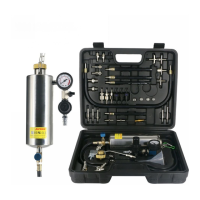
The AUTOOL C80 Fuel System Cleaner is a specialized tool designed for the comprehensive cleaning and maintenance of a vehicle's fuel system. This user manual provides detailed instructions for connecting the device, performing various cleaning procedures, and ensuring proper operation and maintenance. The C80 is engineered to address common issues related to fuel system contamination, aiming to restore optimal engine performance and efficiency.
The primary function of the AUTOOL C80 is to clean the fuel system, including injectors, fuel lines, and the combustion chamber, as well as the throttle body and exhaust pipe. It operates by introducing a mixture of gasoline and detergent into the fuel system under controlled pressure, effectively dissolving and removing carbon deposits, varnish, and other contaminants that accumulate over time.
The device supports two main connection methods for fuel system cleaning: with a return hose connection and without a return hose connection. These methods allow the C80 to be adapted to different vehicle fuel system configurations. When connected with a return hose, the C80 integrates into the engine's fuel supply and return lines, creating a closed loop where the cleaning solution circulates through the system. This method typically involves disconnecting the vehicle's fuel pump and using the C80 to supply the cleaning mixture. For systems without a return hose, the C80 is connected to the fuel inlet hose, and the fuel return line (if present) is blocked or the fuel pump is disabled.
Beyond the fuel system, the C80 also facilitates the cleaning of the Three-Way Catalytic Converter (TWC) and intake manifold, as well as the throttle body and exhaust pipe. For TWC and intake manifold cleaning, a specific TWC detergent is introduced into the intake vacuum pipe via a specialized flushing nozzle. This process requires the engine to be running at varying speeds to ensure thorough distribution and cleaning. For throttle body and exhaust pipe cleaning, a dedicated detergent is sprayed directly into the throttle body using a spray nozzle kit, again with the engine running to aid in the cleaning process.
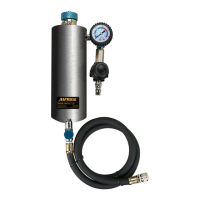
The C80 is designed to operate with compressed air, which is used to pressurize the cleaning solution in its steel bottle. An air control valve allows for precise adjustment of the air pressure, ensuring that the cleaning solution is delivered at the optimal pressure for effective cleaning without damaging engine components. The manual specifies different pressure ranges for electronic fuel injection systems and carburetor fuel systems, highlighting the versatility of the device.
The AUTOOL C80 is designed for ease of use, with clear instructions for each cleaning procedure. Before operation, users are advised to wear protective gloves and clothing, and to ensure a fire extinguisher is readily available, emphasizing safety during the cleaning process. It is crucial to stop the engine immediately if any fuel leak is detected.
For fuel system cleaning, the process involves disconnecting specific fuel hoses (supply and return) and connecting them to the C80 using appropriate adaptors. The manual provides a detailed diagram (Fig.01 and Fig.02) to illustrate these connections, making it straightforward for users to identify the correct points. Once connected, the cleaning mixture (gasoline and detergent) is poured into the C80's bottle, pressurized with compressed air, and then introduced into the engine's fuel supply pipe. The engine is then started to begin the flushing process. Users are instructed to check for any leaks at the connections before starting the engine to ensure a safe and effective cleaning operation. After flushing, the pressure in the C80's bottle is drained, and the device is disconnected, with all original fuel system pipes restored and checked for leaks.
When cleaning the TWC and intake manifold, the C80 is connected to the output pipe, and a TWC Flushing Nozzle is inserted into the intake vacuum pipe. The engine is started, and the detergent is slowly introduced. The procedure involves running the engine at idle speed, periodically increasing it to 1000 rpm, and then accelerating to 2000-3000 rpm for short intervals to ensure thorough cleaning. This process typically takes 30 to 40 minutes. After the detergent is exhausted, the engine is stopped, the vacuum pipe reconnected, and the engine run at idle for 5 to 10 minutes to clear any remaining detergent.
For throttle body and exhaust pipe cleaning, the throttle body detergent is poured into the C80, pressurized, and then sprayed directly into the throttle body using a spray nozzle kit. This procedure also requires the engine to be running. The manual emphasizes the importance of removing the pipe ahead of the throttle before flushing to allow direct access.
A critical note for all cleaning procedures is the importance of leading exhaust gases outdoors, as they contain toxic and hazardous substances. Additionally, for on-vehicle cleaning, the transmission should be in neutral (N) and the parking brake engaged for safety.
The AUTOOL C80 itself is a robust device, but its effective operation relies on proper usage and adherence to the cleaning procedures outlined in the manual. While the manual does not detail specific maintenance steps for the C80 unit itself, it implicitly guides users on how to maintain the vehicle's fuel system through its cleaning functions.
After performing cleaning procedures, especially for the throttle body, a crucial maintenance step for the vehicle is to initialize the Throttle Position Sensor (TPS) using an automotive scan tool. Failure to do so can result in the illumination of the fault indicator lamp and the recording of a Diagnostic Trouble Code (DTC) by the Powertrain Control Module (PCM). This highlights the importance of post-cleaning calibration to ensure the vehicle's electronic systems correctly adapt to the cleaned components.
The manual also provides information on warranty access and service, which can be considered a form of maintenance support for the device itself. AUTOOL offers a 3-year warranty for the main unit and a 1-year warranty for accessories, starting from the date of product receipt. This warranty covers repairs or replacements for specific fault conditions and guarantees that all replacement parts are brand new. In cases of product breakdown that cannot be resolved within 90 days, customers are advised to provide video and pictures as proof, and AUTOOL will cover freight costs and provide necessary accessories. For issues arising after 90 days, the customer bears the freight cost, but accessories are provided free of charge.
However, the warranty does not cover products bought through non-official AUTOOL channels, or failures caused by incorrect use, use for other wrong purposes, or human factors. This emphasizes the importance of following the instructions in the user manual to ensure the longevity and proper functioning of the AUTOOL C80 and to maintain warranty eligibility. The disclaimer also notes that AUTOOL reserves the right to change product designs and specifications without prior notice, and advises users to refer to the actual product and contact customer service for any questions, ensuring that users have access to support for any operational or maintenance queries.
 General
| Model | C80 |
|---|---|
| Category | Ultrasonic Jewelry Cleaner |
| Ultrasonic Frequency | 40 kHz |
| Tank Capacity | 600 ml |
| Power Consumption | 50 W |
| Heating Function | Yes |
| Tank Material | Stainless Steel |
| Material | Plastic |
| Power Supply | AC 100-240V |

 To Next Page