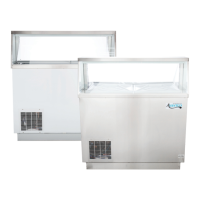
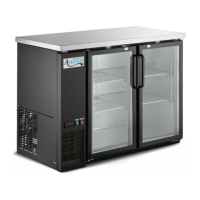
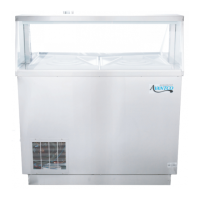
This document is a user manual for Avantco Ice Cream Dipping Cabinets, specifically covering models 178CPW47HC, 178CPSS47HC, 178CPW68HC, 178CPSS68HC, 178CPW88HC, and 178CPSS88HC. It provides essential information for the setup, operation, and maintenance of these refrigeration units.
Function Description
The Avantco Ice Cream Dipping Cabinets are designed to store and display ice cream at optimal temperatures for serving. These units maintain a consistent cold environment, ensuring the quality and safety of the ice cream. They are equipped with a refrigeration system that includes a compressor, fan, and a defrost cycle to manage ice buildup. The cabinets are intended for commercial use, providing a reliable solution for businesses that serve ice cream. The core function is to keep ice cream at ideal dipping temperatures, typically cycling between a minimum of -15°F and a maximum of -8°F, as factory-set for food safety.
Usage Features
Before initial use, it is crucial to follow specific installation guidelines. If the unit has been transported on its side, it must remain upright and still for a minimum of 24 hours before being plugged in. This allows the refrigerant and oils to settle, preventing potential damage to the compressor. Once plugged in, the unit should be allowed to reach its desired temperature before any product is loaded. Proper ventilation around the unit is essential for efficient operation. All accessories, such as shelves, shelf clips, and casters, should be installed prior to plugging in the unit.
The cabinets should be installed on strong and level surfaces to prevent noise and malfunction. An indoor, well-ventilated area is recommended for optimal performance, with a minimum clearance of 4 inches at the back of the unit. The front of the unit should remain unobstructed. Outdoor use is not advised as it can decrease efficiency and cause damage. High humidity and dusty environments should be avoided, as humidity can lead to rust and reduced efficiency, while dust on the condenser coil can cause malfunction and void the warranty. The unit should also be placed away from heat and moisture-generating equipment to prevent the compressor from overworking, which can lead to higher energy bills and premature breakdown. The manual specifies that the unit should not be used in areas above 80 degrees Fahrenheit, and definitely not above 90 degrees Fahrenheit, as high ambient temperatures will void the warranty.
Electrically, the unit requires a consistent supply of the specified voltage. Both low and high voltage can negatively impact the refrigeration unit. All units must be plugged into a grounded and properly-sized electrical outlet with appropriate overcurrent protection, as detailed on the nameplate. Each unit should have its own dedicated outlet, and extension cords must not be used.
The temperature controls are managed by a digital interface. The display shows the current minimum temperature. To adjust the temperature, users can hold the "SET" button for one second, which will cause the display to flash. Arrow buttons can then be used to set the desired minimum temperature, and pressing "SET" again saves the setting. It is important to consider the temperature differential; the cabinet temperature will fluctuate up to +7 degrees Fahrenheit above the set minimum as the compressor cycles on and off. Setting the temperature too high can result in unsafe maximum temperatures and potential health code violations. Indicator LEDs are present for the refrigerant (compressor on), fan (fan on), and defrost (defrost cycle running).
For safety, several warnings are highlighted. The unit uses a flammable refrigerant and should only be repaired by trained service personnel. The refrigerant tubing must not be punctured. Users should consult the repair manual/owner's guide before attempting any service. It is crucial to follow all safety precautions. When handling the unit, care must be taken to avoid puncturing the refrigerant tubing. All handling instructions must be followed carefully and in compliance with local government regulations.
Maintenance Features
Regular maintenance is crucial for the longevity and efficient operation of the Avantco Ice Cream Dipping Cabinets. Before performing any maintenance, the power cord must be disconnected from the unit.
Cleaning the Condenser Coil: For efficient operation, the condenser surface must be kept free of dust, dirt, and lint. It is recommended to clean the condenser coil and fins at least once per month. A commercial condenser coil cleaner, available from kitchen equipment retailers, should be used. The condenser fins should be brushed from top to bottom, not side to side. After cleaning, any bent condenser fins should be straightened with a fin comb.
Cleaning the Fan Blades and Motor: If necessary, the fan blades and motor should be cleaned with a soft cloth. If washing the fan blades is required, the fan motor must be covered to prevent moisture damage.
Cleaning the Interior of the Unit: When cleaning the cabinet interior, a solvent of warm water and mild soap should be used. Steel wool, caustic soap, abrasive cleaners, or bleach should not be used, as these can damage the stainless steel surface.
Defrost System: To ensure optimal performance, the unit should be defrosted when the ice on the cabinet wall reaches 1/4 inch thickness. To defrost, the unit must be free of product and either unplugged or put into a manual defrost cycle until the ice melts. Sharp tools or scrapers should not be used to remove ice, as this can damage the interior of the cabinet. After defrosting, the wall should be cleaned with a dry cloth before restoring power. A manual defrost cycle can be initiated by pressing the defrost button (snowflake symbol and down arrow) for approximately 3 seconds. Repeating this action will stop the defrost cycle.
The manual also notes that the sound of water flowing during operation is normal, as this is the refrigerant. Condensation may form on the freezer surface in high humidity conditions. The condenser and compressor will be hot when the freezer is running. For best performance, the unit should be installed where the ambient temperature is below 75°F and humidity is below 55%.
Troubleshooting: The manual provides a troubleshooting section for common issues.
- Compressor Not Running: Possible causes include a blown fuse or tripped circuit breaker (solution: replace fuse or reset breaker), unplugged power cord (solution: plug in cord), thermostat set too high (solution: set thermostat lower), or the cabinet being in a defrost cycle (solution: wait for defrost cycle to finish).
- Condensing Units Run For Long Periods of Time: This can be due to an excessive amount of warm product (solution: allow adequate time for product to cool), prolonged drawer opening or ajar (solution: ensure drawers are closed when not in use and avoid opening for long periods), or a dirty condenser coil (solution: clean the condenser coil).
- Cabinet Temperature is too Warm: Causes include the thermostat set too warm (solution: set thermostat lower), excessive warm product (solution: allow adequate time for product to cool), a blown fuse or tripped circuit breaker (solution: replace fuse or reset breaker), or a dirty condenser coil (solution: clean the condenser coil).
- Cabinet has Excessive Condensation: This can be caused by high relative humidity (solution: relocate cabinet away from doors and windows to an air-conditioned area). Some condensation is considered normal.
Overall, the manual emphasizes safety, proper installation, and regular maintenance to ensure the efficient and long-lasting operation of the Avantco Ice Cream Dipping Cabinets.


 To Next Page
 General