Cleaning and Care
1. Disconnect the power cord from the electrical outlet by unplugging it.
DO NOT disconnect by pulling on the cord.
2. DO NOT immerse in water or spray directly with liquid.
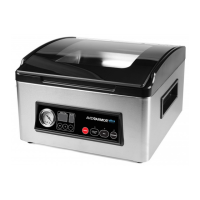
3. Check the vacuum chamber and gasket making sure they are clean and
free of debris. If needed, use a clean cloth with mild soap.
a. Wipe the vacuum chamber clean.
b. Wipe the gasket clean.
c. Wipe the seal area clean.
4. Do not store the vacuum sealer outside.
NOTE: Always leave the lid in resting position when storing. DO NOT stack
items on top of the lid or vacuum sealer. If the lid is closed or forced down,
the gasket will become compressed and the vacuum sealer may not operate
properly.
Vacuum Packaging Guidelines
• Follow all food safety regulations as outlined by the FDA at
www.FDA.gov.
• Vacuum packaging is NOT a substitute for canning.
• Vacuum packaging cannot reverse the deterioration of foods.
• Vacuum packaging is NOT a substitute for refrigeration or freezing.
• Some fruits and vegetables may release gases, known as outgassing. When
packaging these fruits and vegetables, outgassing can cause the vacuum
to be gradually lost over time. Blanching or freezing before vacuum
packaging helps prevent this from occurring.
NOTE: Due to the risk of anaerobic bacteria, soft cheeses, fresh mushrooms,
garlic and onions should never be vacuum packaged.
• It is critical that food handling and storage are maintained at low
temperatures. You can reduce the growth of microorganisms
at temperatures of 40°F or less (4°C). Freezing at 0°F will not kill
microorganisms, but reduces the chances of them growing. For long-term
food storage, always freeze foods that have been vacuumed packaged.
NOTE: Beef and other proteins may look darker after being vacuum packaged.
This is due to the removal of oxygen and is not an indication
of spoilage.
• Before vacuum packaging liquids such as soups, stews, and broths, make
sure to pre-freeze in a dish, bowl or ice tray until solid. Remove the frozen
liquid and vacuum package. Store in your freezer until ready to use.


 To Next Page