The UJK Universal Dovetail Jig is a versatile woodworking tool designed for creating various types of joints, including half-blind dovetails, groove/housing joints, sliding dovetails, through dovetails, box/finger joints, and corner dovetail rebates. It is manufactured by Axminster Tools and is designed for use with a router.
Function Description
The jig allows users to precisely cut a range of woodworking joints by guiding a router with a specific cutter and guide bush along a template. The design ensures accuracy and repeatability for both professional and hobbyist woodworkers. The jig features horizontal and vertical cam clamps to securely hold timber, a comb support arm, and a magnetic extraction system for dust management. Adjustable side stops and comb adjuster wheels enable fine-tuning of joint dimensions and alignment.
Important Technical Specifications
General:
- Max Timber Width: 300mm (for half-blind, through dovetails, and box/finger joints), 290mm (for groove/housing and sliding dovetails, and corner dovetail rebates).
- Min Timber Thickness: Varies by joint type (e.g., 13mm for half-blind, 10mm for through dovetails and groove/housing, 6mm for box/finger joints).
- Max Timber Thickness: Varies by joint type (e.g., 25mm for half-blind, groove/housing, sliding dovetails, box/finger joints, and corner dovetail rebates; 19mm for through dovetail pin board, 25mm for tail board).
Included Components:
- UJK Universal Dovetail Jig with Cam Clamps (Part A)
- Magnetic Extraction (Part B)
- Comb Bar Support Arm (Part C)
- Router Extraction Support Bar (Part D)
- Comb Half Blind / Sliding (Template B) (Part E)
- Comb Through Dovetail / Box (Template A) (Part F)
- Router Cutters (Part G):
- 1/4" Shank, 13.55mm Diameter Dovetail Cutter
- 1/4" Shank, 10.39mm Diameter Twin Flute Straight Pin Cutter
- 1/4" Shank, 12.5mm Diameter Twin Flute Straight Box Joint Cutter
- Magnetic Set Gauge (Part H)
- Countersink Hex Screws M6 x 12mm (6 pieces) (Part I)
- Guide Bushes & Locking Ring: 3/4" (19.1mm) & 5/8" (15.9mm) (2 pieces) (Part J)
- 4mm 'T' Key (Part K)
Router Cutter & Guide Bush Details:
- Dovetail Cutter: 1/4" Shank, 13.55mm (7° dovetail/straight).
- Straight Cutters: 1/4" Shank, 10.39mm (for pins), 1/4" Shank, 12.5mm (for box joints).
- Guide Bushes: 3/4" (19.1mm) and 5/8" (15.9mm). A guide bush adaptor (not supplied) is required to attach the guide bush to the router.
- Cutter Shank Insertion: Important to insert the cutter shank 3/4" into the router's collet. Most cutter shanks have a 'K' mark for correct depth.
Usage Features
Assembly & Setup:
- Mounting: The jig should be mounted onto a firm, stable workbench at a comfortable height, close to the front edge to allow clear passage for timber and ample clearance at the rear for longer timber lengths. Mounting holes are provided for permanent attachment, or it can be secured to a movable base with F or G clamps.
- Comb Template Attachment: The appropriate comb template (Template A for through dovetail/box, Template B for half-blind/sliding) is secured to the comb bar support arms using four countersink hex screws.
- Router Preparation: The correct router cutter and guide bush must be selected for the desired joint. The guide bush and locking ring are fixed to the router base, ensuring the flange faces downwards. It is crucial that the cutter is perfectly central within the guide bush.
Joint-Specific Usage (General Principles):
- Timber Preparation: All timber components must be sized and cut square and accurately. It is recommended that timber widths increase in 1/2" measurements (e.g., 5", 5 1/2", 6") to achieve fully-formed dovetails without partial pins or sockets at the ends. Identifying drawer pieces (e.g., left inside, back inside, front outside, right outside) helps ensure correct positioning.
- Clamping: Timber is secured using horizontal and vertical cam clamps. Side stops are used to position the timber accurately against the comb.
- Comb Adjustment: Comb adjuster wheels and clamping knobs allow for precise alignment of the comb template with the timber, ensuring the finger line or square line is correctly positioned.
- Cutter Depth Setting: A cutter depth set line is marked on the timber using an opposing board or the cutter set line mark on the comb. The cutter is then plunged until its tip meets this marked line. Cutter depth is often set to approximately 2/3 the thickness of the material for optimal aesthetic and strength results.
- Routing Process: The router is moved from right to left (or left to right, depending on the joint and cut) in a slow, steady, continuous motion. It is critical not to lift the router whilst it is running to avoid damage to the cutter or workpiece. For very hard wood, a half-depth cut or stock removal cut with a smaller cutter may be required first.
- Magnetic Extraction: The magnetic extraction system is attached to the support bar to manage dust and chips during routing.
- Fit Testing: After cutting, the joint components are removed and tested for fit.
- Joint too tight: Raise the cutter very slightly (approx. 0.5mm) and recut. For pins, move the comb backwards.
- Joint too loose: Lower the cutter very slightly (approx. 0.5mm) and recut. For pins, move the comb forwards.
- Gaps at one end: Indicates timber not square, comb not flat on timber, or timber not centralised.
- Gaps in the middle: Board cupped.
- Box sides not in line: Timber not centralised or cut equally.
- Too much overhang: Adjust comb forwards using adjuster knobs.
- Excessive breakout: Use a sacrificial breakout board behind the cut.
- Joint not square on board: Pencil line not marked square, comb slot set gauge not used.
Specific Joint Considerations:
- Half Blind Dovetails: Both parts cut simultaneously (single pass). Template B used. Horizontal board levels the comb.
- Groove / Housing Joints: Slot boards cut horizontally. Template B used with long groove slot. Side stops in central position. Square line marked on board for groove centre.
- Sliding Dovetails: Dovetail slot boards cut horizontally, tenon boards cut vertically. Template B used. Cutter depth is the same for both slot and tenon. Stock removal cut with a 6mm cutter may be wise for hard wood.
- Through Dovetails: All boards cut vertically. Template A used. Dovetails cut first (dovetail cutter, 3/4" guide bush), then pins (straight cutter, 5/8" guide bush). Comb is turned around for pin cutting.
- Box / Finger Joints: All boards cut vertically. Template A used. Straight cutter (12.5mm) and 3/4" guide bush. Opposing cut uses the precut fingers to set up.
- Corner Dovetail Rebates: For 12mm & 15mm thick boards, both parts can be cut in a single pass. Other thicknesses may require 2 passes. Template B used. 8mm line marked from top edge of vertical board. Direction of travel for 15mm board is clockwise. For 2-pass cuts, a line 2/3 thickness of the board is marked.
Maintenance Features
- Cleanliness: Keep the work area as uncluttered as practical. Ensure router cutter bits are clean.
- Cutter Inspection: Regularly check router cutter bits for damage and ensure they are sharp.
- Storage: The jig can be stored away when not in use, especially if mounted to a movable base.
- Safety:
- Always read and fully understand the general instructions and safety precautions in the router's owner's manual.
- Keep tools and equipment out of reach of young children.
- Under no circumstances should children be allowed in work areas.
- Ensure the correct cutter is used for the job.
- Do not lift the router whilst it is running.
- Do not release the plunge fully when the cutter is fitted through the inner guide bush, as this can damage the cutter.
The UJK Universal Dovetail Jig is a robust and precise tool, designed to simplify the creation of complex woodworking joints with high accuracy and consistent results, provided the user adheres to the detailed setup and operational guidelines.

 Need help?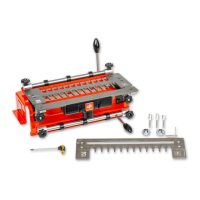

 To Next Page
 General