Need help?
Do you have a question about the Badland ZXR 9500 and is the answer not in the manual?
Details rated line pull and capacity for different rope layers.
Shows line pull, speed, and amp draw for the first layer.
Explains DANGER, WARNING, CAUTION, and NOTICE symbols.
Defines symbols for hazards like cut/sever and properties like VDC, Amperes.
Safety steps to follow during winch installation.
Covers load capacity, motor stalls, clutch, wire rope handling, and avoiding kinks.
Includes advice on entanglement, fairlead clearance, and using dampening blankets.
Details on keeping clear, avoiding side pressure, submerging, and vehicle transmission.
Advises on extreme angles, using snatch blocks, and pacemaker considerations.
Safety guidelines for performing maintenance and service on the winch.
Instructions for securely mounting the winch to a suitable surface.
Steps for installing the control box near the winch.
Safety warnings related to battery connections and wiring.
Diagram and steps for connecting the winch wiring to the battery.
Instructions for properly coiling and tensioning the wire rope.
Ensuring wire rope condition, battery charge, and electrical connections.
Guidance on correctly hooking the object using straps or chains.
Explains how double line systems reduce load and heat buildup.
Steps for connecting wire rope using a snatch block for a double line system.
Testing the wired remote control and operating the winch.
Guidance on extreme angles, intermittent use, and motor cooling.
Defines duty cycle and its importance for preventing winch overheating.
Procedures for inspecting, cleaning, and lubricating the winch.
Instructions for replacing the wire rope, including tensioning.
Addresses problems like motor not turning or overheating.
Troubleshoots drum not turning or motor running slowly.
A comprehensive list of all parts included with the winch.
An illustrated diagram showing the assembly of winch components.
Details the terms and conditions of the 90-day limited warranty.
Instructions on how to make a warranty claim and return procedures.
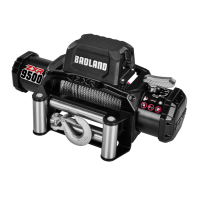
The BADLAND ZXR 9500 is a truck/SUV winch designed for vehicle recovery, offering a robust solution for challenging situations. This powerful 12VDC 5.5 HP series wound winch is built for durability and reliable performance, featuring a 3-stage planetary geartrain with a 218:1 gear ratio, ensuring strong and consistent pulling power. Its underwind orientation, where the wire rope enters and exits at the bottom of the drum, is crucial for safe operation.
The primary function of the BADLAND ZXR 9500 winch is to pull heavy loads, typically vehicles, out of difficult situations such as mud, sand, or inclines. It achieves this through a motor-driven drum that winds a wire rope, generating significant pulling force. The winch is operated using a wired remote control, allowing the user to maintain a safe distance from the winching operation. The clutch handle enables the user to engage or disengage the drum, allowing for manual free-spooling of the wire rope when not under power. This feature is particularly useful for quickly extending the wire rope to an anchor point.
The winch is equipped with a spring-loaded safety latch clevis hook for secure attachment to anchor points or recovery straps. A roller fairlead with nylon bushings guides the wire rope smoothly onto and off the drum, reducing wear and tear on the rope and preventing tangles. For safety, the winch includes an overload protection disconnect switch, which helps prevent damage to the motor and electrical system in case of excessive load.
The BADLAND ZXR 9500 is designed for intermittent use, meaning it should not be operated continuously for extended periods, especially at or near its maximum rated load. The duty cycle specifies that after 45 seconds of continuous operation at maximum load, the winch requires at least 14 minutes and 15 seconds of rest to prevent overheating and premature failure. This is a critical aspect of its operation to ensure longevity and safety.
Operating the BADLAND ZXR 9500 requires careful planning and adherence to safety guidelines. Before any winching operation, it is essential to inspect the wire rope for fraying, kinking, or damage. The vehicle's battery should be fully charged, and all electrical connections to the winch must be tight and clean. The vehicle's transmission should be in neutral, and if the vehicle is not intended to move, the emergency brake should be engaged, and wheels blocked with chocks.
To extend the wire rope, the clutch handle is moved to the "Released" position, allowing the rope to be pulled out manually using a hook strap. It is crucial to leave at least five full turns of wire rope on the drum to maintain the rope's connection and support the load. The hook should be attached to a secure pulling point, such as a tow strap, tree strap, or chain, ensuring the attachment point is centered in the hook's loop and the safety clasp is fully closed. It is strictly prohibited to wrap the wire rope around an object and hook it onto itself, as this can damage both the object and the rope.
For added safety, a whiplash dampening blanket or winch damper (sold separately) should be placed over the wire rope span, approximately six feet from the hook, to absorb force in case the rope breaks. Once the rope is secured, the clutch handle is re-engaged to the "Engaged" position. The wired remote control is then connected to the control box, and the winch can be operated to pull the load.
The winch should not be operated at extreme angles. For a roller fairlead, the maximum winching angles are 15 degrees horizontally and 45 degrees vertically. If the object to be pulled requires an angle, a snatch block (sold separately) and an anchor point directly in front of the winch should be used to keep the wire rope pull straight, reducing strain on the winch and improving efficiency. Double line rigging, which involves using a snatch block to halve the load on the winch, is recommended whenever possible to reduce heat buildup and utilize the lower, higher-capacity layers of wire rope.
During operation, it is important to stop the winch and release tension on the wire rope before moving the dampening blanket. The vehicle's engine can be kept running to continually recharge the battery, but extreme caution must be exercised, and operation should only occur in an outdoor area. After pulling the load, the winch direction should be reversed just enough to release tension, allowing the hook to be unfastened, and then the wire rope can be reeled in. The wired remote control should be disconnected when not in use.
Regular maintenance is essential for the safe and efficient operation of the BADLAND ZXR 9500. Before each use, a thorough inspection of the winch's general condition is required. This includes checking for loose hardware, misalignment or binding of moving parts, cracked or broken components, damaged electrical wiring, corroded or loose terminals, and any other condition that might affect safe operation. The wire rope must also be carefully examined for fraying, kinking, or damage; if any damage is found, the winch should not be used.
After each use, the external surfaces of the winch should be wiped clean with a cloth. The wire rope should be lubricated occasionally with a light oil to prevent corrosion and maintain flexibility. The winch's internal mechanism is permanently lubricated and should not be opened by the user. However, if the winch is accidentally submerged in water, it must be immediately disassembled, cleaned, dried, and re-lubricated by a qualified technician to prevent permanent damage from corrosion.
Wire rope replacement is a critical maintenance task. To replace the wire rope, the clutch handle is moved to the "Released" position, and the old wire rope is extended to its full length, noting how it is connected to the drum. The old rope is then removed, and a new wire rope assembly is attached. It is crucial to use only a wire rope rated to the same specifications or better than the original. The new wire rope must be retracted onto the drum carefully, avoiding kinking, and then properly tensioned under at least 500 lb. of tension. After replacement, the electric winch should be tested for proper operation.
For any troubleshooting or servicing not explicitly covered in the manual, a qualified technician should perform the work. Before any inspection, maintenance, or cleaning, the wired remote control must be unplugged, and the battery cables disconnected to prevent accidental operation. Maintaining labels and nameplates on the winch is also important, as they contain vital safety information. If they become unreadable or go missing, replacements should be obtained from Harbor Freight Tools.
 General
| Motor | 5.5 hp Series Wound |
|---|---|
| Gear Ratio | 161.28:1 |
| Gear Train | 3-Stage Planetary |
| Rated Line Pull | 9500 lbs |
| Cable | 5/16" |
| Fairlead | Roller |
| Remote Control | 12V wired remote |
| Braking | Automatic load-holding brake |
| Battery Requirements | 12V |

 To Next Page