Need help?
Do you have a question about the Badland ZXR 2500 and is the answer not in the manual?
Safety guidelines and precautions to follow when operating the winch.
Instructions and considerations for physically mounting the winch to a vehicle or surface.
Guidance on using both wired and wireless remote controls for winch operation.
Step-by-step instructions for safe and effective winch operation.
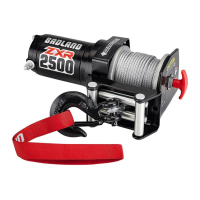
This document is the owner's manual and safety instructions for the BADLAND ZXR2500 ATV/Utility Winch, model 56258. It provides comprehensive information on the winch's function, technical specifications, usage, and maintenance.
The BADLAND ZXR2500 is an ATV/Utility Winch designed for pulling applications. It is intended for intermittent use, not constant duty, and is suitable for tasks such as vehicle recovery or moving objects within its rated capacity. The winch operates on a 12VDC power supply and features both wired and wireless remote control options for operation. Key features include an auto load-holding dynamic brake, a freespool clutch for quick wire rope deployment, and a roller fairlead to guide the wire rope. The manual emphasizes safe operation, including proper rigging techniques like double line rigging to reduce load on the winch and extend its lifespan.
The manual also provides a detailed table for "Rated Line Pull" and "Wire Rope Capacity" across different layers of the drum, indicating that the pulling capacity decreases as more layers of wire rope are spooled onto the drum. The "First Layer of Wire Rope Performance" table further details line pull, line speed (fpm/mpm), and amp draw at 12V for various load conditions on the first layer.
The winch offers several usage features designed for convenience and safety:
The manual outlines essential maintenance procedures to ensure the winch's longevity and safe operation:
The manual stresses that any procedures not specifically explained should only be performed by a qualified technician and that all safety precautions, including disconnecting battery cables, must be followed during maintenance.

 To Next Page
 General