
 To Next Page
W
Walter MonroeSep 4, 2025
Why do cupcakes crack on top in my Bakers Pride GDCO-G?
- AamywareSep 4, 2025
If cupcakes crack on top in your Bakers Pride Convection Oven, the thermostat may be set too high. Lower the oven temperature.

Why do cupcakes crack on top in my Bakers Pride GDCO-G?
If cupcakes crack on top in your Bakers Pride Convection Oven, the thermostat may be set too high. Lower the oven temperature.
Why are my cookies too flat in my Bakers Pride Convection Oven?
If cookies are too flat when using your Bakers Pride Convection Oven, allow the cookie sheet to cool between batches.
Why is my cake too brown on the bottom in my Bakers Pride GDCO-G Convection Oven?
If a cake is too brown on the bottom or a crust forms on the bottom when using your Bakers Pride Convection Oven, lower the oven temperature. If using a glass or dark pan, lower the temperature by 25°F (-3.8°C).
Why does my cake ripple when using a Bakers Pride Convection Oven?
If cakes ripple when using your Bakers Pride Convection Oven, reduce the amount of batter in the pans or thicken the batter.
Why does my cake settle slightly in the center when using a Bakers Pride GDCO-G?
If cakes settle slightly in the center when using your Bakers Pride Convection Oven, bake them longer or slightly increase the oven temperature. Avoid opening the oven door for extended periods.
Why do pies have uneven color in my Bakers Pride GDCO-G?
If pies have uneven color in your Bakers Pride Convection Oven, reduce the number of pies per rack or eliminate the use of bake pans.
Why are meats well done and not browned in my Bakers Pride GDCO-G Convection Oven?
If meats are well done but not browned in your Bakers Pride Convection Oven, raise the oven temperature. Also, limit the amount of moisture.
Why do my cakes have a light outer color in my Bakers Pride Convection Oven?
If your cakes have a light outer color when using the Bakers Pride Convection Oven, raise the oven temperature because the thermostat might be set too low.
Why are my cakes too coarse when baked in my Bakers Pride GDCO-G?
If cakes are too coarse in your Bakers Pride Convection Oven, lower the oven temperature, as the thermostat may be set too high.
What to do if my Bakers Pride GDCO-G Convection Oven has no heat?
If your Bakers Pride Convection Oven isn't heating, ensure the power switch on the control panel is set to COOK or OVEN ON. Also, verify that the gas valve to the oven is open and that the doors are fully closed. If these steps don't resolve the issue, there may be a defective ignitor or door micro-switch, requiring a call to a Bakers Pride factory authorized service center.
Details procedures for checking the oven upon arrival and identifying any transit damage.
Provides instructions for positioning and assembling the oven, including leg installation.
Guides on installing optional casters and ensuring proper appliance restraint for safety.
Step-by-step guide for assembling the open rack stand, including parts list.
Specifies required clearances around the oven for safe operation and proper airflow.
Details requirements for connecting the gas supply, pipe types, and pressure regulations.
Covers grounding, power cord connection, and voltage requirements for electrical hookup.
Explains requirements for venting the oven, including under hood or direct venting.
Describes the expected appearance of the burner flame for proper operation.
Outlines steps to verify system functionality using rotary controls and indicator lights.
Refers to a separate manual for programming digital controls on specific oven models.
Provides foundational advice for using the oven efficiently and effectively for cooking.
Details the sequence of operations for using the rotary controls for cooking functions.
Explains how to use the timer and thermostat for timed cooking cycles.
Details operation for cooking and then holding food at a set temperature.
Describes the procedure for activating the steam injection feature for enhanced cooking.
Outlines the process for safely cooling down the oven to a lower temperature.
Details programming and operation for the Cook & Hold-3 Plus controller on specific oven models.
Explains the function of each button and indicator on the oven's controller interface.
Describes the capabilities of the programmable controller for storing recipes and settings.
Explains the four positions of the rotary control for fan speed and oven operation.
Details the function of the momentary switch used to control the interior oven light.
Provides information on the optional steam injection feature and its operation.
Offers important tips and observations for efficient oven operation and performance.
Guides users through the steps to initiate a cooking cycle using the oven's controls.
Explains how the holding timer functions after a cooking cycle is completed.
Interprets the various readouts and symbols displayed on the oven's control panel.
Details configuration options for temperature display and programmable functions of the controller.
Provides step-by-step instructions for programming each product key on the oven controller.
Details methods for cleaning racks, support guides, stainless steel interior, and blower wheel.
Explains how to clean the exterior stainless steel surfaces of the oven.
Outlines safety precautions and procedures for servicing the appliance by authorized personnel.
Provides a step-by-step guide for safely removing the front trim panel for access.
Shows the electrical wiring for 120V, 1-phase BCO-G and GDCO-G models with dial controls.
Illustrates the electrical wiring for 120V, 1-phase GDCO-G models with push button controls.
Details the wiring for 240V, 1-phase BCO-G and GDCO-G models featuring dial controls.
Presents the electrical layout for 240V, 1-phase GDCO-G models with push button controls.
Shows the electrical schematic for the 120V steam injection option.
Illustrates the wiring diagram for the 220/240V steam injection option.
Addresses causes and solutions for uneven browning of food products.
Provides guidance on preventing food from drying out during the cooking process.
Explains why cookies might be too flat and how to correct it.
Offers solutions for cakes browning excessively on the bottom or forming a hard crust.
Covers issues related to the oven not generating heat and potential causes.
Addresses problems where the oven fails to reach its set temperature.
Details reasons why the convection fan may not be operating correctly.
Presents a diagram showing all parts of the oven with corresponding numerical labels.
Specifies the types of defects and conditions covered under the product warranty.
Defines the eligibility of the purchaser for warranty claims.
Outlines the duration of limited parts, labor, and door warranties for different models.
Explains the scope of warranty services, including on-site labor and travel expenses.
Provides blank space for users to record important information about their equipment.
 General
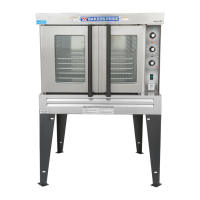
| Model | GDCO-G |
|---|---|
| Fuel Type | Gas |
| Number of Decks | 1 |
| Type | Convection Oven |
| Temperature Range | 200°F - 500°F |
| Gas Type | Natural Gas or Propane |
| Electrical Requirements | 120V |
| Construction | Stainless Steel |