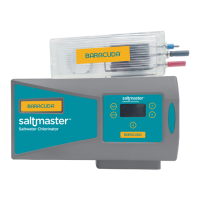
Baracuda
®
Saltmaster
TM
Saltwater Chlorinator | Installation and Operating Instructions
8
(b) Manual - Running: The chlorinator/
pump will run continuously.
(c) Manual - Stopped: The chlorinator/
pump will stay off continuously.
Section 9. Fault Codes
The User Display can indicate the following fault
codes;
• NO F – No flow indication
• LO S – Low salt indication
Refer to troubleshooting table at the end of this
manual for actions to correct these errors.
Section 10. Setting the
Right Chlorine Output and
Filtration Time
Your Saltmaster Chlorinator must be run
every day toensure that your pool is correctly
sanitised. As the sun dissipates chlorine, running
times are higher in the summer compared to the
winter. Baracuda recommends that you initially
run your chlorinator at maximum output for the
first few days, then adjust as required.
10.1 Summer
You should set your chlorinator to operate for
8 to 10 hours per day. Ideally, run it for 4-5
hours in the morning (say 8 - 12 pm) and 4-5
hours in the evening (say 6 - 11 pm).
In extremely hot weather it may be necessary to
extend the running time if you find that the free
chlorine level is too low.
To prevent consumption of chlorine by sunlight,
try adding cyanuric acid as recommended by
your local pool professional. Additional benefit
will be gained by operating your chlorinator and
pump into the evening when the strong sunlight
has abated. See Section 11 for more information.
Chlorine is most effective when the pH of your
pool water is 7.4. The electro-chemical process
of the chlorinator, (change salt into chlorine) will
automatically raise the pH of your pool water, so
it is very important to check your pH weekly and
adjust as necessary.
10.2 Winter
You should set your chlorinator to operate for
6 to 8 hours per day. Again, running it in the
morning and evening is preferable.
10.3 Checking Chlorine Level
Ideally, check your chlorine level after the
morning operating period. The free chlorine
residual level should be somewhere between
1 and 3 parts per million. Increase or decrease
the output of the chlorinator to get the right
residual chlorine level. It may also be necessary
to adjust the operating period if you are running
at minimum or maximum output.
Section 11. Water Chemistry
11.1 Stabiliser/Cyanuric Acid
As previously mentioned, sunlight rapidly
dissipates the amount of free chlorine in your
pool. Chlorine stabiliser greatly reduces this
effect. Without stabiliser, you may need to run
your chlorinator and filtration system up to
16hours per day or longer.
Keep the stabiliser reading between 30 and
60 ppm.
11.2 pH Level
You should keep you pH level between 7.0
and7.4 for fibreglass pools and 7.2 to 7.6 for
other pools.
11.3 Total Alkalinity
The ideal range is between 80 and 120 ppm.
11.4 Salt Level
Although salt is not consumed by the
chlorinator, salt is lost during backwashing,
and when your pool overflows due to rain or
splashing. The correct salt level is important
to cell life and the effective operation of your
chlorinator. Salt level should be maintained
around 6,000 ppm but should never be allowed
to fall below 4,000 ppm.


 To Next Page