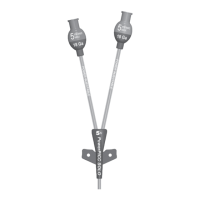
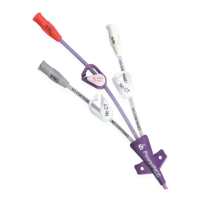
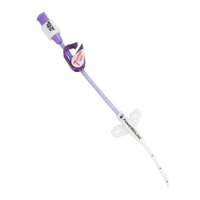
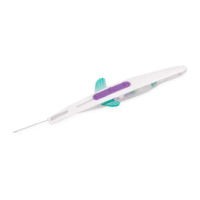
• Carefully read and follow all instructions prior to use.
• Federal (U.S.A.) law restricts this device to sale by or on the order of a physician.
• Only qualified health care practitioners should insert, manipulate and remove these devices.
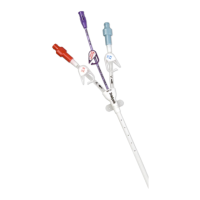
• ThePowerPICC*SVcatheterfeaturesareverse-tapercatheterdesign.Placementoflargercathetersatorbelowantecubital
fossamayresultinanincreasedincidenceofphlebitis.PlacementofthePowerPICC*SV above antecubital fossa is
recommended.
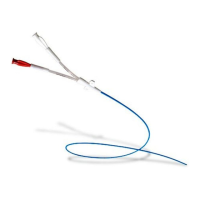
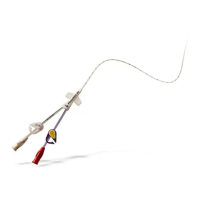
• Never use force to remove the stylet. Resistance can damage the catheter. If resistance or bunching of the catheter is
observed, stop stylet withdrawal and allow the catheter to return to normal shape. Withdraw both the catheter and stylet
together approximately 2 cm and reattempt stylet removal. Repeat this procedure until the stylet is easily removed. Once the
stylet is out, advance the catheter into the desired position (zero mark).
• When trimming the catheter, do not cut stylet.
• Use aseptic techniques whenever the catheter lumen is opened or connected to other devices.
• Do not advance the guidewire past the axilla without fluoroscopic guidance.
• The catheter must be secured in place to minimize the risk of catheter breakage and embolization.
• Forbloodsamplingorbloodinfusion/administration,a20gaugeorlargercatheterlumenisrecommended.
-Bloodcanbesafelywithdrawnthroughthe21gaugelumenofthe4FrD/LPowerPICC*SVcatheter,however,flowratewill
be reduced compared to the 19 gauge lumen.
• Toreducethepotentialforbloodbackflowintothecathetertip,alwaysremoveneedlelesscapsslowlywhileinjectingthelast
0.5 mL of saline.
I.
Prior to placement:
•
Examine the package carefully before opening to confirm its integrity and that the expiration date has not passed. The catheter
is supplied in a sterile package and is non-pyrogenic. Do not use if package is damaged, opened or the expiration date has
passed. Sterilized by ethylene oxide. Do not resterilize.
• Inspect kit for presence of all components.
• Flush the stylet with sterile normal saline to wet the stylet prior to use, repositioning or withdrawal.
II. During placement:
• Do not allow device contact with sharp instruments. Mechanical damage may occur. Use only smooth edged, atraumatic
clamps or forceps.
• Do not perforate, tear, or fracture the catheter when using a stylet.
• Do not use the catheter if there is any evidence of mechanical damage or leaking.
• Avoid placement or securement of the catheter where kinking may occur, to minimize stress on the catheter, patency problems
or patient discomfort.
• Do not bend the catheter at sharp angles during implantation as this can compromise patency of the catheter.
• Do not place suture around the catheter. Sutures may damage the catheter or compromise catheter patency.
• Do not cut the stylet.
• Do not advance the guidewire into superior vena cava except under x-ray or fluoroscopy. Assure proper tip position in order to
prevent erosion or perforation of central venous system.
III. After placement:
• WARNING:Do not use the device if there is any evidence of mechanical damage or leaking. Damage to the catheter may lead
to rupture, fragmentation, possible embolism, and surgical removal.
• Accessories and components with Luer Lock connections should be used with this device.
• WARNING:If signs of extravasation exist, discontinue injections. Begin appropriate medical intervention immediately.
• DO NOT USE A SYRINGE SMALLER THAN 10 mL! Prolonged infusion pressure greater than 25psi may damage blood ves-
sels or viscus.
• WARNING:Exceeding the maximum power injection flow rate may result in catheter failure and/or catheter tip displacement.
Possible Complications
The potential exists for serious complications including the following:
• AirEmbolism
• Bleeding
• BrachialPlexusInjury
• CardiacArrhythmia
• CardiacTamponade
• CatheterErosion
Through the Skin
• CatheterEmbolism
• CatheterOcclusion
• Catheter-relatedSepsis
• Endocarditis
• ExitSiteInfection
• ExitSiteNecrosis
• Extravasation
• FibrinSheathFormation
• Hematoma
• IntoleranceReactiontoImplanted
Device
• LacerationofVesselsorViscus
• MyocardialErosion
• PerforationofVesselsorViscus
• Phlebitis
• SpontaneousCatheterTipMalposition
or Retraction
• Thromboembolism
• VenousThrombosis
• VesselErosion
• RisksNormallyAssociatedwithLocal
or General Anesthesia, Surgery, and
Post-OperativeRecovery


 To Next Page
 Loading...