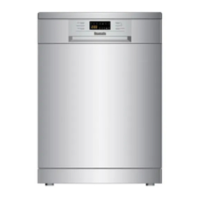
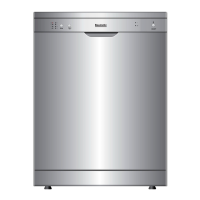
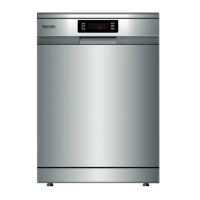
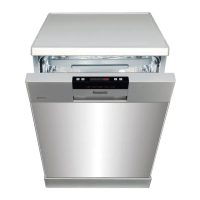
This document is an instruction manual for the Baumatic BBM14S Freestanding 60cm Dishwasher. It provides comprehensive information on the appliance's function, technical specifications, usage, and maintenance.
Function Description
The Baumatic BBM14S is a freestanding dishwasher designed for domestic use, intended for washing dishes in households and similar environments such as staff kitchen areas, farmhouses, hotels, motels, and bed and breakfast establishments. It is equipped with features to ensure optimum performance and energy efficiency. The dishwasher includes upper and lower baskets for organized dish placement, an upper impeller and a lower impeller for water distribution, and a filtration system. Some models may also feature a tabletop and a fan drying system.
Important Technical Specifications
The dishwasher has a capacity of 14 standard place settings.
- Power Input: 220-240 V, 50 Hz
- Total Power Consumption: 1800-2100 W
- Heater Power Consumption: 1800 W
- Total Current: 10 A
- Drain Pump Power Consumption: 30 W
- Water Pressure: 0.3-10 bar (equivalent to 3-100 N/cm² or 0.03-1.0 Mpa)
The product complies with EU directives 2006/95/EC, 2004/108/EC, and 93/68/EC, ensuring it meets safety rules and quality control standards. Technical specifications may be subject to change without prior notice for product quality improvement.
Usage Features
The manual emphasizes safe and efficient use of the dishwasher.
- Installation: The appliance should be placed on a solid, flat floor with sufficient load-carrying capacity, at least 1 cm away from other furniture, and not on long pile rugs or similar surfaces. It should not be installed where temperatures may fall below 0°C. Water supply and drainage hoses must be securely fastened and undamaged. The water inlet hose should be connected directly to a water tap with a minimum pressure of 0.3 bar and a maximum of 10 bars. If pressure exceeds 10 bars, a pressure relief valve should be installed. The water discharge hose should be between 50 cm and 100 cm from the floor. An Aquasafe+ system (model dependent) protects against water leaks at the hose inlet. Electrical connection requires a grounded outlet protected by a fuse complying with the specified values (16 Amps recommended if lower).
- Initial Use: Before first use, ensure all installation steps are completed. Run the shortest program with detergent while the machine is empty to prepare it for use.
- Loading Dishes: For optimum energy consumption and washing/drying performance, dishes should be placed in an orderly way. Coarse food remnants should be wiped off before loading. Heavily soiled and larger items go in the lower basket, while smaller, delicate, and light items go in the upper basket. Hollowed dishes should be placed upside down to prevent water accumulation. Sharp and pointed dishes should be placed upside down or horizontally to prevent injuries.
- Baskets and Racks:
- Silverware Basket: Designed for forks, spoons, etc. Some models include a movable silverware basket (A, B) to create wider space in the lower basket.
- Collapsible Lower Basket Wires: Available in 2, 4, or 6 pieces (model dependent), these wires can be folded down (by pressing latch A) to create larger spaces for pans, bowls, etc. For 6-piece models, wires are pushed from the mid-position in the direction of arrows (B) to bring them to a horizontal position, and lifted up to return to vertical.
- Lower Basket Multipurpose/Height Adjustable Service Rack: Allows washing of extra glasses, long ladles, and bread knives. Racks can be folded (A), slid up (B), put in vertical position (C), and locked with tabs (D). Height can be adjusted by folding (E), sliding up (F), and opening at the desired level (G). Ensure the impeller does not touch dishes on the racks.
- Lower Basket Bottle Wire: Designed for washing long pieces with wide mouths. It can be removed when not in use (H).
- Upper Basket Height Adjustable Rack: Lower and upper parts can be slid down or up (A, B, C) to accommodate different heights of glasses, cups, etc.
- Upper Basket Drawer: Allows easy placement of additional desert spoons, small forks, and knives.
- Upper Basket Glass Support Piece: For long-stemmed glasses or wine glasses, lean them against the basket edge or rack (1), not against other pieces. The tab can be released to create wider space for large-volume items.
- Collapsible Upper Basket Wires: Wires can be laid down (A) or gradually laid (B) to create more room for big dishes. To bring them to horizontal position, press the latch (1) and place larger dishes (2). Lift them up to return to vertical.
- Detergent and Rinse Aid: Only dishwasher-safe detergents, rinse aids, and additives should be used. Detergent (powder or tablet) should be added just before operation. The detergent dispenser has level markings (15 cm³ or 25 cm³ for main wash, 5 cm³ for prewash) to guide the amount. Rinse aid increases drying efficiency and prevents water/limescale stains. The rinse aid indicator (3) shows when refilling is needed. The rinse aid amount adjuster (4) can be set between 1 and 6 (factory default is 4).
- Items Not Suitable for Dishwasher: Dishes soiled by cigarette ash, candle remnants, polish, dyestuff, chemicals, iron alloy items, silverware/cutlery with wooden/bone stems, glued pieces, heat-sensitive items, copper/tin-plated containers, and decorative chinaware/aluminum/silver items (which may discolor or tarnish) are not recommended.
Maintenance Features
Regular cleaning extends the product's service life and reduces problems.
- General: Unplug the product and turn off the tap before cleaning. Do not use abrasive substances. Clean filters and impellers at least once a week.
- Outer Surface: Clean gently with a mild cleaning material and damp cloth. Wipe the control panel with a damp cloth.
- Interior: Clean by running a prewash program without detergent or a long washing program with detergent. If water remains, drain it and clean any leftover deposits blocking the water path.
- Filters: Clean at least once a week. Remove the micro filter (3) and coarse filter (2) assembly by turning counter-clockwise (A). Pull out the metal/plastic filter (1) (B). Press the pawls on the coarse filter (C) to separate it. Clean all three filters under tap water with a brush. Replace the metal/plastic filter, then the coarse filter into the microfilter, turning clockwise until it clicks. Do not use the dishwasher without filters.
- Impellers: Clean at least once a week. Check for clogged holes on the lower impeller (1) and upper impeller (2). Remove the lower impeller by pulling it up (A, B). Remove the upper impeller by turning its nut to the left (C, D). For the ceiling impeller (3), push it upwards (E) and turn clockwise (F) to remove. Clean and ensure they rotate freely after reinstallation.
- Hose Filter: Check and clean regularly to prevent damage from impurities in the water supply. Turn off the tap, remove the hose, clean the filter under running water, replace it, and reinstall the hose.
Troubleshooting
The manual includes a troubleshooting section for common issues:
- Machine does not start: Check power cable, fuses, water supply, door closure, and if the On/Off button is pressed.
- Dishes not washed clean: Check dish placement, program suitability, impellers (stuck or clogged), filters (clogged or incorrectly installed), basket overload, detergent storage conditions, detergent amount, rinse aid amount, and detergent dispenser lid closure.
- Dishes not dry: Check dish placement, rinse aid amount, unloading time (wait for dishes to cool), program suitability (longer programs for better drying), and surface quality of kitchen utensils (deteriorated surfaces can affect drying). Teflon utensils may naturally retain water droplets.
- Odour in machine: A new machine may have a peculiar odor that fades. Check for clogged filters. If dirty dishes are left for 2-3 days, remove remnants and run a prewash program without detergent, or use commercial odor removers/cleaners.
- Rust/discoloration/surface deterioration: Address salty food remnants, ensure proper electrical grounding, avoid intensive cleansers (like bleach), do not use metal items for unintended purposes (e.g., opening cans), and avoid washing low-quality stainless steel or already corroded items.
- Detergent remains in dispenser: Ensure dispenser is dry before adding detergent, add detergent shortly before washing, ensure dispenser lid is not obstructed, check detergent storage conditions, and clean clogged impeller holes.
- Decorations/ornaments erased: Decorated glasses and luster porcelains are not suitable for dishwashers.
- Dishes scratched: Avoid washing aluminum utensils. Ensure dishes are placed orderly, not leaning against each other, to prevent contact during washing.
- Misty appearance on glassware: Reduce rinse aid setting, clean spilled rinse aid, and address soft water issues (measure hardness, use higher temperature programs, or glass protective detergents).
- Foam in machine: Do not use hand-wash detergent. Clean spilled rinse aid. Ensure rinse aid reservoir lid is closed.
- Broken kitchen utensils: Ensure dishes are placed orderly and baskets are not overloaded.
- Water remains in dishwasher: Check for clogged filters and discharge hose.
If problems persist, consult the dealer or Authorised Service Agent. Do not attempt to repair the product yourself.

 Need help?
 General

 To Next Page