The BAUMAX Track Dumper RMD650 / RMD650-B is a robust and versatile mini transporter designed for various material handling tasks, particularly in challenging terrains. This operator's manual provides comprehensive information for safe operation, maintenance, and troubleshooting of the device.
Function Description
The track dumper is primarily used for transporting bulk materials, earthwork, and other goods across construction sites, landscaping projects, roads, paths, civil engineering sites, and forestry applications. Its track-based design allows it to navigate uneven surfaces and inclines where wheeled vehicles might struggle. The device is equipped with a skip that can be tipped to unload materials, enhancing efficiency in material handling.
Important Technical Specifications
The BAUMAX Track Dumper RMD650 and RMD650-B models share many core specifications, with some variations in engine and fuel capacity.
Model RMD650:
- Operating weight (unladen): 300 kg
- Engine: Loncin G270F, Single-Cylinder 4-Stroke Petrol OHV
- Rated capacity: 6.6 kW
- Max permitted speed: 3600 rpm
- Engine oil content: 1.0 (SAE10W-40)
- Spark plug: E7RTC
- Electrode spacing: 0.7 mm
- Fuel: Unleaded Petrol (RON95) or Super E10
- Tank capacity: 5.5 liters
- Max. permitted inclination: 20°
- Gears: 3 Forward, 1 Reverse
- Engine starting: Recoil
- Skip tipping: Hydraulic
- Max. angle of tip: 110°
- Skip dimensions (mm): 970x710x465
- Track width (mm): 180
- Dimensions L x W x H (mm): 1660x720x980
- Lash: 0.15
- Intake Valve (mm): 0.20
- Outlet Valve (mm): 0.28
Model RMD650-B:
- Operating weight (unladen): 300 kg
- Engine: Briggs & Stratton 900, Single-Cylinder 4-Stroke Petrol OHV (not stated by B&S)
- Rated capacity: 6.6 kW
- Max permitted speed: 3600 rpm
- Engine oil content: 0.59 (SAE10W-30)
- Spark plug: RC12YC
- Electrode spacing: 0.75 mm
- Fuel: Unleaded Petrol (RON95) or Super E10
- Tank capacity: 2.8 liters
- Max. permitted inclination: 20°
- Gears: 3 Forward, 1 Reverse
- Engine starting: Recoil
- Skip tipping: Hydraulic
- Max. angle of tip: 110°
- Skip dimensions (mm): 970x710x465
- Track width (mm): 180
- Dimensions L x W x H (mm): 1660x720x980
- Lash: 0.15
- Intake Valve (mm): 0.20
- Outlet Valve (mm): 0.28
General Safety Information:
- The machine should only be used by a competent person who has read and understood the manual.
- Operators must be physically and mentally healthy and productive.
- Always wear appropriate personal protective equipment, including ear protection, dust mask, safety shoes, and protective clothing. A helmet is also recommended.
- Avoid working near unprotected holes or trenches.
- Never allow anyone to operate the machine without prior instruction.
- The machine is designed in accordance with recognised safety regulations for construction. Improper use may cause danger to life and limb of the operator or other persons.
- The machine is not suitable for transporting people, overhanging cargo, or liquids.
Usage Features
The BAUMAX Track Dumper is designed for ease of operation while emphasizing safety.
Starting the Machine:
- Ensure the fuel tank is full and the engine oil level is correct.
- The air filter must be clean.
- Open the fuel tap.
- Move the black choke lever to the right (arrow direction) until it stops (for Loncin G270F engine) or turn red knob to the left (for Briggs & Stratton 900 engine).
- For Loncin G270F, move the grey Choke Lever to the "START" position. This causes the fuel-air mix to be enriched and is necessary for cold start of the engine. Once the engine is started and running, move the Choke Lever to the "OPERATION" position, which provides the correct fuel-air mix for normal work.
- For Briggs & Stratton 900, move the black Choke Lever to the right to the "START" position. This causes the fuel-air mix to be enriched and is necessary for cold start of the engine. Once the engine is started and running, move the Choke Lever to the "RUN" position, which provides the correct fuel-air mix for normal work.
- Turn the red On / Off switch on the right-hand guide handle to the "ON" position.
- Pull the starter rope out slowly until a slight resistance is felt; then pull the cord rapidly.
- Set the throttle to half throttle position.
- After cold start, if the engine runs smoothly, move the choke lever slowly back to the "OPEN" position after around 5-15 seconds. After warm start, move the choke lever to the "OPEN" position immediately.
- After warm-up, move the throttle lever towards full throttle position until resistance is felt.
Driving the Track Dumper:
- Select the desired gear using the shift lever.
- If selection is not easy/possible, press and release the clutch lever then try again.
- When the desired gear has been engaged, grip and hold the red clutch lever to start driving.
- To stop the Track Dumper, slowly release the clutch lever - this disengages drive and engages the brake!
- On steep inclines, always select 1st gear to avoid excessive load on the belt drive.
- The Track Dumper is steered by means of the two clutch handles below the left and right guide handles. Grip the lever on the right guide handle to cause the Track Dumper to veer or rotate to the right. Grip the lever on the left guide handle to cause the Track Dumper to veer or rotate to the left.
- Depending on the load and on the incline of any slope to be climbed, different levels of force are required to actuate the levers. In extreme cases (e.g. on a slope with a full load), the clutch lever can no longer be operated because the force to be transmitted is simply too large.
- When driving forwards downhill (i.e. with the load at the front) take care that the Track Dumper does not tilt because of the centre of gravity being so far forward. If in doubt, always use reverse gear.
- IMPORTANT! Gears may only be switched/selected when the red clutch lever is NOT engaged.
Tipping the Skip:
- Pulling upwards on the lever of the hydraulic valve under the oil tank causes the skip to be raised.
- Pushing downwards on the lever of the hydraulic valve under the oil tank causes the skip to lower.
- The speed of lowering is controlled by the built-in Flow Control Valve (see photo) - adjust as necessary. Turn the screw clockwise to reduce the lowering speed.
- ATTENTION! The valve must never be closed completely otherwise the hydraulic pump will be overloaded!
Shut Down:
- Set throttle to idle position.
- Turn the engine ignition switch to the "OFF" position.
- Always close the fuel tap after turning off.
Maintenance Features
Regular maintenance is crucial for the longevity and safe operation of the BAUMAX Track Dumper. The manual provides a detailed maintenance schedule and troubleshooting guide.
Maintenance Intervals (whichever comes first):
- Every 8 hours or daily: Check engine oil level, clean air filter.
- Every 2 months or 50 hours: Change engine oil, check hydraulic oil, check fuel lines and connections, check fuel tank and filter, check spark plug, check belt tension.
- Every 6 months or 100 hours: Replace air filter, check transmission oil, check full throttle speed, check engine cooling fins, check bolts and nuts, check recoil start, check cable clearance, check belt tension, check steering brakes, check throttle.
- Every year or 200 hours: Replace hydraulic oil, replace spark plug.
Engine Oil Change:
- Drain the oil plug at the bottom of the engine (note: there are two). Using a suitable hoist, tilt the device forward and allow all the oil to drain into a suitable container.
- Always dispose of drained oil in accordance with local and national environmental regulations for disposal.
- Oil changes are best carried out with a warm engine, as warm oil flows much better and the crankcase is better drained.
- Then, replace the oil drain plug(s) and tighten according to the technical data specifications, and fill the appropriate amount of engine oil in the dipstick hole.
- Alternatively, the oil can be sucked out from the dipstick hole by means of a plastic syringe and a suction hose.
Air Filter Maintenance:
- The air filter element should be replaced whenever necessary because dirty air filters cause starting problems, reduced engine performance, and can significantly shorten the life of the engine.
- To replace the air filter, loosen the wing nut on the air filter housing. After removing the cover, unscrew the second wing nut (not applicable with VP10/31) and take out the filter element.
- Insert a new filter element, lock with a wing nut and mount the cover in reverse order. When inserting and securing the filter element ensure the correct position and cleanliness of the sealing surfaces!
Fuel Check and Refuelling:
- Open fuel tank and check the fuel level. When refuelling, always use a filter to ensure that no contaminated fuel enters the tank.
- Do not allow petrol to overflow! In the event that any fuel is spilled, thoroughly wipe off before the engine is started!
Belt Tension:
- Never check the belt tension while the engine is running! If your hands are caught in the belt or the clutch, serious injury can result.
- Therefore, before checking the belt tension, always remove the petrol engine spark plug cap from the spark plug.
- Always wear protective gloves when checking the V-belt tension.
- A belt which is too loose will affect the efficiency of the machine. For details on tightening belt tension, see Chapter 12 - Care and Maintenance.
Troubleshooting (Fault Finding):
The manual includes a comprehensive fault-finding guide with common issues and their solutions:
- Engine doesn't start: Check air filter (dirty/replace), old fuel (refill with new fuel), spark plug (wet/dry or no spark/check ignition), no ignition spark (check ignition/ignition switch), clogged carburettor (clean), low engine oil level (add oil).
- Engine emits black smoke: Air filter dirty (replace air filter).
- Engine stalls: Air filter dirty (replace air filter), choke closed (check position of choke lever), fuel supply blocked (check fuel supply/carburettor).
- Engine losing power: Air filter dirty (clean/replace), blocked carburettor (clean), defective spark plug (replace).
- Decreased traction or no traction: Belt loose (tighten), engine speed too low (refill with new fuel), spark plug wet (adjust engine speed), flank brake does not release (adjust or replace), belt broken or defective (replace), fuel regulation faulty (check/adjust).
- Skip does not tip / lower (or does not tip / lower fully): Hydraulic oil level too low (check level/top up), flow control valve fully turned (loosen), hydraulic hoses/connections loose (secure/tighten).
Tightening Torques:
The manual provides a table for tightening torques for various thread sizes:
- M6: 10 Nm (3.5 tensile strength) to 18 Nm (12.9 tensile strength)
- M8: 25 Nm (8.4 tensile strength) to 43 Nm (12.9 tensile strength)
- M10: 49 Nm (8.8 tensile strength) to 84 Nm (12.9 tensile strength)
- M12: 85 Nm (8.8 tensile strength) to 145 Nm (12.9 tensile strength)
- M16: 210 Nm (8.8 tensile strength) to 365 Nm (12.9 tensile strength)
The BAUMAX Track Dumper RMD650 / RMD650-B is a reliable and efficient machine when operated and maintained according to the guidelines provided in this manual.

 Need help?
 General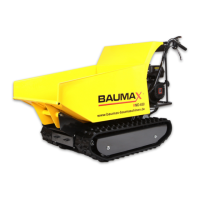

 To Next Page