
 Need help?
Do you have a question about the BCI Zero Emission City Bus and is the answer not in the manual?
Explains vehicle name plate, tyre plate, and electric motor name plate identification.
Details the location and identification of the vehicle's Chassis Vehicle Identification Number (VIN).
Covers BCI body warranty and other supplier warranties for vehicle components.
Guides users to the owner's manual and other technical reference documents.
Key vehicle dimensions, mass, and performance parameters like speed and turning diameter.
Specifications for electric drive motor, axles, steering, suspension, and wheels/tyres.
Information on body structure type, materials, interior finish, doors, and windows.
Instructions for adjusting the ISRI driver's seat features like armrest and backrest.
Guidance on adjusting the steering wheel and column position for optimal driver comfort.
Identification and function of various driver controls on the steering wheel, dashboard, and console.
Operation of demister and touch screen interface located on the overhead console.
Details on the vehicle's inlet for AC/DC charging and the low voltage isolator.
Procedures for operating passenger doors from inside and outside, including emergency functions.
Location and operation of emergency exits including windows, roof hatch, and doors.
Essential checks for electrical, safety, mirrors, emergency apparatus, and air tanks.
Procedures for checking washer fluid, power steering oil, and battery fluid levels.
Steps for starting, driving, and shutting down the vehicle safely.
Best practices for cleaning the vehicle, avoiding environmental pollution and damage.
Guidelines for battery maintenance and cleaning the motor/inverter cooling system.
Coolant recommendations and tyre rotation for optimal vehicle care.
Comprehensive list of chassis and general checks required for vehicle maintenance.
Detailed service intervals for checks at different mileage points (15k, 30k, 60k, 120k km).
Guidance on choosing lubricants for hydraulic power steering and chassis components.
Common chassis-related faults like gear selection, starting issues, power loss, and air pressure.
Solutions for steering issues and body-related faults like entry door operation.
Diagnosing and resolving issues with power-charging indicators, batteries, and vehicle starting.
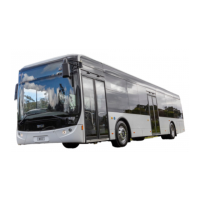
The BCI Zero Emission City Bus is a modern public transport vehicle designed for urban environments, prioritizing good value, safety, and comfortable performance. It offers stable, smooth handling and quiet operation, making it suitable for various public transport, touring, and commercial uses.
Driver's Seat and Controls: The bus is equipped with an ISRI 6860-875 air suspension driver's seat, featuring air lumbar support and a 3-point restraint for comfort and safety. The seat offers multiple adjustments including belt, armrest, backrest, shoulder, height (with memory), and vertical shock absorber. It also includes an integrated pneumatic system (IPS) and a quick release mechanism. For safety, seat adjustments should never be attempted while the vehicle is in motion.
The steering wheel and column are adjustable. With the vehicle at normal pressure, the driver can momentarily press a switch to adjust the steering wheel/column position to suit their preference. A 3-second window is provided for adjustment before the steering lock automatically engages.
The driver's controls are intuitively laid out. These include the steering wheel with horn buttons, a headlight and direction indicator stalk, and a windscreen wiper and retarder stalk. Nearside and offside switches manage various functions, alongside a combination instrument panel (CAN) and transmission control. A driver-side console provides additional controls.
Ignition and Startup: The ignition switch has several positions: "LOCK" (power off, key insertion/removal), "ACC" (accessory power on), "ON" (instrument and control power on), and "START." To prepare the vehicle for driving, hold the key in the "START" position for approximately 3 seconds until the 'READY' message appears on the dash display screen.
Wipers and Indicators: The wiper and direction indicator stalk, located on the left side of the steering column, controls the horn (push button), windscreen washer (press stalk inwards), and wipers (rotate stalk for OFF, intermittent, low, and high speeds). Moving the stalk up or down activates the right or left turn signals, respectively. Pulling the stalk upwards or briefly holding and releasing it activates the high beam.
Nearside Switches: These include a light switch (with off, standing lights, and main headlight activation), a hill hold switch (for stable positioning on inclines), a hazard warning light switch, a kneeling switch (manual or auto mode for door opening), a normal height reset switch, and a vehicle raise/lower switch (for raising or kneeling the vehicle).
Offside Switches: The offside switches control the driver's fan (low/high/off), saloon lights (low/high), driver's reading light (on/off), school bus lights (activate/stop), electric blind (up/down), rearview mirror heater (on/off), and steering column adjustment. Dedicated buttons are also present for opening/closing the front, middle, or both passenger doors simultaneously. A bus stop request bell reset is also available.
Drive Mode Selector: A simple selector allows the driver to choose between 'D' (Drive), 'N' (Neutral), and 'R' (Reverse).
Driver's Side Console: This console houses controls for rearview mirror adjustment, the park brake, master power switch, charge mode switch, emergency override switch for passenger doors, and a USB port for electrical items. The park brake is applied by pulling the lever back until it locks and released by lifting the collar and moving the lever forward. The charge mode switch activates recharging of the main Energy Storage System (ESS) via the CCS2 charging socket, disabling driving while active. The master power switch isolates all vehicle electrics.
Overhead Console: Above the driver, an overhead console contains the demister control unit and the Consat Driver Interface Touch screen. The demister controls fan speed, temperature, and airflow direction. The A/C system is activated when the vehicle starts.
Charging: The vehicle supports AC/DC charging via a CCS2 charging socket located at the center of the rear bay, accessible by opening a flap. An external charger compliant with IEC 61851-23 is used for DC charging.
Passenger Doors: Passenger doors can be operated by the driver from inside the vehicle via dashboard buttons. From outside, open/close buttons are located on the right-hand side of each door. A button on the front door alerts the driver for wheelchair/pram access, allowing manual opening of the loader.
Emergency Exits: The bus features several emergency exits. One window on the offside is marked with an emergency exit label and includes an emergency hammer for breaking the glass. All windows can be broken with the hammer. A roof hatch, also marked with an emergency exit label, can be opened by pulling a plastic cover to access a red release lever, rotating it to unlock, and pushing the hatch up. Passenger doors also serve as emergency exits, with internal emergency exit buttons (red for release, green for close) located above the doors, and external buttons on the right-hand side of each door.
Driving in Winter Conditions: Special attention is required in winter. Maintain and add specified coolant to the cooling system, remove accumulated water from air tanks after stopping, and check fluid levels, specific gravity, and electrolyte voltage in the low voltage battery system. Only recommended coolant should be used. The vehicle should not be driven until all brakes are released.
Shutting Down: To switch off the vehicle, turn the ignition key to the "ACC" position. Before leaving the vehicle in 'ready mode,' ensure the shift range selector is in "N" (Neutral), apply the park brake and emergency brake, and chock the wheels. If the passenger door is open and the park brake is not applied in 'ready mode,' a buzzer will sound until the park brake is engaged.
Routine Checks: Before and after driving, the vehicle should be parked on level ground for checks. These include verifying electrical appliance functionality (power supply, fault warnings, normal operation of instruments, lights, and indicators), checking the driver's seat safety belt, adjusting and cleaning rearview mirrors, and checking emergency apparatus like fire extinguishers. The speedometer and dash mileage display should also function normally. Water in the air tanks should be discharged regularly by toggling the drain valve to remove grease, dirt, and water. The air dryer cartridge should be replaced at least once a year. Foot and hand brakes should operate normally without leaks. Steering box free-play should be within ±10°.
Weekly Checks: Before driving, check tire pressure (760Kpa) and for any tire damage. Ensure wheel-nuts are securely fastened. For new vehicles, re-check wheel-nuts after approximately 50 km, applying specified torque (600Nm for steel rims, 550Nm for alloy rims) in a cross-symmetrical sequence. Windscreen washer fluid level should be checked and refilled if insufficient. Inspect the motor, drive axle, steering system, cooling system, and pipelines for any oil or air leakage.
Bi-Weekly Checks: Check the oil level in the power steering oil tank and refill if insufficient. To fill, start the vehicle and slowly add oil until it reaches midway in the reservoir viewing mirror, turning the steering wheel to full lock positions several times to exhaust air bubbles. For the low voltage system, check battery fluid level and add distilled water if needed, ensuring the battery isolation switch is OFF.
General Maintenance: The vehicle will remain in good operating condition with correct maintenance. Park on a level, dry surface with the park-brake "ON." Maintenance intervals should be reduced under extreme operating conditions (bad roads, thick dust, frequent stop-start). Clean surrounding areas before adding fluids or changing parts.
Cleaning: Be careful not to pollute or damage the environment when washing. Use correct detergent concentrations, avoid washing in direct sunlight, and prevent water from entering the air intake system or spraying high-pressure water onto radiator fins or ECUs.
Battery Maintenance: Refer to the battery Supplier's Operation Handbook for detailed information. For long-term parking (over a month), fully charge batteries and recharge every two months to balance cell voltage.
Cooling System: Keep the motor and inverter radiator clean for good airflow. Use compressed air or water to clean the outside, and steam for hard scale. Avoid high-pressure cleaners on radiator fins. Only coolant recommended by the battery manufacturer should be used.
Tire Rotation: Periodically rotate radial tires as per the provided diagram to extend tire life.
Service Schedules: The manual provides detailed service schedules for 5,000 km, 15,000 km, 30,000 km, 60,000 km, and 120,000 km, covering chassis and other checks. The first service is at 5,000 km or 6 months, including all 15,000 km checks and differential oil replacement. These intervals are guides and may change; always confirm with the Supplier's maintenance booklet.
Lubricants: Refer to the Supplier's Manual for lubricant choices. Oil should be replaced after a certain period due to consumption and deterioration from high temperatures. DEXRON-II hydraulic transmission oil (C-3 / 10W or C-3 / 30) is recommended for power steering, depending on ambient temperature. Lithium-based Extreme Pressure 2" grease "LX EP-2" should be used for chassis components.
 General
| Length | 12 meters |
|---|---|
| Width | 2.55 meters |
| Emission Standard | Zero Emission |
| Type | Electric City Bus |
| Passenger Capacity | 80 |
| Drive | Electric |

 To Next Page
