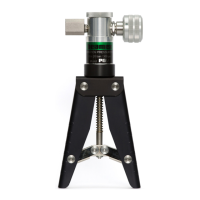
2 OPERATION
READ THE WARNINGS PRESENTED IN THIS MANUAL BEFORE
OPERATING THE PRESSURE PUMP.
1. Connect the instrument to be tested to the Pressure Measurement
Hose and attach it to the pump. Be sure that all the output connectors
are properly plugged or connected to an instrument to avoid leakage.
2. Adjust the fine control to "mid-travel".
3. Ensure the pressure release valve is closed (turn fully clockwise, but
keep in mind that excessive force may damage the seals).
4. Operate the handles several times to raise the pressure close to the
required value.
5. Do the final adjustment with the variable volume. If necessary, wait with
the adjustment until the temperature has stabilized (see chapter
2.1 Practical notes).
6. Repeat steps 4 and 5 until the highest calibration point is reached.
7. To decrease the pressure, open the release valve slightly.
Follow the decreasing of the pressure e.g. with the help of the
calibrator’s display. Close the release valve when the pressure is a little
above the required level.
8. Use the variable volume to set the exact pressure. Again, if necessary,
wait with the adjustment until the temperature has stabilized.
9. Repeat steps 7 and 8 until all of the decreasing calibration points are
done.
Small gauge pressures as well as negative pressures may be generated
using only the variable volume. The negative pressure is restricted to
approx. 150 mbar (then the force of the vacuum is equal to the force of the
volume piston’s spring).
2.1 Practical Notes
When increasing the pressure, the temperature of the air inside the system
rises on account of thermodynamic phenomena. When the temperature
returns to the level of the environment, the generated pressure may slightly
fall.
Respectively, when the pressure decreases, the air cools down. So when
the temperature again rises to the level of the environment, a slight in-
crease in the pressure may occur.
The temperature change depends (among other things) on the volume of
the system and the pressure change created by the user. Thus the effect of
the phenomenon varies for each calibration and even for each calibration
step.
Another phenomenom that affects the pressure is the flexibility of the hoses
used in the measurement system. When the pressure increases, the hoses
stretch, thus slightly altering the volume of the measurement system.
3 TROUBLESHOOTING/MAINTENANCE
If the pump assembly fails to indicate a pressure increase after consider-
able pumping action, the following items should be examined:
• Check to assure that the connections between the pump, the hose end
and the attached instrument(s) are tight and repeat operating instruc-
tions items 3 and 4. Check to assure that all the unused output connec-
tors are properly plugged.
If a pressure increase still cannot be obtained, it’s possible that one or more
of the seals and/or the check valve on the main piston is leaking and needs
to be replaced.
3.1 Seal Replacement
Depending on the frequency of use, the Main Piston Seals (and others) will
eventually need replacing. Although the replacement seals are an optional
accessory, the same instructions for fitting the seals are included in this
manual as in the replacement package.
f e


 To Next Page
 Loading...