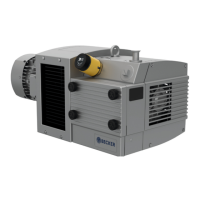
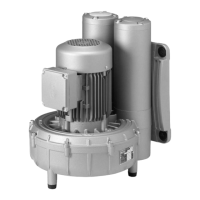
This document serves as a comprehensive manual for the Becker KDT 3.100 series, providing detailed instructions for operation, maintenance, and technical specifications across various languages. The device appears to be a vacuum pump or compressor, designed for industrial applications requiring reliable air movement or pressure/vacuum generation.
Function Description:
The Becker KDT 3.100 is a robust industrial pump, likely a dry-running rotary vane pump, given the emphasis on maintenance intervals for filters and lubrication. Its primary function is to generate either vacuum (suction) or pressure (compression) for various industrial processes. The manual indicates its use in systems where controlled air flow and consistent performance are critical. The inclusion of motor protection features, soft start recommendations, and various filter types suggests its application in environments where air quality, motor longevity, and operational stability are important. The device is designed for continuous operation, with specified maintenance intervals for optimal performance and extended lifespan.
Important Technical Specifications:
The manual provides several key technical specifications, often presented in a visual format with clear icons and values:
- Max. Pressure/Vacuum: The device is rated for a maximum pressure, indicated by "MAX. PRESSURE" and "MAX.V mbar" on the specification labels. While specific numerical values are not consistently visible across all examples, the presence of these labels confirms its capability to generate significant pressure or vacuum.
- Air Flow/Inlet Capacity: The "inlet capacity" is specified in m³/h, indicating the volume of air the pump can handle per hour. This is a crucial parameter for sizing the pump to specific application requirements.
- Frequency and Speed: The pump operates at specific frequencies (e.g., 50Hz, 60Hz) and corresponding speeds (min⁻¹), which are standard for industrial electrical motors.
- Power Required: The "power required" in kW indicates the electrical power consumption of the motor, essential for electrical system design and energy efficiency calculations.
- Noise Level: The noise emissions are specified according to DIN EN ISO 11203, Accuracy Class 2. The sound pressure level (LPA) is 76 dB(A) at 50Hz and 78 dB(A) at 60Hz, measured at 1m distance. A KPA of 3 dB(A) is also noted, indicating the uncertainty of the measurement. These values are important for workplace safety and environmental considerations.
- Weight: The device weighs between 107-129 kg (236-284 lbs), indicating a substantial piece of industrial equipment that requires proper handling and installation.
- Environmental Operating Conditions:
- Temperature: The operating temperature range is specified as > 5°C/41°F to < 45°C/113°F. This indicates the ambient temperature limits for safe and efficient operation.
- Humidity: The maximum relative humidity is 90%, suggesting the device is designed to operate in moderately humid environments.
- Altitude: A maximum altitude of 800m is specified, which might relate to air density and cooling efficiency.
- Motor Protection: The manual highlights the importance of motor protection, indicating the use of a motor protection switch and providing options for PTC (Positive Temperature Coefficient) or Bi-metal thermal protection, especially for motors > 5.5 kW. This ensures the motor is protected against overload and overheating.
- Electrical Specifications: The manual shows voltage (V) and current (A) ratings for both 50Hz and 60Hz operation, which are critical for electrical connection and safety.
- Pressure Connections: The manual illustrates connections for 1½", 2", and 1x additional pressure lines, indicating flexibility in system integration.
Usage Features:
The Becker KDT 3.100 is designed for user-friendly operation and integration into industrial systems:
- Multi-language Support: The manual is provided in numerous languages, making it accessible to a global user base.
- Clear Safety Instructions: Prominent warning symbols (exclamation mark, hand protection, ear protection, no smoking, etc.) are used throughout the manual to highlight critical safety information, emphasizing the importance of personal protective equipment and safe operating procedures.
- Installation Guidelines: Visual instructions guide users on proper installation, including minimum clearance requirements (MIN 2m around the unit) for adequate ventilation and maintenance access. The illustrations show air intake and exhaust directions, crucial for correct setup.
- Motor Protection Integration: The manual details how to connect the motor to a motor protection switch, with options for direct connection or through a soft start unit, especially for higher power motors. This ensures the motor's longevity and prevents damage from electrical faults.
- Operational Control: The "ON (I) - OFF (0)" switch indication, along with a "MAX 10x/h" limit for switching frequency, provides guidance on proper operational control to prevent excessive wear on the motor and electrical components.
- Pressure Measurement Points: The inclusion of pressure gauge connections (1½", 2", +1x) suggests the ability to monitor system pressure during operation, allowing for performance verification and troubleshooting.
- Component Identification: Key components are identified with numbers (e.g., D2, D3, F1, F2, F3), facilitating easy reference during maintenance and parts ordering.
Maintenance Features:
Maintenance is a significant aspect of the KDT 3.100's design, with clear instructions and recommended intervals to ensure optimal performance and extend the device's lifespan:
- Maintenance Schedule: The manual specifies various maintenance intervals:
- Cleaning Interval: Suction air filters (F1, F2, F3) require cleaning every 40 hours or replacement every 200 hours. This is critical for maintaining air quality and preventing damage to the pump.
- Filter Replacement: Different filter types (F1=F2 standard, F2* polyester, F3 standard) are available, each with specific part numbers for ordering. The manual provides clear visual instructions for accessing and replacing these filters.
- Grease Application: Special grease (No. 74330500000) needs to be applied every 2000 hours, with specific instructions on the amount (≈5g) and application points (10x). This indicates the presence of lubricated bearings or other moving parts requiring periodic lubrication.
- Vane Replacement (or similar internal component): An interval of 3000 hours is specified for checking and potentially replacing internal components, indicated by the "A" measurement (AMAX = 39mm, AMIN = 26mm). If the measurement "A < 26mm", replacement is necessary. This likely refers to the rotary vanes or other critical wear parts within the pump, which are essential for its performance. The manual provides different part numbers (SET) for these components based on the specific KDT 3.100 model variant (e.g., KDT 3.100/0-52, KDT 3.100/6-54).
- Cleaning Procedures: Instructions for cleaning include using compressed air or a brush for filters and other components. The manual shows how to disassemble parts (e.g., filter covers, internal components) for cleaning and reassembly.
- Torque Specifications: Specific torque values (e.g., 11Nm, 3Nm) are provided for fastening bolts during reassembly, ensuring proper sealing and structural integrity.
- Safety During Maintenance: The manual emphasizes safety during maintenance, including turning off the device ("0=OFF"), disconnecting power, and waiting for the device to cool down ("n=0min⁻¹" and "2-3 Min" wait time).
- Parts Ordering: The manual includes part numbers for various maintenance kits and individual components, facilitating easy ordering and replacement.
- Troubleshooting: While not explicitly detailed in the provided pages, the comprehensive nature of the manual suggests it would include troubleshooting guides to help users diagnose and resolve common issues.
In summary, the Becker KDT 3.100 is a high-performance industrial pump designed for demanding applications. Its robust construction, detailed technical specifications, user-friendly operational guidelines, and comprehensive maintenance instructions ensure reliable and efficient operation over its lifespan. The emphasis on safety, regular maintenance, and the availability of specific parts underscores Becker's commitment to product quality and customer support.

 Need help?
 General

 To Next Page