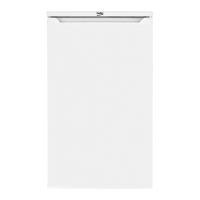
How to fix a Beko Refrigerator that is not working?
- KkcastroAug 20, 2025
If your Beko Refrigerator isn't working, ensure it's properly plugged into the socket. Also, check the fuse connected to the socket or the main fuse, as it may be blown.
How to fix a Beko Refrigerator that is not working?
If your Beko Refrigerator isn't working, ensure it's properly plugged into the socket. Also, check the fuse connected to the socket or the main fuse, as it may be blown.
Why is my Beko TS 190320 running too often?
If your Beko Refrigerator runs too often or for too long, it might be due to several factors. The room temperature could be high, or the refrigerator might be newly plugged in or have new food items inside, which is normal. Avoid placing hot food inside and opening the doors too frequently. Ensure the doors are fully closed and the temperature isn't set too low. Also, check if the door washer is dirty, worn, or broken, and clean or replace it if necessary.
How to prevent condensation in Beko TS 190320?
To address condensation on the side wall of your Beko Refrigerator's cooler compartment, avoid opening the door too frequently and ensure the refrigerator is not installed in a humid environment. Keep foods containing liquids in sealed containers and avoid leaving the door open for extended periods. Also, make sure the thermostat is set to an appropriate temperature.
What to do if Beko Refrigerator temperature is too high?
If the temperature in your Beko Refrigerator's cooler or freezer is too high, it could be due to a high cooler compartment temperature setting. Adjust the cooler or freezer temperature and wait for it to reach the desired level. Avoid opening the doors too frequently and ensure they are fully closed. Remember that recently plugged-in or new food items can also cause this, as well as placing hot food inside.
Why is the door of my Beko Refrigerator not closing?
If the door of your Beko Refrigerator isn’t closing properly, check for food packages blocking the door and relocate them. Ensure the refrigerator is standing upright and the ground is level and durable. Adjust the stands to balance the refrigerator if needed.
Why is my Beko TS 190320 freezer too cold?
If the freezer temperature in your Beko Refrigerator is very low while the cooler temperature is adequate, the freezer compartment temperature might be set too low. Increase the freezer compartment temperature and check again.
Why does my Beko TS 190320 sound like liquid is flowing?
The sound of liquid flowing or spraying in your Beko Refrigerator is normal, as its operating principles involve liquid and gas flows; it is not a malfunction.
Why does my Beko TS 190320 make a wind blowing sound?
The sound of wind blowing from your Beko Refrigerator is normal because it uses a fan for the cooling process; this is not a malfunction.
Why is there condensation on the inside of my Beko TS 190320 Refrigerator?
Condensation on the internal walls of your Beko Refrigerator is normal during hot or humid weather, which increases icing and condensation. Avoid opening the doors too frequently and ensure they are fully closed.
Why is there condensation on the outside of my Beko TS 190320?
Condensation on the exterior or between the doors of your Beko Refrigerator is normal in humid weather. The condensation will dissipate when the humidity is reduced.
Specifies the intended use of the refrigerator, including indoor and closed area applications.
Covers general safety precautions for product disposal, service, and handling of specific components.
Highlights safety measures concerning children, especially regarding locks and supervision.
Instructions and important notes regarding the proper electrical connection of the refrigerator.
Guidelines for selecting an appropriate location and positioning the refrigerator.
Covers installation location, ambient temperature, cleaning, and initial operation guidelines.
Troubleshooting steps for when the refrigerator fails to start or operate.
Diagnoses and potential solutions for issues where the compressor is not operating.
Specifies the intended use of the refrigerator, including indoor and closed area applications.
Covers general safety precautions for product disposal, service, and handling of specific components.
Highlights safety measures concerning children, especially regarding locks and supervision.
Instructions and important notes regarding the proper electrical connection of the refrigerator.
Guidelines for selecting an appropriate location and positioning the refrigerator.
Covers installation location, ambient temperature, cleaning, and initial operation guidelines.
Troubleshooting steps for when the refrigerator fails to start or operate.
Diagnoses and potential solutions for issues where the compressor is not operating.
| Child lock | - |
|---|---|
| Door hinge | Right |
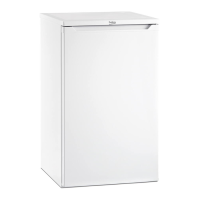
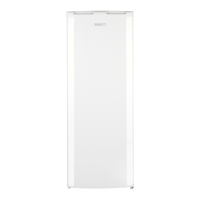
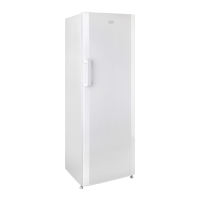
| Product color | White |
| Built-in display | No |
| Reversible doors | Yes |
| Appliance placement | Freestanding |
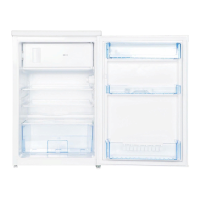
| Fridge door balconies | 3 |
| Number of vegetable drawers | 1 |
| Fridge number of shelves/baskets | 2 |
| Noise level | 43 dB |
| Climate class | SN-T |
| Total net capacity | 90 L |
| Fridge net capacity | 86 L |
| Total gross capacity | - L |
| Connected load | - W |
| Annual energy consumption | 118 kWh |
| Freezer position | Top-placed |
| Freezing capacity | 0.323 kg/24h |
| Storage time during power failure | - h |
| Depth | 530 mm |
|---|---|
| Width | 480 mm |
| Height | 820 mm |
| Weight | 29000 g |