Need help?
Do you have a question about the Beko WCB 77127 and is the answer not in the manual?
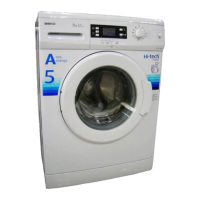
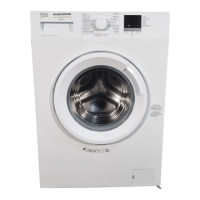
This document describes a BEKO washing machine, covering its general safety, installation, initial preparations for washing, program selection, operation, and maintenance.
The washing machine is designed for home use, specifically for washing and rinsing textiles marked accordingly. It's crucial to ensure the machine is placed on a flat, non-carpeted surface to prevent overheating of electrical parts. The power cable and mains plug should be undamaged, and any repairs must be handled by an Authorized Service. The drain hose and water intake hoses must be securely fitted, without folds, squeezes, or breaks, to prevent leaks and ensure proper water flow. The machine is designed to resume operation after a power interruption. If there's residual water upon receipt, it's normal from quality control. For minor issues, pressing the "Start/Pause/Cancel" button for 3 seconds can reset the program before contacting service. This appliance is not intended for use by persons with reduced physical, sensory, or mental capabilities, or lack of experience, unless supervised. Packaging materials should be kept out of reach of children and disposed of according to waste directives.
For first use, run a "Cottons 90°C" program without laundry but with detergent. Ensure cold and hot water connections are correct. A qualified electrician should install a 16 Ampere fuse or circuit breaker if the current fuse is less than 16 Amperes. Grounding installation by a qualified electrician is essential, as the company is not liable for damages from ungrounded use.
Safety instructions emphasize connecting the appliance to an earthed outlet with a suitable fuse. Hoses must be securely fastened and undamaged. The draining hose should be fitted to a washbasin or bathtub securely to prevent scalding from high washing temperatures. Never open the loading door or remove the filter while water is in the drum. Unplug the machine when not in use and never wash it down with a water hose due to electric shock risk. Avoid touching the plug with wet hands or operating a damaged machine. For unsolvable malfunctions, turn off the machine, unplug it, turn off the water tap, and contact an authorized service agent. Information on disposal can be obtained from local agents or waste collection centers. Children should be kept away from the machine during operation and not allowed to tamper with it. The loading door should be closed when leaving the area.
Removing Packaging Reinforcement: To remove the packaging reinforcement, tilt the machine and pull the ribbon.
Opening the Transportation Locks: Transportation safety bolts must be removed before operating the machine to prevent damage. Loosen all bolts with a spanner until they rotate freely, then gently remove them. Fit the supplied covers into the holes on the rear panel. Keep the bolts for future relocation and never move the appliance without them properly fixed.
Adjusting the Feet: Do not use tools to loosen the lock nuts. Manually loosen the lock nuts, adjust the feet until the machine is level and firm, then tighten all lock nuts again.
Connecting to the Water Supply: The required water supply pressure is 1-10 bar (0.1-1 MPa). Connect the special hoses supplied with the machine to the water intake valves. If using a double water-inlet machine as a single (cold) water-inlet unit, install the stopper supplied for the hot water valve. For both inlets, connect the hot water hose after removing the stopper and gasket group. Single water inlet models should not be connected to the hot water tap. After maintenance, ensure hoses are not folded, squeezed, or blocked.
Connecting to the Drain: The water discharge hose can be attached to a washbasin or bathtub, firmly fitted to prevent it from coming out. The end of the drain hose must be directly connected to the wastewater drain or washbasin, attached at a height of 40-100 cm. If the hose is elevated below 40 cm, water discharge becomes difficult, and laundry may remain wet. The hose should be pushed into the drainage for more than 15 cm and can be shortened if too long. The maximum combined length of hoses must not exceed 3.2 m.
Connect the machine to an earthed outlet protected by a fuse of suitable capacity, complying with national regulations. Voltage and fuse protection are specified in "Technical Specifications." The specified voltage must match mains voltage. Avoid extension cords or multi-plugs. A damaged power cable must be replaced by a qualified electrician. Do not operate the appliance if it is damaged due to electric shock risk.
The door locks during program operation, and the "Door Locked Symbol" lights up. It can be opened when the symbol fades out.
Detergent Drawer: The drawer has three compartments: (I) for prewash, (II) for main wash, and (III) for softener (siphon). Add detergent and softener before starting. Never open the drawer during a program. For programs without pre-wash, do not add detergent to compartment I.
Detergent Quantity: The amount depends on laundry, soiling, and water hardness. Do not exceed recommended quantities to avoid excessive foam, poor rinsing, and environmental impact. Never exceed the max level marking for softener to prevent waste. Do not use liquid detergent with the time delay feature.
Preparing Clothes: Remove metal attachments (bras, buckles, buttons) or place items in a clothing bag to prevent machine damage. Sort laundry by fabric type, color, soiling, and permissible water temperature, following garment labels. Place small items in a laundry bag. Wash "machine washable" or "hand washable" items with appropriate programs. Do not wash colors and whites together; new dark cottons may release dye and should be washed separately. Use only machine-wash suitable dyes/color changers and lime removers, following packaging instructions. Wash trousers and delicate clothes inside out.
Correct Load Capacity: Follow the "Program Selection Table" information. Overloading degrades washing results.
Control Panel: The control panel includes buttons for spin speed, time delay, temperature adjustment, and start/pause/cancel, along with a program selection knob, display, and on/off button.
Display Symbols: The display shows indicators for spin speed, temperature, spin symbol, temperature symbol, remaining time, delaying time, program indicators (pre-wash/main wash/rinse/softener/spin), economy symbol, time delaying symbol, door locked symbol, start symbol, standby symbol, auxiliary function symbols, and water cut-off symbol.
Turning the Machine On: Plug in, turn on the tap, check hose connections, load laundry, add detergent and softener, then press the "On/Off" button.
Program Selection: Turn the Program Selection Knob to the desired program. The recommended temperature and spin speed appear. Press "Start/Pause/Cancel" to start. Sort laundry by fabric type, color, soiling, and permissible water temperature when choosing a program.
Main Programs:
Additional Programs: (May differ by model)
Economy Symbol: Indicates energy-saving programs and temperature selections. Not lit for "Intensive" and "Baby" programs due to higher temperatures for hygiene.
Special Programs:
Temperature Selection: The anticipated temperature appears when a program is selected. Press the "Temperature" button to change it in 10° increments. Cold selection is shown with a "-" symbol. Examples: 90°C for normally soiled white cottons; 60°C for normally soiled colored linens, cottons, synthetics, or lightly soiled white linens; 40°C/30°C/Cold for blended clothes, synthetics, woolens, and delicates.
Spin Speed Selection: The maximum spin speed for the selected program is displayed. Press the "Spin" button to decrease speed gradually, then rinse hold and no spin options appear. Rinse hold is shown with "I", and no spin with "——". If you don't want to unload clothes immediately, use rinse hold to prevent wrinkles; laundry stays in the final rinsing water. To spin after rinse hold, adjust spin speed and press "Start/Pause/Cancel." To drain water without spinning, use the no spin function.
Auxiliary Functions: Select required functions before starting. Auxiliary function buttons may differ by model. If incompatible functions are chosen, the first selected is cancelled, and the last remains active. Incompatible functions cannot be selected.
Starting the Program: Press "Start/Pause/Cancel." The button lights up, the door locks, and the "Lid" light fades.
Progressing a Program: Progress is shown through the program follow-up indicator. The relevant lamp lights up at the start of each step and turns off when completed. If the machine isn't spinning, it may be in rinse hold or the automatic spin correction system may be active due to unbalanced laundry.
Changing Selections After Program Start: To change selections (e.g., temperature or textile group), cancel the ongoing program by pressing and holding "Start/Pause/Cancel" for 3 seconds. Then, select the new program and press "Start/Pause/Cancel."
Switching to Standby Mode: Momentarily press "Start/Pause/Cancel." Auxiliary functions can be cancelled or selected based on the program step. The door can be opened if the water level is suitable to add/remove laundry.
Child-proof Lock: Protects the appliance from tampering. All buttons except "On/Off" are inactive. To activate, press the 1st and 2nd auxiliary functions for 3 seconds (1st auxiliary function light flashes). To deactivate, press the same buttons for 3 seconds.
Ending Program Through Canceling: To cancel, press "Start/Pause/Cancel" for 3 seconds. The machine discharges water, "Wash" and "Program Finished" lights light up. "Start/Pause/Cancel" and "Wash" lights go off after discharge, and "Lid" light flashes until the door unlocks. If cancelled mid-process, "Wash" and "Program Finished" lights light up. The machine may drain water or take in water 3 times to cool clothes and complete draining. When draining is complete, "Wash" light goes off, "Program Finished" lights up, and "Lid" light continuously flashes until the door unlocks.
End of Program: The "Program Finished" lamp lights up. The lid unlocks 2 minutes later, and "Program Finished" and "Lid" lamps light up continuously. The machine is ready for a new cycle. If any key is pressed or the knob is changed, "Program Finished" light goes off, and only "Lid" lamp remains lit. If the door is still locked, "Lid" light continues flashing until unlocked. Press "On/Off" to shut down.
Detergent Drawer: Remove powder residue buildup. Press the dotted point on the siphon in the softener compartment and pull to remove. Wash the drawer and siphon with lukewarm water. Replace the drawer, ensuring the siphon is in its original location. If excessive water and softener gather, the siphon needs cleaning.
Inlet Water Filters: Filters are at the end of each water intake valve at the back and at the end of each water intake hose connected to the tap. These prevent foreign substances from entering the machine and should be cleaned when dirty. Close the taps. Remove nuts of water intake hoses and clean filter surfaces with a brush. If very dirty, pull out filters with pliers and clean. Take out filters on flat ends of hoses with gaskets and clean thoroughly under streaming water. Replace gaskets and filters carefully and tighten hose nuts by hand.
Draining Remaining Water and Cleaning the Pump Filter: The filter system ensures cleaner water discharge and extends pump life by preventing solid items from clogging the propeller. If the machine fails to drain, the pump filter may be clogged and needs cleaning every 2 years or when plugged. Water must be drained to clean the filter. Water may also need draining before transport or if there's a risk of frost.
 General
| Maximum Spin Speed | 1200 RPM |
|---|---|
| Washing Capacity | 7 kg |
| Spin Speed | 1200 RPM |
| Number of Programs | 15 |
| Dimensions (HxWxD) | 84 x 60 x 49 cm |


 To Next Page