Bennington Owner’s Manual 11
CARBON MONOXIDE
Exhaust fumes contain carbon monoxide (CO), an odorless and colorless gas. Carbon monoxide is
poisonous and a health hazard that can be fatal if breathed over an extended period of time. Symp-
toms of CO poisoning can include (but not limited to): dizziness, nausea, headache, sleepiness,
vomiting, throbbing in temples, muscular twitching and the inability to think clearly. Seek urgent
medical attention if these symptoms occur and persist.
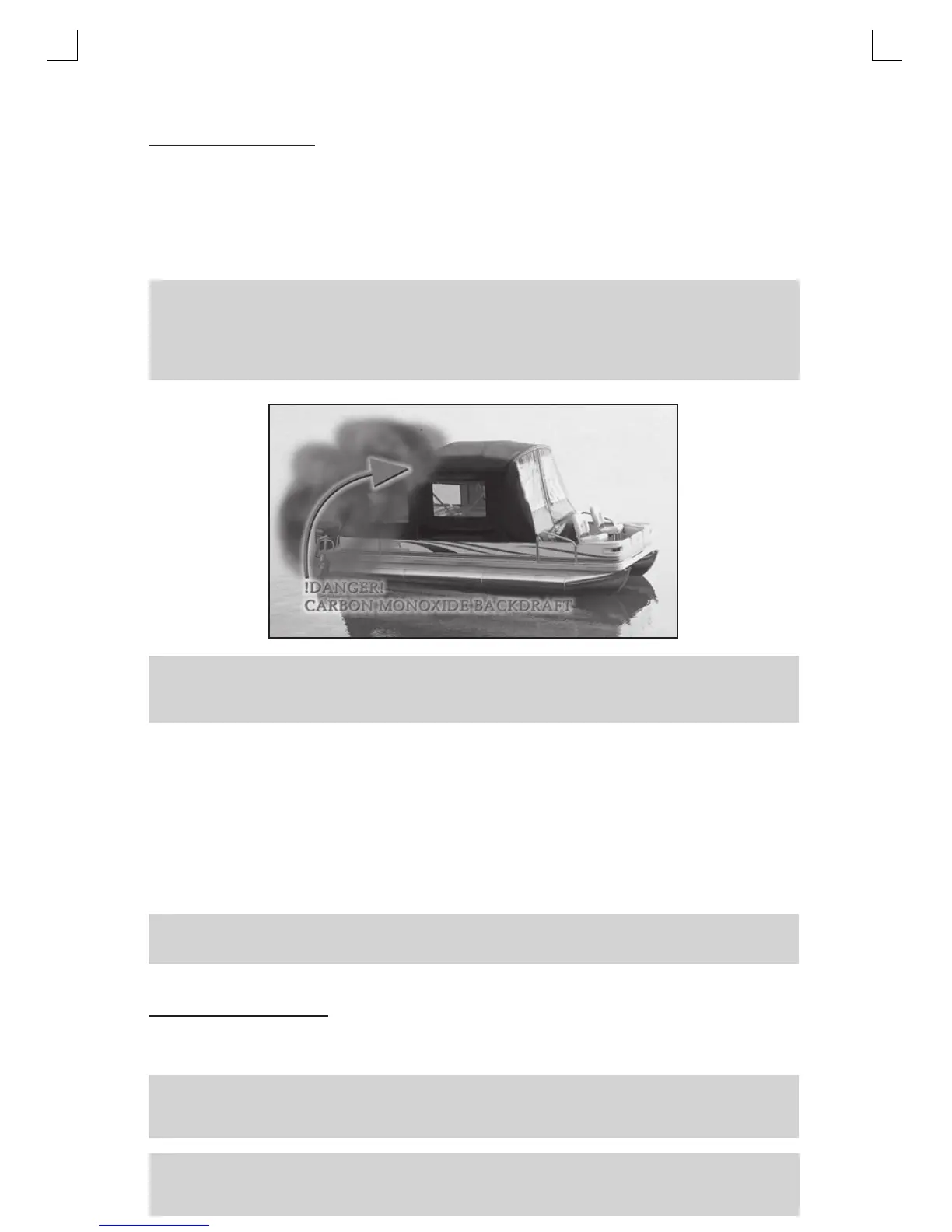
Carbon monoxide can accumulate in enclosed in areas and under canvas.
ENGINE EXHAUST BACKDRAFT FIGURE
DRUGS & ALCOHOL
Drugs & Alcohol do not mix with boating. Keep yourself, your passengers, and other water users
safe.
DO NOT OPERATE A BOAT WHILE UNDER THE INFLUENCE OF DRUGS AND/OR
ALCOHOL.
The use of alcohol and/or drugs affects everyone in at least four possible ways that affect safe boat
driving skills:
Judgment, Coordination, Reaction Time, and Vision. Also, the infl uence of drugs and alcohol by
passengers can be dangerous. Under the infl uence, passengers can fall overboard and risk injury and
death.
FUEL SYSTEM SAFETY
USE AND HANDLE FUEL WITH THE BEST OF CARE! GASOLINE IS HIGHLY
FLAMMABLE AND CAN CAUSE PERSONAL INJURY AND DEATH!
! DANGER !
CO in engine exhaust from your boat can accumulate within enclosed areas when your boat is
operating at a slow speed or stopped in the water. Installing rear canvas while underway increases
the risk of CO accumulation in your boat. Tail wind can increase accumulation. Provide adequate
ventilation or increase speed as needed. (Note Backdrafting Figure Below)
! DANGER !
Carbon monoxide can be harmful or even fatal if inhaled. Keep exhaust outlets clear of block-
age. Provide adequate ventilation. Open windows and vents to ensure good ventilation.
! DANGER !
Never operate a boat while under the infl uence of drugs or alcohol.
! DANGER !
DO NOT SMOKE WHILE FUELING YOUR BOAT.
SHUT OFF ENGINE WHILE FUELING YOUR BOAT
! DANGER !
Gasoline vapors are highly explosive. To prevent a possible explosion and fi re,
check for fumes or accumulation of fuel before each engine start.



 To Next Page