22 Bennington Owner’s Manual
General Navigation Rules:
Cross waves at right angles. Head on 90 degree angle.
When caught in heavy waves, head either directly into the waves or at a slight angle. Reduce your
speed, but maintain enough power to move your boat safely.
When meeting a boat head on, keep to the right whenever possible.
When two boats cross, the boat to the starboard (right) side has the right of way.
When passing another boat, the boat being passed has the right of way. However, the boat being
passed is asked to maintain the same direction and speed to allow the passing boat by safely. Please
keep in mind, sailboats and windsurfers always have the right away.
Docking:
Always approach the dock slowly. If possible, come in against the wind or current depending on
which is stronger. As the boat nears the dock, slowly swing parallel to it. Use caution if the wind or
current is from your stern. Approach slowly at a slight angle with engine in slow reverse.
Tie up on the down wind side of the dock. Use fenders over the side between the boat and the dock
to keep your boat from being damaged.
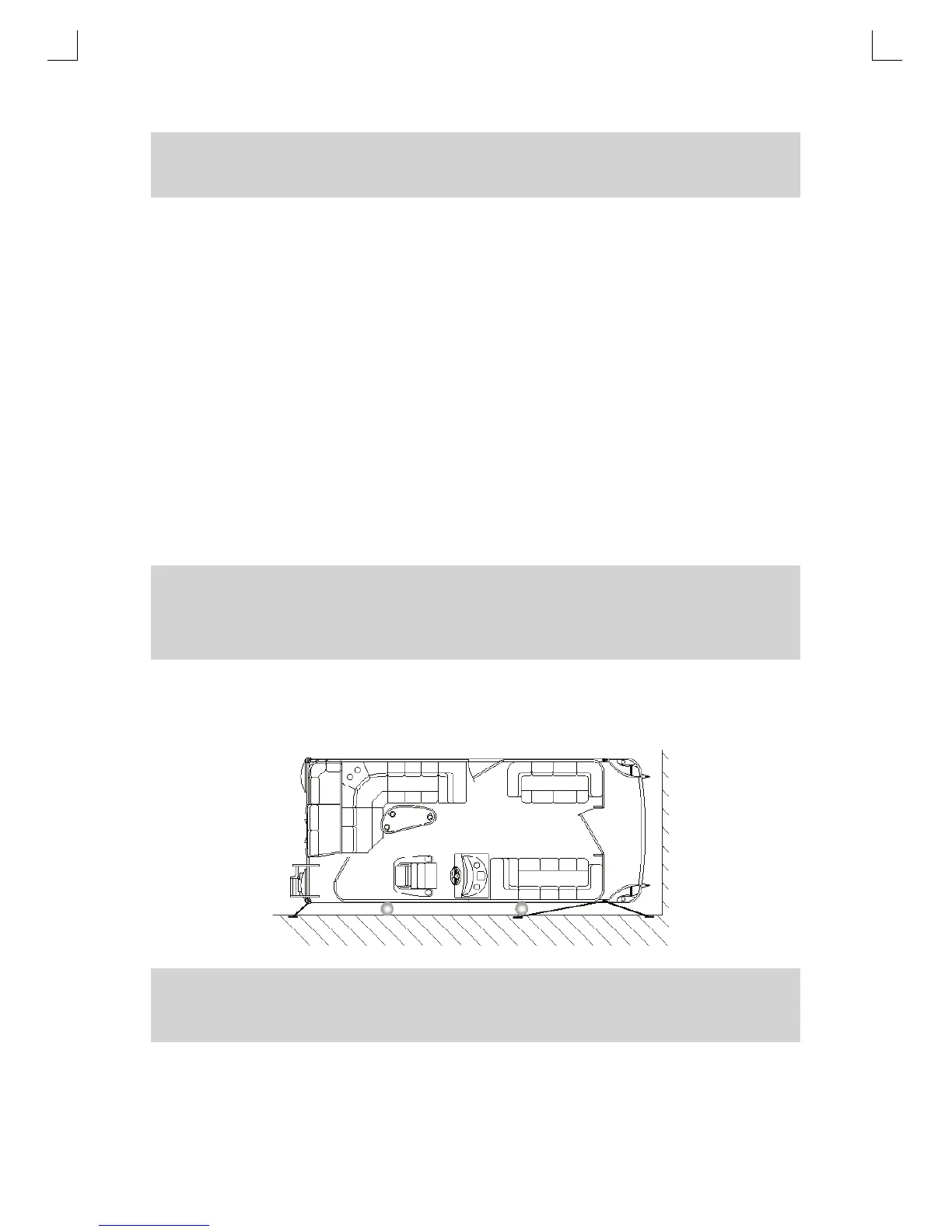
Docking/Mooring Tie Down Figure:
An eye spliced into the end of the line provides a secure tie down to a deck cleat.
Another convenient method of making a tie down is to an open cleat.
Trimming:
The outboard engine or stern drive can be trimmed to adjust to the ideal boat angle for given load
and water conditions. The engine should be trimmed so that it is perpendicular to the water when
the boat is running at full speed. On two-tube pontoon boats, trimming the motor does not signifi -
cantly affect a boat’s riding attitude in most cases. However, on three-tube pontoon boats with higher
horsepower engines, the boat is likely to ride higher in the water. It will accelerate more rapidly and
is more responsive in turns. Trimming is more likely to affect the boat’s performance and overall
attitude, but the effect will be less as compared to a boat with a planing hull.
! WARNING !
You cannot stop a boat as quickly as you can an automobile
because a boat does not have brakes.
! WARNING !
Do not use hands or feet to fend your boat from a dock.
Your boats weight coupled with forward momentum could
cause injury to a limb caught between the boat and a dock.
Remember to take it slow.
! CAUTION !
If tides are a consideration, be sure to leave slack in the lines to
make up for the rise and fall of the water while your boat is docked.



 To Next Page