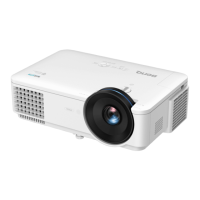
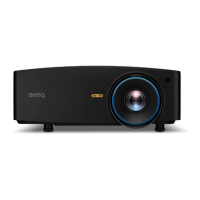
Need help?
Do you have a question about the BenQ L720D Series and is the answer not in the manual?
This document serves as an installation guide for controlling BenQ L720/L720D Series projectors via RS232 commands from a computer. It outlines the necessary connection procedures, communication settings, and a comprehensive command table for various projector functions.
The BenQ L720/L720D Series projectors can be remotely controlled using RS232 serial communication. This allows for integration into control systems, enabling automated operation and management of the projector's features. The control can be established through a direct RS232 serial port connection, via a Local Area Network (LAN), or through HDBaseT. The guide provides detailed instructions for setting up each connection type and configuring the communication parameters.
The RS232 communication relies on a D-Sub 9 pin connection. The wire arrangement for a crossover cable is specified, detailing the pin assignments for P1 and P2 connectors, including Black (pin 1), Brown (pin 2), Red (pin 3), Orange (pin 4), Yellow (pin 5), Green (pin 6), Blue (pin 7), Purple (pin 8), Gray (pin 9), and a Drain wire for the Case. The RS232 pin assignment clarifies the functions of each pin: Pin 1 (NC), Pin 2 (RXD), Pin 3 (TXD), Pin 4 (NC), Pin 5 (GND), Pin 6 (NC), Pin 7 (RTS), Pin 8 (CTS), and Pin 9 (NC).
For serial port communication, the supported baud rates are 9600, 14400, 19200, 38400, 57600, and 115200 bps. The data length is fixed at 8 bits, parity check is set to None, stop bit to 1 bit, and flow control to None. These settings are crucial for establishing a stable serial connection.
When controlling via LAN, the projector's Wired LAN IP address must be known, and the TCP port is specified as 8000. For HDBaseT control, the connection also utilizes a D-Sub 9 pin and RJ45 port, with similar serial communication settings as the direct RS232 connection.
The command table provides a comprehensive list of ASCII commands for various projector operations. Each command follows a specific format, typically <CR>*command=value#<CR>, where <CR> represents a carriage return. Commands are case-insensitive.
The projector offers extensive control over its power state, input source selection, audio settings, picture modes, picture settings, aspect ratio, digital zoom, brilliant color, projector position, quick cooling, auto search, direct power on, signal power on, standby network settings, and lamp control.
<CR>*pow=on#<CR><CR>*pow=off#<CR><CR>*pow=?#<CR><CR>*sour=RGB#<CR> for COMPUTER/YPbPr, <CR>*sour=hdmi#<CR> for HDMI(MHL), etc.Current source command <CR>*sour=?#<CR> can be used to query the active input.<CR>*mute=on#<CR>, <CR>*mute=off#<CR><CR>*mute=?#<CR><CR>*vol=+#<CR> (increase), <CR>*vol=-#<CR> (decrease)<CR>*vol=value#<CR> (set specific level)<CR>*vol=?#<CR><CR>*audiosour=off#<CR> to disable, <CR>*audiosour=?#<CR> for status.<CR>*appmod=preset#<CR> for Presentation, <CR>*appmod=srgb#<CR> for sRGB, etc.Picture Mode status can be queried with <CR>*appmod=?#<CR>.<CR>*con=+#<CR> (increase), <CR>*con=-#<CR> (decrease), and query value with <CR>*con=?#<CR>.<CR>*bri=+#<CR> (increase), <CR>*bri=-#<CR> (decrease), and query value with <CR>*bri=?#<CR>.<CR>*color=+#<CR> (increase), <CR>*color=-#<CR> (decrease), and query value with <CR>*color=?#<CR>.<CR>*sharp=+#<CR> (increase), <CR>*sharp=-#<CR> (decrease), and query value with <CR>*sharp=?#<CR>.<CR>*ct=warmer#<CR>, <CR>*ct=normal#<CR>, etc. Query status with <CR>*ct=?#<CR>.<CR>*asp=4:3#<CR>, <CR>*asp=AUTO#<CR>, etc.<CR>*asp=?#<CR>.<CR>*zoomI#<CR>, <CR>*zoomO#<CR><CR>*auto#<CR><CR>*BC=on#<CR>, <CR>*BC=off#<CR><CR>*BC=?#<CR><CR>*pp=FT#<CR>, <CR>*pp=RE#<CR>, etc.<CR>*pp=?#<CR>.<CR>*qcool=on<CR>, <CR>*qcool=off<CR><CR>*qcool=?<CR><CR>*QAS=on#<CR>, <CR>*QAS=off#<CR><CR>*QAS=?#<CR><CR>*blank=on#<CR>, <CR>*blank=off#<CR><CR>*freeze=on#<CR>, <CR>*freeze=off#<CR><CR>*menu=on#<CR>, <CR>*menu=off#<CR><CR>*up#<CR>, <CR>*down#<CR>, etc.The guide provides commands relevant to monitoring and managing the projector's lamp and baud rate.
<CR>*baud=2400#<CR>.<CR>*baud=?#<CR>. It is important to match the baud rate of the connected projector from its OSD menu.<CR>*ltim=?#<CR>.<CR>*lampm=lnor#<CR> for Normal mode, <CR>*lampm=eco#<CR> for Eco mode, etc.<CR>*lampcustom=value#<CR> and queried with <CR>*lampcustom=?#<CR>.Lamp Mode Status can be queried with <CR>*lampm=?#<CR>.<CR>*lensload=m1#<CR> to load memory 1, and <CR>*lenssave=m1#<CR> to save memory 1.<CR>*lensreset=center#<CR> to reset the lens to the center position.The document emphasizes that available functions and commands may vary by model, and users should refer to their projector's specifications and user manual. It also notes that commands work if the standby power is 0.5W or a supported baud rate is set. Error messages like "Illegal format," "Unsupported item," or "Block item" are provided for troubleshooting command execution issues. For LAN control, commands are functional whether they start and end with <CR>, and their behavior is identical to serial port control.

 To Next Page
 General