EasyManua.ls Logo

Bentley R Type - Bleeding the Hydraulic System; Hydraulic Master Cylinder

Bentley R Type
126 pages
Print Icon
To Next Page IconTo Next Page
To Previous Page IconTo Previous Page
Loading...
Tun
BneKrNG
Sysrnu.
Adjustment of
the
Servo.
The
servo
is
of
the
dry disc-brake
type, and
is
shown
in
Fig.
17.
An adjustment
is
provided
for the initial
setting and
wear
of the
friction
surfaces,
but
once correctly
set, should
require
no further
attention for
a considerable
period,
as very little
wear
occurs.
As
the
operation
is
of a
delicate
nature
it is
advised that
this adjustment
should be
effected by
Messrs.
Bentley
Motors
(r9Sr)
Ltd., or
one
of
their
"Special
Retailers".
Lubrication.
The
need for hand lubrication
of various
parts
of the
mechanism
has been reduced
to
a
minimum,
by
the
use
of selflubricating bearing
bushes
at the fulcrum of
practically
all levers.
The
only
points
that
require attention are
the
jaws
and pins
of the
pull
rods and intermediate
levers
(6, 7
and 17, Fig. 17).
Oil
should be
applied
to these
points
every
5,ooo
miles,
as directed
on
page
3r.
The
ball bearing cams
which
actuate
the servo
(as
described earlier
in
this chapter) are filled with lubricant upon
initial build,
and require
no attention
between overhauls of the chassis.
6r
1.
2.
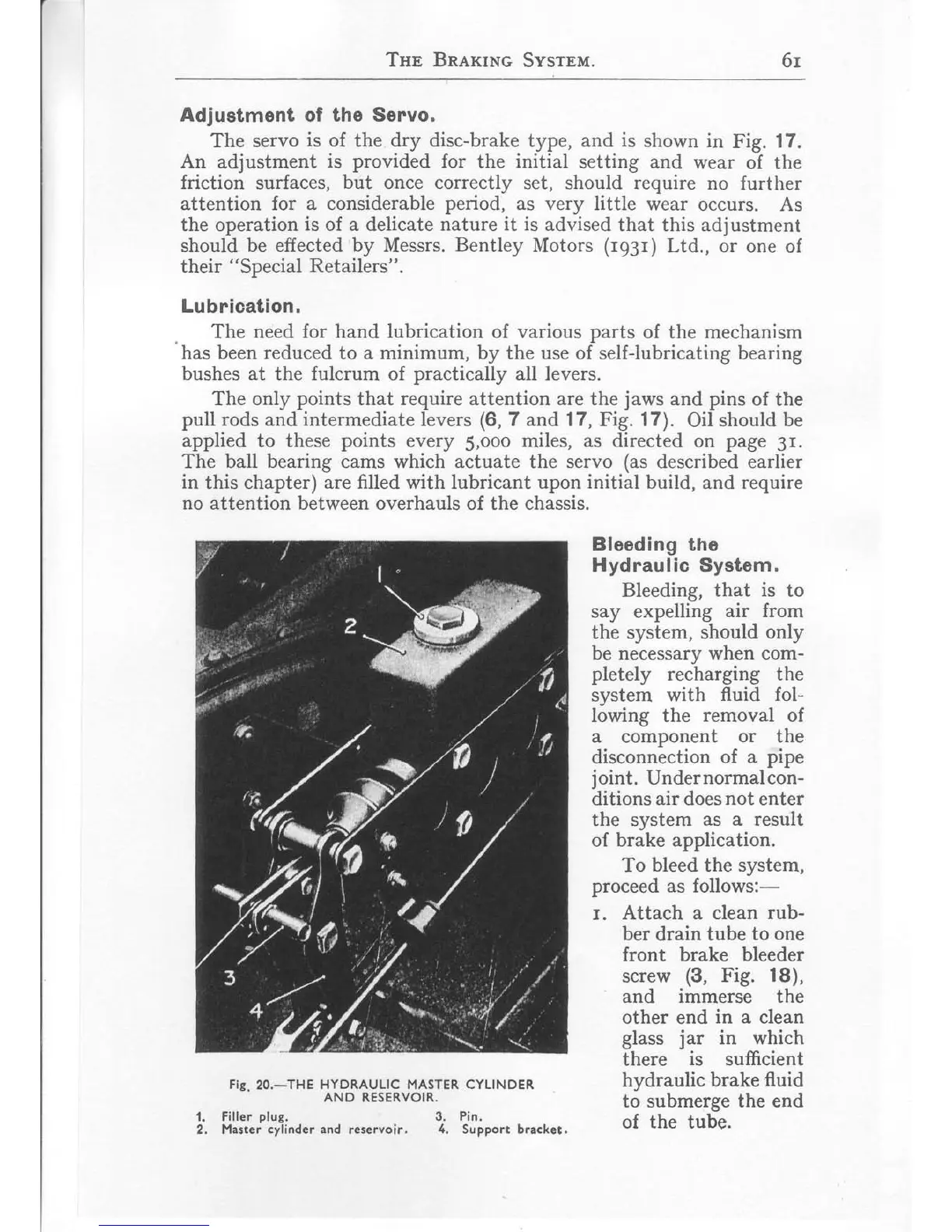
Fic.
20.-THE
HYDRAULIC
MASTER
CYLINDER
AND RESERVOIR.
Filler
plug.
3. Pin.
Master
cylinder and
reservoir.
4,
Support bracket.
Bleeding
the
Hydraulic System.
Bleeding, that
is
to
say expelling
air from
the system, should
only
be necessary when com-
pletely
recharging the
system with
fluid fol-
lowing the
removal
of
a
component
or
the
disconnection
of a
pipe
joint.
Undernormalcon-
ditions
air
does
not
enter
the system
as a result
of brake application.
To
bleed
the system,
proceed as
follows:-
r.
Attach a clean
rub-
ber
drain
tube to
one
front brake
bleeder
screw
(3,
Fig.
18),
and
immerse the
other
end
in
a clean
glass
j"t
in which
there
is sufficient
hydraulic
brake fluid
to submerge the end
of
the
tube.