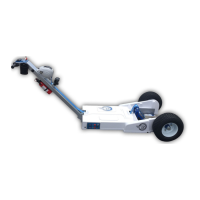
The Best Tugs Alpha A2 and A3 are innovative and advanced aircraft tugs designed to move planes efficiently and safely. These tugs are built with a focus on quality and workmanship, aiming to exceed user expectations.
Function Description:
The primary function of the Best Tugs Alpha A2 and A3 is to provide a motorized solution for moving aircraft, eliminating the need for manual pushing or pulling. They are designed to simplify hangar movements and pre-flight positioning. The tugs feature a control panel with several functions to facilitate operation:
- Power Switch: Turns the tug on and off. It's crucial not to leave the tug on for extended periods or while charging to prevent battery drain.
- LED Light: An indicator light, which should be off while the tug is charging.
- High/Low Speed (A3 only): The A3 model offers two speed settings. "High" moves the plane at a faster speed, suitable for open areas, while "Low" is recommended for safe movements around the hangar.
- Over Center Lock: A locking arm that moves in an arching motion. When locking, ensure the arm is fully rotated down and secured in place.
- Variable Speed Throttle: A thumb-operated throttle that controls the tug's movement. Right thumb pressure moves the tug forward, and left thumb pressure moves it backward. Users are advised to slowly increase pressure for smooth operation.
- Digital Read Out: Displays the tug's current state of charge, allowing users to monitor battery levels.
The tugs are designed to pivot while pulling aircraft, which eliminates the need to pick up and move the tug when turning. This feature, while making pulling easy, can make pushing feel awkward initially, as it drives like backing up a trailer (opposite of where you turn). Users can also lock the pivoting base if preferred by placing pin 3 back in the lock slot (as shown in FIG 4).
Important Technical Specifications:
- Battery: 12 Volt 18 Ah Sealed AGM Battery. Acceptable brands include Duracell, UPG, Bright Way Group, Panasonic, Interstate, and others.
- Length: 7.17 in
- Width: 3.03 in
- Height: 6.57 in
- Voltage: 12V
- Lead Acid Type: Deep Cycle
- Capacity: 18Ah
- Chemistry: Lead Acid
- Lead Acid Design: AGM
- Product Category: Sealed Lead Acid
- Product Subcategory: Deep Cycle
- Terminal Type: M6 Nut and Bolt, NB, Nut, and Bolt.
- Tire Pressure: Recommended 45 PSI for inner tube equipped tires.
- Wheel Lug Torque: 70 ft/lbs, to be tightened quarterly.
- Loaded Weight (Duty Cycle): The manual provides tables for A2 and A3 models, indicating the percentage of continuous usage based on the aircraft's loaded weight and the degree of slope. For example, an A2 with a 1,300 lb load on a 0.0-degree slope can be used 100% continuously, while the same tug with a 2,600 lb load on a 3.0-degree slope is rated at 58% continuous use. Similar tables are provided for the A3 model with loads up to 3,600 lbs. These tables are crucial for preventing motor damage due to overheating.
Usage Features:
- Uncrating: The manual provides detailed instructions for uncrating, including removing screws from the lid and end wall, cutting retaining straps, and pivoting the tug out of the crate.
- First Time Set Up:
- Familiarization: Users are strongly recommended to practice with the tug without an aircraft attached to get accustomed to the controls, throttle, maneuverability, and stop speeds.
- Connecting Arms: The right and left connecting arms feature a "Drop Pin" and "Slide" mechanism. The Slide should be spun out to be as close as possible to the center of the connecting arm, then twisted until firmly attached to the tow points, ensuring minimal "slop" in the connection.
- Loading Your Plane: Drive the tug to within one to two feet of the aircraft, turn power OFF, and manually push the tug into position. Position the tug with arms on either side, insert the right arm into the tow connection, and use the locking arm to close the left connecting arm.
- Moving Your Plane: Always check surroundings, remove obstructions, and verify wheel chocks are removed. Slow and steady movements are recommended. The right thumb moves the tug forward, and the left thumb moves it backward. Be mindful of the nose gear's turn radius.
- Unloading Your Plane: Chock the aircraft's mains, ensure the tug is in line with the plane, rotate the locking arm upwards to open the arms, and ensure connecting arms will clear the plane as the tug is pulled away.
- Switching Out Arms: Pull the detention pin, slide out the connecting arm, insert the new arm, and reinsert the pin.
- Attaching Trailer Attachment (option): Remove both connecting arms and pins, insert trailer attachment connections into the arm slots, and insert pins to secure.
- Changing Ball Size (for trailer attachment): Push down and rotate the center of the ball counter-clockwise to free it, replace with the desired size, push the center down, and rotate clockwise to lock.
Maintenance Features:
- Storage: Store the tug in a dry, safe area away from elements. While limited exposure to rain/snow doesn't affect electrical systems, extended exposure is not recommended. For extended non-use, leave the tug plugged in, as the smart charger maintains the battery. Always turn off the tug and accessories.
- Battery Care: The tug includes a smart charger with trickle charge and battery maintenance cycles. It's designed to prevent overcharging. Users should always turn off the master switch when charging. Charging is recommended when the battery falls below 70% (at rest), and definitely before 30% for optimal battery life. If the battery reads less than 10.5VDC when charging, or if the charger indicates fully charged but voltage is below 12.4VDC (sulfated battery), replacement is needed.
- Wheel Lugs: Tighten quarterly to 70 ft/lbs.
- Tire Pressure: Maintain 45 PSI for inner tube equipped tires.
- Caster Wheel: Re-grease every two years for continuous use.
Critical Cautions:
- Soft Stop: Tugs do not stop instantly; this is a protective feature for the aircraft's landing gear. Users must compensate for this "coast" to avoid damage. An E-Stop will stop the tug immediately but can damage landing gear and the motor control module.
- Chock Mains: Always chock the aircraft's mains to prevent accidental movement.
- Awareness: Never position yourself between the tug and an object, as the tug can exert thousands of pounds of pressure, posing a risk of serious injury or death.
- No Secondary Brakes: The motor/transmission provides all braking. If it fails, the aircraft can roll freely. Users are responsible for keeping the aircraft within safe limits and should not operate on slopes where loss of braking would be dangerous.
- Exceeding Parameters: Operating the tug beyond its load ratings (e.g., on steep slopes, with heavy aircraft, or rough surfaces) can cause power train failure, degrading gears and potentially leading to total failure. Under-inflated tires also increase rolling resistance, effectively increasing the load.
- Heat Buildup: DC motors heat from the inside out. Excessive heat from heavy loads, slopes, rough terrain, or long-distance movements can damage the motor and reduce lifespan. Tugs are designed for intermittent use. For long distances, slow down or pause to allow for heat dissipation.
Optional Accessories:
- LED Flood Lamp: High-intensity light for loading/unloading.
- Extinguisher: Type BC, for flammable liquid and energized electrical equipment.
- Tundra Package: Improves operation on grass fields.
- Connecting Arms: Options to connect to various airplanes.
- Trailer Attachment: For connecting to trailers.
- Under Glow: LED accent lights, functioning when the tug is on.
The Best Tugs Alpha A2 and A3 are robust tools designed for safe and efficient aircraft handling, provided users adhere to the operational guidelines and maintenance schedules.



 To Next Page
 General