
 Need help?
Do you have a question about the Best Tugs BRAVO 5 and is the answer not in the manual?
Details on using the Multifunction switch for EZ Load, Lazy Susan, and Lift functions.
Guidance on setting the control arm height and angle for optimal user comfort and safety.
Instructions for adjusting and using the EZ Load and Lazy Susan tire cages, including critical safety warnings.
Steps for installing the Quick Lock Fork and Wheel Chock, and switching between them safely.
Procedure for safely loading an aircraft onto the tug using the Lazy Susan or EZ Load system.
Procedure for safely unloading an aircraft from the tug using the Lazy Susan or EZ Load system.
Details on using JumpStart, Ground Power Unit (GPU), and JumpStart + Boost for aircraft power and starting.
Routine checks for wheel lugs, tire pressure, chains, and winch straps for optimal performance.
Specific procedures for lubricating and adjusting the Lazy Susan mechanism and its locking components.
Solutions for dead tug batteries, master switch problems, and unexpected stops during operation.
Diagnosing attachment conflicts, parking brake engagement, and other operational errors.
Essential safety guidelines covering tug stopping, surfaces, motor heat, braking, and operational parameters.
The device described in the manual is a "BEST TUGS" aircraft tug, specifically the Bravo series (models 5, 8, 12, & 18). Its primary function is to move aircraft on the ground, designed to be innovative and advanced, ensuring quality and workmanship. The tug is intended to make the process of moving planes easier and safer, with various features to accommodate different aircraft types and user preferences.
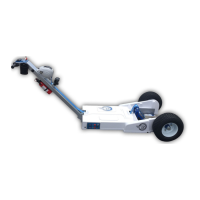
The BEST TUGS Bravo series is an electric aircraft tug designed to push and pull small to medium-sized aircraft. It features a control arm for steering and operation, a loading tray to secure the aircraft's nose wheel, and a winch system for loading the plane onto the tug. The tug is equipped with an automatic parking brake that engages when the tug stops, and a red light on the control panel indicates when the brake is set. It offers both "PUSH" and "PULL" directions for movement and has "HIGH" and "LOW" speed settings for maneuvering. The "LOW" setting is recommended for tight or restrictive areas for better control and safety, while "HIGH" is for maximum speed and long-distance movements. A key safety feature is the "soft auto stop," which protects the aircraft's nose gear from damage by gradually slowing down. However, an "Emergency Stop Switch" (E-Stop) provides an immediate stop, overriding the soft auto-stop, but its aggressive nature can damage the system and lock the parking brake. The tug also includes options for jump-starting aircraft and providing ground power.
The Bravo series includes models 5, 8, 12, and 18, with varying load capacities. The manual provides detailed load and duty cycle charts for each model, including "Standard" and "Commercial" versions, and "HD" (Heavy Duty) versions for B12 and B18. These charts specify the maximum load capacity in U.S. pounds for different grades (in degrees) and duty cycles. For example, a B5 Standard tug can handle 5,000 lbs on a 0.0-degree grade for a 100% duty cycle, while a B18 HD can handle 18,000 lbs on a 0.0-degree grade for a 100% duty cycle. The tug is powered by 12 Volt 35 AH Sealed AGM Batteries, with acceptable brands including Duracell, UPG, Bright Way Group, Panasonic, and Interstate. The battery dimensions are 7.68 inches (length), 5.12 inches (width), and 7.09 inches (height). The recommended tire pressure for inner tube equipped tires is 45 PSI, and wheel lugs should be tightened to 70 ft/lbs.
Optional accessories include:
The tug arrives fully assembled, but the control arm needs to be adjusted to the preferred height by removing the L-Handle Pin and rotating the arm. The Quick Lock Fork (QLF) or Wheel Chock Kit are used to secure the aircraft's nose wheel, but they are not to be used together. The QLF involves pushing a spring-loaded locking slide and rotating it to fit snugly against the nose gear. The Wheel Chock Kit uses a wheel chock that drops into the loading tray, secured by a pin. Loading the plane involves chocking the aircraft mains, positioning the tug with the nose wheel centered on the ramp, and using the winch to pull the plane onto the loading tray. The winch has forward/reverse positions. Unloading requires chocking the mains, releasing stress on the winch, and slowly driving the tug away. For EZ Load/Lazy Susan configurations, the cage width and diameter can be adjusted to fit the specific tire. The Lazy Susan also has a locking mechanism for rotation. The manual emphasizes familiarization with the tug's controls and movements without an aircraft attached before actual use. It also highlights the importance of checking surroundings, removing obstructions, and verifying the aircraft's turn radius.
Regular maintenance is crucial for the longevity and safe operation of the tug.

 To Next Page
 General