EasyManua.ls Logo

Bestway Voyager 500 - User Manual

Bestway Voyager 500
2 pages
Print Icon
To Next Page IconTo Next Page
Loading...
1
S-S-004206/21.0x28.5cm(#65001E / #65051E / #65008E /#92100E / #92101E / #92102E) JS-YF-2016-B-01641
S-S-004206
2
(#65001E)
1
3
(#65001E)
4
11
(#65001E)
6
7
8
9
10
5
#65001E / #65051E / #92100E / #92101E
2
4
6
5
1
9
8
10
#65008E / #92102E
MODEL: #65001E / #65051E / #65008E /
#92100E / #92101E / #92102E
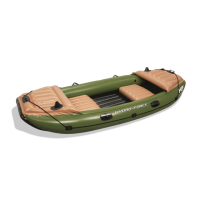
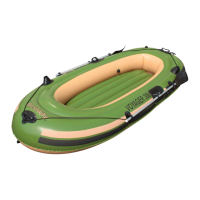
Construction of the boat
NOTE: All pictures for illustration purpose only. May not reflect
actual product. Not to scale.
WARNING
IMPORTANT SAFETY INSTRUCTIONS
Follow all the Safety and Operating Instructions. If you don’t follow this instructions, it may cause
the boat to overturn or explode and result in drowning.
1. Do not exceed the maximum recommended number of persons. Regardless of the number of
persons on board, the total weight of persons and equipment must never exceed the maximum
recommended load. Always use the seats /seating spaces provided.
2. When loading the craft, never exceed the maximum recommended load: Always load the craft
carefully and distribute loads appropriately to maintain design trim (approximately level). Avoid
placing heavy weights high up.
NOTE: The maximum recommended load includes the weight of all persons onboard, all
provisions and personal effects, any equipment not included in the light craft mass, cargo (if
any) and all consumable liquids (water, fuel, etc.).
3. When using the boat, life saving devices such as life jackets and buoys should be pre-inspected
and used at all times.
4. Before every use, carefully inspect all boat components including air-chambers, grab ropes,
oars, and air valves, to ensure everything is in good condition and tightly secured. If you find any
damage, please stop to repair it.
5. Buckets, water scoops and air pumps should always be available in case of air leakage or if the
boat takes on water.
6. When the boat is in motion, all passengers must remain seated at all times to avoid falling
overboard. Keep the boat balanced. Uneven distribution of persons or load in the boat may
cause the boat to overturn and result in drowning.
7. Use the boat near the shore and beware of natural factors such as wind, tide waters and tidal
waves.
BE AWARE OF OFFSHORE WINDS AND CURRENTS.
8. If one chamber is punctured when the boat is in the water, it may be necessary to fully inflate
the other air chamber to prevent the boat from sinking.
9. Be careful when landing on the shore. Sharp and rough objects such as rocks, cement, shells,
glass, etc. may puncture the boat. To avoid damage, do not drag the boat on rough surfaces.
10. When choosing an outboard motor, refer to the technical specifications section of this manual to
determine acceptable horsepower ratings.
11. For electrical motors equipped with batteries, note that battery acid can be caustic, which can
cause damage to both skin and boat materials.
12. For motors which use fuels such as gaso, il or petrol, since fuel is a flammable substance, it
should be kept away from open flames. Further, clean the boat material immediately if fuel
spatters onto the boat surface. Be aware of the potential harmful effects of liquids such as
battery acid, oil or petrol. The liquids may damage your boat.
13. Inflate according the numbered air chamber and rated pressure of the boat, or it will cause
over-inflation and potential boat explosion. Exceeding the data given on the capacity plate may
cause the craft to be damaged, overturn and lead to drowning.
14. If you use the tow rings to tow the boat, go slowly to avoid over-towing as damage may occur.
15. Know how to operate a boat. Check in your local area for information and/or training as needed.
Inform yourself about local regulations and dangers related to boating and/or other water
activities.
16. The operator of a vessel is responsible for the maintenance and safe conduct of the vessel and
the safety of passengers.
17. Prohibit the product misue, such as, but not limited to: (a) riding seat back, gunwale, or other
unsafe position, (b) failure to use hanhold, (c) overloading or improper loading, (d) excessive
speed for the operating conditions, (e) using a boat in weather or sea conditions beyond the skill
or experience of the operator, (f) continued operation with operator’s visibility blocked or
impaired, (g) operating under the influence of drugs or alcohol, and/or (h) modifications.
18. Boat operation where the boat operator or occupants are not under the influence of drugs
and/or alcohol.
19. Knowledge of federal, state, and/or local regulations concerning operation requirement,
including: (a) discharge of oil, (b) solid waste disposal (Marpol Treaty), (c) marine sanitation, (d)
speed, (e) noise, and (f) wake.
20. Knowledge of accident reporting requirements.
21. The owner of operator of a vessel is required by law to render assistance to any individual or
vessel in distress, as long as his vessel is not endangered in the process.
22. U.S.Coast Guard Infoline: (800)368-5647. Website: www.uscgboating.org
Components:
• Repair Patch
• Deflation Pipe
Boat
Rope
• Inflation Scale
Screw Valve x 2
Oar
Oar Blade x 2
Shaft x 2
Coupling x 2
Oar Ring x 2
#65051E;#65001E;#92100E;#92101E
mc
11 12 13 14 15
Components:
• Repair Patch
• Deflation Pipe
Boat
Rope
• Inflation Scale
Screw Valve x 2
#65008E;#92102E
mc
11 12 13 14 15
Screw ValvePrinted ScaleStorage Bag
Heavy-duty
Handle
Inflatable
Seat Cushion
Fishing
Rod-Holder
1 2 3 4 5 6
Oar Clasp Oarlock Rope Grommet Safety-grab Rope
Motor
Mount Grommet
7 8 9 10 11
Technical Specifications
Item
Inflated Size
Deflated Size
Maximum Load Capacity
Maximum Number of Persons
Maximum Motor Power
Recommended Working Pressure
2 adults
/
0.03 bar (0.435 psi)
3 adults
1.0 kw (1.4 hp)
0.0306 bar (0.444 psi)
3 adults
/
0.0299 bar (0.434 psi)
#65051E / #92100E
96 in. x 40 in. (2.43 m x 1.02 m )
100 in. x 46 in.(2.55 m x 1.17 m)
374 lbs.(170 kg)
#65001E / #92101E
137 in. x 56 in. (3.48 m x 1.41 m)
142 in. x 65 in. (3.61 m x 1.65 m)
573 lbs. (260 kg)
#65008E / #92102E
124 in. x 49 in. (3.16 m x 1.24 m)
130 in. x 51 in. (3.30 m x 1.30 m)
661 lbs. (300 kg)
Dry Weight 27.5 lbs.(12.5 kg) 11.2 lbs.(5.1 kg) 25.8 lbs.(11.7 kg)
The boats are designed and manufactured in conformity with ABYC H-28. Boat Design
Category -“SHELTERED WATERS”: Designed for voyages on sheltered coastal waters, small
bays, small lakes, rivers and canals when conditions up to, and including, wind force 4 and
significant wave heights up to, and including, 0.3 m may be experienced, with occasional waves
of 0.5 m maximum height, for example from passing vessels.
WARNING: To avoid damage to the boat and injury to passengers, please
don’t exceed the data given on the builder’s plate.
OWNER’S MANUAL
" "
- Recommended seating arrangement of the occupants.
Question and Answer IconNeed help?

Do you have a question about the Bestway Voyager 500 and is the answer not in the manual?

Summary

Construction of the Boat

Technical Specifications

Important Safety Instructions

Key Safety Precautions and Operation Guidelines

Essential instructions for safe operation, load limits, and maintenance to prevent accidents and damage.

Overview

This document serves as the owner's manual for several Bestway inflatable boat models: #65001E, #65051E, #65008E, #92100E, #92101E, and #92102E. It provides essential information regarding the assembly, operation, maintenance, and safety of these recreational vessels.

Function Description

These Bestway inflatable boats are designed for recreational use in sheltered waters, such as small bays, lakes, rivers, and canals. They are suitable for voyages where wind force does not exceed 4 and significant wave heights are generally below 0.3 meters, with occasional waves up to 0.5 meters from passing vessels. The boats are constructed with multiple air chambers to ensure buoyancy and stability. Depending on the model, they can accommodate two or three adults. Some models are also designed to be fitted with an outboard motor, enhancing their versatility for various water activities. The primary function of these boats is to provide a safe and enjoyable platform for leisure activities on calm bodies of water.

Usage Features

The manual emphasizes several key usage features and operational guidelines to ensure safety and optimal performance.

Assembly and Inflation:

The boats are designed for manual inflation using a hand air pump; high-pressure air machines should not be used as they can damage the product and void the warranty. An inflation scale is provided to guide users in achieving the correct pressure for each air chamber. It is crucial to inflate the product until the printed scale matches the supplied scale, ensuring the boat is stiff to the touch but not hard. Over-inflation or under-inflation can lead to safety hazards. The manual provides specific inflation measurements for each chamber of different models, indicating the inflated size for Chamber 1, Chamber 2, and Chamber 3, as well as the overall inflated and deflated sizes. During inflation, users are advised not to stand on or rest objects on the boat. The bottom chamber and other accessories, such as seats, should also be inflated until stiff but not hard.

Components and Accessories:

Each boat model comes with various components, including oars, oar blades, shafts, oar rings, couplings, and ropes. Some models also include heavy-duty handles, inflatable seat cushions, storage bags, printed scales, screw valves, fishing rod holders, oar clasps, oarlocks, rope grommets, safety-grab ropes, and motor mount grommets. The oars are designed for easy installation into the oarlocks and can be locked into oar clasps when not in use to prevent damage. For models like #65001E and #92101E, an outboard motor can be installed at the stern using an engine mount. Users are advised to refer to the outboard motor's manual for correct installation and operation and to use recommended Bestway motor mounts and motors.

Seating and Load Capacity:

The manual provides recommended seating arrangements for occupants, ensuring proper weight distribution. It strictly warns against exceeding the maximum recommended number of persons and the total load capacity. The total weight of persons and equipment must never exceed the maximum recommended load. Loads should be distributed appropriately to maintain design trim (approximately level), and heavy weights should not be placed high up. The maximum recommended load includes the weight of all persons onboard, provisions, personal effects, light craft mass, cargo, and consumable liquids.

Safety and Operational Guidelines:

A comprehensive list of safety instructions is provided to prevent accidents and ensure a safe boating experience.

  • Life-Saving Devices: Life jackets and buoys should be pre-inspected and used at all times.
  • Pre-Use Inspection: Before each use, all boat components, including air chambers, grab ropes, oars, and air valves, must be inspected for good condition and tightness. Any damage found should be repaired immediately.
  • Emergency Equipment: Buckets, water scoops, and air pumps should always be available for air leakage or water intake.
  • Passenger Conduct: All passengers must remain seated while the boat is in motion to avoid falling overboard. Maintaining balance is crucial, as uneven distribution of persons or load can cause the boat to overturn.
  • Environmental Awareness: Users should operate the boat near the shore and be aware of natural factors like wind, tide waters, and tidal waves. Offshore winds and currents pose significant risks.
  • Puncture Management: If one chamber is punctured in the water, fully inflating other air chambers may be necessary to prevent sinking.
  • Shore Landing: Care should be taken when landing to avoid sharp objects (rocks, cement, shells, glass) that can puncture the boat. The boat should not be dragged on rough surfaces.
  • Motor Selection: When choosing an outboard motor, users must refer to the technical specifications for acceptable horsepower ratings.
  • Chemical Awareness: Battery acid from electrical motors can be caustic and damage skin and boat materials. Fuels like gasoline or petrol are flammable and should be kept away from open flames. Spilled fuel should be cleaned immediately, as these liquids can damage the boat material.
  • Towing: If tow rings are used, towing should be done slowly to avoid damage.
  • Operator Responsibility: Operators must know how to operate a boat, be aware of local regulations and dangers, and ensure the maintenance and safe conduct of the vessel and passengers.
  • Prohibited Misuse: The manual prohibits misuse such as riding on seat backs or gunwales, failure to use handholds, overloading, excessive speed, operating in unsuitable weather, impaired visibility, operating under the influence of drugs or alcohol, and modifications.
  • Legal Compliance: Operators must be aware of federal, state, and local regulations concerning oil discharge, solid waste disposal, marine sanitation, speed, noise, and wake. They must also know accident reporting requirements and render assistance to vessels in distress if safe to do so.

Maintenance Features

Proper maintenance is crucial for the longevity and safety of the inflatable boat. The manual outlines several maintenance features and procedures.

Cleaning:

After use, the boat should be carefully cleaned with mild soap and clean water. Harsh chemicals like acetone, acid, or alkaline solutions should not be used. All surfaces should be gently dried with a cloth. The product should not be dried in direct sunlight or with electric blowers, as this can cause damage and shorten its lifespan.

Storage:

Before storage, the oars should be removed from the oarlocks, and all accessories should be kept for future use. The hull chambers should be deflated simultaneously to prevent damage to the boat's inner structures, followed by the floor. The boat can then be folded from front to back to remove any additional air; a pump can also be used to drain remaining air.

Repair:

For small punctures, users can repair the boat using the provided repair patch according to its instructions. If a hole is too large for the provided patch, users should purchase a Bestway repair kit or take the boat to a specialized repair shop.

Registration:

For boat registration, users need the Hull Identification Number (HIN) and model name. The HIN is located on the starboard outboard side of the hull, near the stern. Users can visit www.bestway-service.com to obtain a Certificate of Origin or email info_service@bestwaycorp.us. The manual should be kept in a secure place and handed over to the new owner if the craft is sold.

The manual also provides contact information for Bestway (USA) Inc. for further assistance and directs users to the U.S. Coast Guard Infoline and website for additional boating information.

Bestway Voyager 500 Specifications

General IconGeneral
TypeInflatable Boat
MaterialPVC
Capacity3 adults
Air Chambers3
IncludesOars, pump, repair kit
Beam1.3 m
Tube Diameter30 cm

Related product manuals