Need help?
Do you have a question about the Beurer BF 180 and is the answer not in the manual?
Advice on safely handling batteries, covering choking hazards, leakage, and disposal.
Important usage information including measurement tolerances, scale capacity, and unit settings.
Instructions on how to accurately take weight and body composition measurements.
Guidance on interpreting body fat, water, muscle, bone mass, and BMI readings.
Details on the scale's low battery indicator and its automatic switch-off feature.
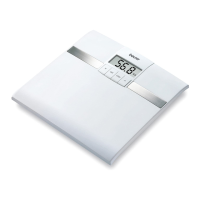
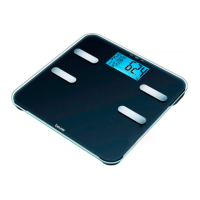
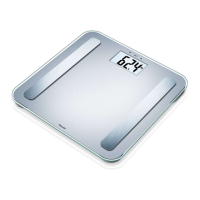
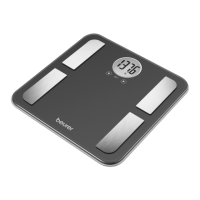
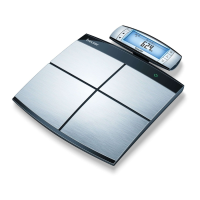
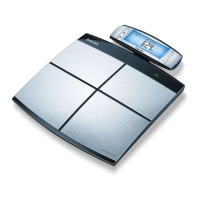
The BF 180 diagnostic bathroom scale operates on the principle of Bioelectrical Impedance Analysis (B.I.A.), a method that calculates body content in seconds using a completely harmless and imperceptible electrical current. By measuring electrical resistance (impedance) and integrating constants and individual values such as age, height, gender, and activity level, the scale determines body fat percentage and other relevant body variables. Muscle tissue and water, being good conductors, exhibit lower resistance, while bones and fat tissue, with their high resistance, conduct current poorly. It's important to note that the values provided by this scale are approximations of actual medical analytical values; precise body fat, body water, muscle percentage, and bone structure can only be determined by a specialist doctor using medical methods like computer tomography.
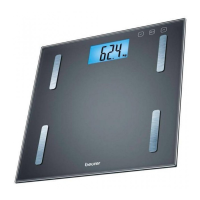
The scale is designed for weighing individuals and recording personal fitness data, intended solely for private, non-medical, and non-commercial use. It has a maximum capacity of 180 kg (396 lb / 28 st). For accurate measurements, the scale should always be placed on an even, hard surface, not on carpet.
To begin using the device, first ensure the batteries are correctly inserted. If a battery insulating strip is present, pull it off, or remove the battery's protective film and insert the battery according to polarity. If the scale doesn't function, remove and reinsert the batteries completely. The battery compartment is secured with at least one screw, requiring an appropriate tool (screwdriver) for battery changes.
The scale is initially set to weigh in "kg." To change the weight unit, briefly apply pressure to the standing surface with your foot for approximately 1-2 seconds until "0.0 kg" appears on the display. A toggle button on the rear of the scale allows you to select "pound" (lb) or "stones" (st).
For calculating body fat percentage and other body values, personal user data must be saved. The scale offers 10 user memory spaces for you and your family members to store and access personal settings. To configure these settings, place the scale on a hard surface, switch it on by briefly stepping on it until "0.0 kg" appears, then press the SET button. The first memory space will flash. Use the ▲/▼ buttons to select the desired memory space and confirm with SET.
You can then set the following user data:
Activity levels are crucial for accurate calculations, considering medium-term and long-term physical exertion:
Values can be modified by pressing ▲/▼ or holding for rapid progress, and confirmed by pressing the SET button. After all values are set and displayed, "0.0" will appear with the selected gender symbol, indicating the scale is ready for measurement. If no measurement is taken, the scale automatically switches off after a few seconds.
For taking measurements, always place the scale on an even, hard surface. For comparable results, weigh yourself at the same time of day, ideally in the morning, after using the toilet, on an empty stomach, and without clothing. Body fat calculation requires bare feet; lightly dampen soles if needed, as dry or callused feet can impair conductivity. Stand straight and still with equal weight distribution and both legs on the stainless steel electrodes. Wait a few hours after physical exertion and approximately 15 minutes after getting up for accurate body water dispersion. Remember that long-term trends are more important than short-term fluctuations, which are often due to fluid loss.
To measure weight and perform diagnostics, switch on the scale (briefly step on or press SET) until "0.0" appears. Press SET; the last selected user memory will flash. All user values will then be shown in turn until "0.0" is displayed. Step onto the scale with bare feet, ensuring feet, legs, calves, and thighs do not touch each other, as this can prevent correct measurement. The scale will immediately begin measuring your weight and display the results consecutively before switching off automatically.
The displayed data includes:
For weight-only measurements, step onto the scale wearing shoes and stand still with your weight distributed equally on both feet. The scale will immediately begin measurements.
The scale is equipped with a low battery indicator. When batteries are flat, "Lo" will appear on the display, and the scale will automatically switch off. Replace the batteries (2x 3V CR 2032) when this occurs. When replacing batteries, use batteries of the same type, make, and capacity, and ensure they are free from heavy metals. Do not use rechargeable batteries.
The device should be cleaned periodically using a damp cloth and, if necessary, a small amount of detergent. Do not use abrasive solvents or cleaning products. Never submerge the device in water or rinse it under running water, and do not clean it in a dishwasher. Ensure no liquids come into contact with the scale.
When not in use, do not place any objects on the scale. Avoid pressing buttons violently or with pointed objects. Protect the scale from high temperatures, strong electromagnetic fields (e.g., mobile phones), knocks, damp, dust, chemicals, marked temperature fluctuations, and nearby heat sources (ovens, heaters).
If the device is not to be used for a relatively long period, remove the batteries from the battery compartment.
In case of errors during measurement, the display will show an error message. Common issues and their remedies include:
Empty, completely flat batteries must be disposed of through specially designated collection boxes, recycling points, or electronics retailers, as required by law. The codes Pb (lead), Cd (cadmium), and Hg (mercury) are printed on batteries containing these harmful substances. For environmental reasons, do not dispose of the device in household waste at the end of its service life. Dispose of it at a suitable local collection or recycling point in your country, in accordance with the EC Directive – WEEE (Waste Electrical and Electronic Equipment). For questions, contact local authorities responsible for waste disposal. Dispose of packaging in an environmentally friendly manner.
 General
| Type | Electronic personal scale |
|---|---|
| Shape | Rectangle |
| Accuracy | 100 g |
| Material | Stainless steel |
| Turn-on type | Tap |
| Product color | Black |
| Memory function | - |
| Top surface type | Glass |
| Units of measurement | kg/lb, st |
| Maximum weight capacity | 180 kg |
| Number of memory records | 10 |
| Number of activity levels | 5 |
| Body Mass Index (BMI) measuring | Yes |
| Digit size | 34 mm |
| Backlight color | Blue |
| Battery type | CR2032 |
| Battery voltage | 3 V |
| Power source type | Battery |
| Number of batteries supported | 2 |
| Number of batteries included | 2 pc(s) |
| Certification | CE |
| Quantity per pack | 1 pc(s) |
 Weight and Dimensions
| Width | 300 mm |
|---|---|
| Height | 19 mm |
| Weight | 1540 g |

 To Next Page