28
pressure measurement. In this case, after the measurement, the
device will indicate any irregularities in your pulse by displaying
the
symbol in the display. This can be an indicator for ar-
rhythmia. Arrhythmia is an illness in which the heart rhythm is
abnormal because of flaws in the bioelectrical system that regu-
lates the heartbeat. The symptoms (skipped or premature heart
beats, pulse being slow or too fast) can be caused by factors
such as heart disease, age, physical disposition, excess alcohol
and tobacco, stress or lack of sleep. If the
symbol appears
on the display after the measurement, the measurement must
be repeated as the measurement accuracy may be impaired. To
assess your blood pressure, only use the results that have been
recorded without corresponding irregularities in your pulse. If
the symbol appears frequently, please consult your doctor.
Only they can establish the existence of an arrhythmia during a
checkup, using their means of diagnosis.
Risk indicator
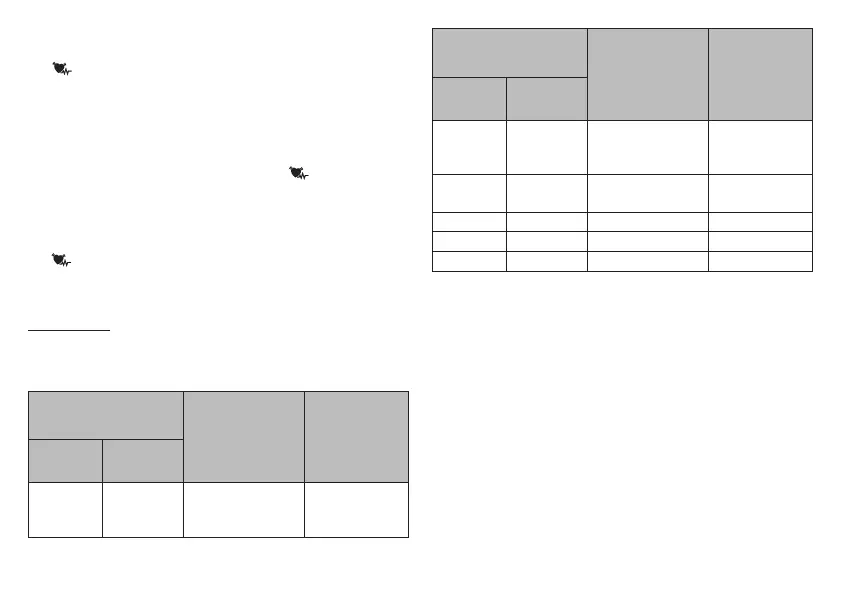
The World Health Organization (WHO) has defined the interna-
tionally recognised classification for the evaluation of measured
blood pressure values listed in the table below:
Measured blood
pressure value range
Classification
Colour of the
risk indicator
Systole
(in mmHg)
Diastole
(in mmHg)
≥ 180 ≥ 110
High blood
pressure stage 3
(severe)
Red
Measured blood
pressure value range
Classification
Colour of the
risk indicator
Systole
(in mmHg)
Diastole
(in mmHg)
160 – 179 100 – 109
High blood
pressure stage 2
(moderate)
Orange
140 – 159 90 – 99
High blood pres-
sure stage 1 (mild)
Yellow
130 – 139 85 – 89 High normal Green
120 – 129 80 – 84 Normal Green
< 120 < 80 Optimal Green
Source: WHO, 1999 (World Health Organization)
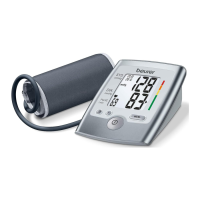
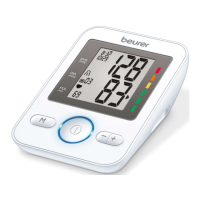
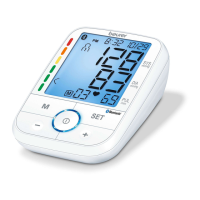
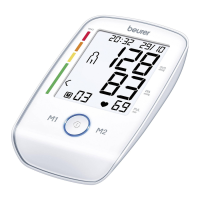
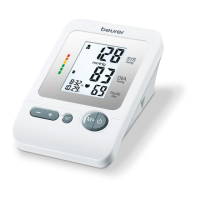
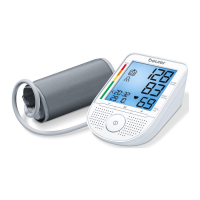
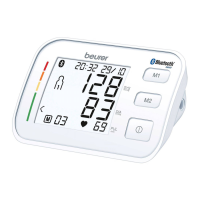
The risk indicator (the arrow in the display and the associated
scale on the device) shows which category the recorded blood
pressure falls into. If the measured values are in two dierent
classifications (e.g. systole in the high normal category and di-
astole in the normal category), the risk indicator then always
shows you the higher category – “high normal” in the example
described.
Please be aware that these standard values can only serve as
a general guideline, as the individual blood pressure varies in
dierent people and dierent age groups, etc.
Furthermore, it must be noted that measurements taken your-
self while at home are generally lower than those that are taken
by the doctor. For this reason, it is important that you regularly
consult your doctor for advice. Only they are able to give you
your personal target values for controlled blood pressure – in
particular if you receive medicinal therapy.


 To Next Page
 Loading...