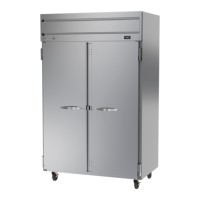
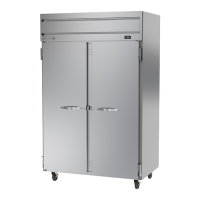
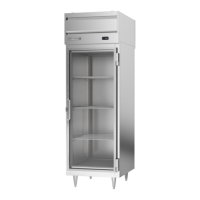
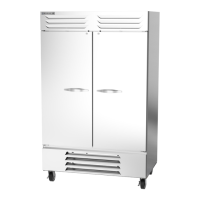
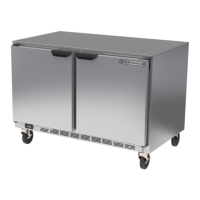
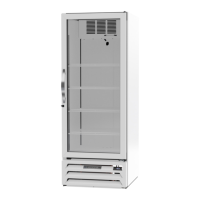
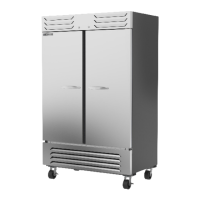
This document is an installation and operating manual for Beverage-Air HF Freezer Models, designed for commercial use in environments such as bars and restaurants. It provides comprehensive instructions for setup, operation, and maintenance, emphasizing safety and proper handling of the equipment.
Function Description
The Beverage-Air HF Freezer is a commercial refrigeration unit designed to maintain internal temperatures for freezing products. It operates based on air temperature measured by a probe at the return air, automatically adjusting to maintain a set temperature. The unit includes features for automatic defrosting and internal fan operation to ensure consistent cooling. It is intended for indoor use in a controlled environment, requiring a dedicated electrical circuit.
Important Technical Specifications
The manual lists various HF Freezer models with their respective dimensions, door configurations (half or full, glass or solid), full load amps, power cord plugs (NEMA 5-15P or 5-20P), and refrigerant type/charge (R-290/130g, with some models having two systems).
- Cabinet Dimensions (w x d x h): Range from 26 x 33 5/8 x 85 inches to 78 x 33 7/8 x 85 inches. Height includes casters.
- Temperature Settings: Shipped to maintain 0°F, with a range between 2.5°F and -2.5°F. Field adjustable down to -10°F.
- Electrical: All models are 115 volts, 60 Hz AC. Voltage tolerance is 103.5V (minimum) to 126.5V (maximum).
- Refrigerant: R-290 (Propane), a flammable refrigerant. Service must be performed by a trained trade professional certified to work on R290 systems.
- Room Air Temperature: Designed for ambient temperatures between 60°F (minimum) and 100°F (maximum).
- Clearance: Requires 12 inches at the top, 3.0 inches at the rear, and 0.0 inches at the left and right sides for proper ventilation.
- Power Cord: Equipped with either a 5-15P or 5-20P plug. Must be connected to a dedicated power supply and not to GFI/GFCI outlets.
- Warranty: Three (3) year parts and labor warranty, with an additional four (4) year compressor part-only warranty for units shipped after 03/01/2020. Exceptions apply for CT96 and SR/SF (Slate) models.
Usage Features
- Controller Display: Shows the current internal temperature.
- Temperature Adjustment: Set temperature can be adjusted, but lowering it will not speed up cooling. The display reverts to current temperature after 30 seconds.
- Manual Defrost: Activated by pushing and releasing the "melting" or defrost button. Holding the button too long will shut off the controller.
- Internal Fan: Operates when the compressor is on and doors are closed.
- Compressor and Condenser Fan: Turn on when the controller senses an increase in internal cabinet temperature past the set point.
- Cabinet Lighting: For glass door models, holding the SC button turns the cabinet light on or off.
- Door Reversal: Instructions are provided for reversing door hinges and handles.
- Shelf Installation: Detailed steps for securely installing shelves, including warnings against improper installation and overloading.
- Error Messages: The controller displays various messages (e.g., dEF for defrosting, H for too warm, dor for door open, LEA for long compressor run time, E01-E04 for sensor failures) to indicate operational status or issues.
- Standby Mode: Indicated by a blue dot on the controller. Can be exited by pushing and releasing the Defrost button.
- Set Point Adjustment: Can be adjusted using UP/DOWN buttons after pressing the SELECT (OK) button.
Maintenance Features
- Daily Exterior Cleaning: Wash with a mild detergent (non-chlorine), rinse, dry with a soft cloth, polish with a soft cloth (wiping with the grain), and wipe weekly with stainless steel cleaner.
- Weekly Interior Cleaning: Remove food and shelves, disconnect power, remove loose food particles, scrub surfaces and gaskets with warm detergent solution, rinse, air dry, return shelves, restore power, and return food.
- Quarterly Condenser Coil Cleaning: Critical for efficient operation. Requires unplugging the unit, removing the front panel, brushing and vacuuming dust and lint from the coil surface. If greasy, professional cleaning with coil cleaner is recommended. Air filters are not recommended as they restrict airflow.
- Daily Gasket Inspection: Check that hinges are tight to the cabinet.
- Routine Maintenance: Annually.
- Condensing Coils: Must be cleaned at regular intervals; failure to do so can void the warranty. A minimum monthly cleaning is recommended.
- Troubleshooting Guide: Provides a table of common malfunctions, possible causes, and likely solutions for both users and technicians.
- R290 Service Guidelines: Emphasizes that service must be performed by certified professionals. Key points include not using wire nuts, using exact replacement switches, using process tubes for service access, cutting (not un-brazing) refrigeration components, venting R290 in a well-ventilated area free from flames/sparks, attaching a service sign, and using a combustible gas leak detector. It also highlights the importance of thorough evacuation and precise charging by weight.

 Need help?
 General

 To Next Page