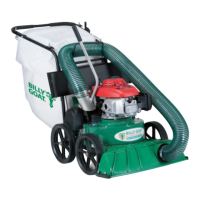
The Billy Goat MV Push EU Owner's Manual describes a multi-vac push vacuum, specifically the MV650HEU model, designed for efficient outdoor cleanup. This robust machine is primarily used for vacuuming various types of organic litter, such as leaves, grass clippings, and thatch, making it an essential tool for maintaining clean outdoor spaces. While its main purpose is organic debris, it can also handle small amounts of mixed debris like cans, bottles, and sand, though continuous use with such items may affect the machine's longevity.
The MV Push EU vacuum is designed for ease of use, featuring a push operation that allows the user to maneuver the machine across different terrains. The operator stands at the rear of the machine, grasping both handlebars firmly to steer and control the unit. This ergonomic design ensures sufficient leverage for effective steering during operation.
A key usage feature of this vacuum is its adjustable nozzle height. For optimal pickup, the nozzle height should be set as close to the debris as possible without blocking the airflow into the nozzle. The manual explicitly warns against burying the nozzle into debris. The height adjustment is controlled by turning a crank handle clockwise or counter-clockwise, allowing for precise adaptation to varying ground conditions and debris types.
Further enhancing its versatility, the vacuum nozzle also features an adjustable door. This door can be set to different positions to maximize performance under various applications. When the handle is fully back, the nozzle is fully opened, which is ideal for turf applications. For hard surface applications, the handle should be set midway. The nozzle can also be closed for use with the optional hose kit (P/N 840116), which is designed for vacuuming hard-to-reach areas. This adaptability ensures that the machine can be optimized for different cleaning tasks, from wide-open lawns to tight corners.
The starting procedure for the MV Push EU vacuum involves several steps to ensure safe and proper operation. Before starting, the operator must check the engine oil level. The throttle control needs to be in the "CHOKE" position, and the unit should be placed on a level, firm surface free of rocks or other debris. The throttle is then moved to the "RUN" position, and the unit is secured at the handle with the left hand while the pull rope starter is engaged with the right hand. After starting, the throttle control is pulled all the way back to the "STOP" position to shut down the machine.
The manual also highlights the importance of monitoring for excessive vibration during operation. If such vibration occurs, the engine must be shut off immediately, and the machine should be inspected for damaged or worn impellers, loose impeller bolts, loose impeller keys, loose engines, or lodged foreign objects. This emphasizes the machine's safety and the need for prompt attention to potential issues.
Maintenance is a crucial aspect of ensuring the longevity and optimal performance of the MV Push EU vacuum. The manual provides a detailed periodic maintenance schedule, outlining tasks to be performed daily, every 5 hours, or every 25 hours.
One of the most frequent maintenance tasks is emptying the debris bag. The manual advises frequent emptying to prevent bag overloading, which can make it difficult to lift. Debris bags are considered normal replaceable wear items, and bag liners are available for use in various conditions where debris is vacuumed. A specific warning is given not to place the bag on or near hot surfaces, such as the engine, and to ensure the engine has completely stopped before removing or emptying the bag.
For units used in dusty conditions, the manual offers several tips to maintain the machine's ability to vacuum effectively. These include running the machine at idle to quarter throttle and pressure-washing the debris bag if normal cleaning doesn't fully clean it. It's crucial to ensure the bag is thoroughly dry before reuse. Having one or more spare bags (P/N 840189) is recommended to reduce downtime while dirty bags are being cleaned. The optional Felt Bag (P/N 840194) accessory is specifically highlighted as being beneficial for dusty conditions.
Other periodic maintenance tasks include inspecting for worn or damaged parts, checking for excessive vibration, and inspecting for loose parts. The debris bag should be cleaned regularly. Lubricating the throttle control cable and linkage with white lithium grease or an equivalent lubricant is also recommended.
The manual also provides detailed instructions for impeller removal, a more involved maintenance procedure. This process requires disconnecting the spark plug wire and waiting for the engine to cool. The fuel and oil must be drained, and the engine, impeller, and mounting plate removed from the housing. Special care is advised when removing the impeller from the crankshaft, with warnings not to drop it. If the impeller is stuck, techniques involving crowbars or a longer bolt with a gear or wheel puller are described. Reinstallation requires a new impeller bolt and lock washer, with specific torque specifications for the impeller bolt. Before reconnecting the spark plug wire, the engine starting rope should be pulled slowly to ensure the impeller rotates freely.
Troubleshooting guidance is also provided, addressing common issues such as poor vacuum performance, abnormal vibration, and engine starting problems. Solutions range from cleaning the debris bag and adjusting nozzle height to checking the impeller, throttle control, spark plug wire, and air cleaner. For engine-specific problems or if the engine is locked, contacting an engine servicing dealer is recommended.
Accessories mentioned in the manual include a caster kit for maneuverability, a hose kit for hard-to-reach areas, a bag liner kit for collecting leaves, thatch, and grass, a felt bag kit for dusty conditions, and a housing liner kit to decrease housing wear. These accessories enhance the vacuum's functionality and adaptability to various cleaning needs.
Overall, the Billy Goat MV Push EU multi-vac push vacuum is presented as a versatile and user-friendly machine for outdoor cleanup, with clear instructions for operation, adjustment, and maintenance to ensure its effective and safe use.


 To Next Page
 General