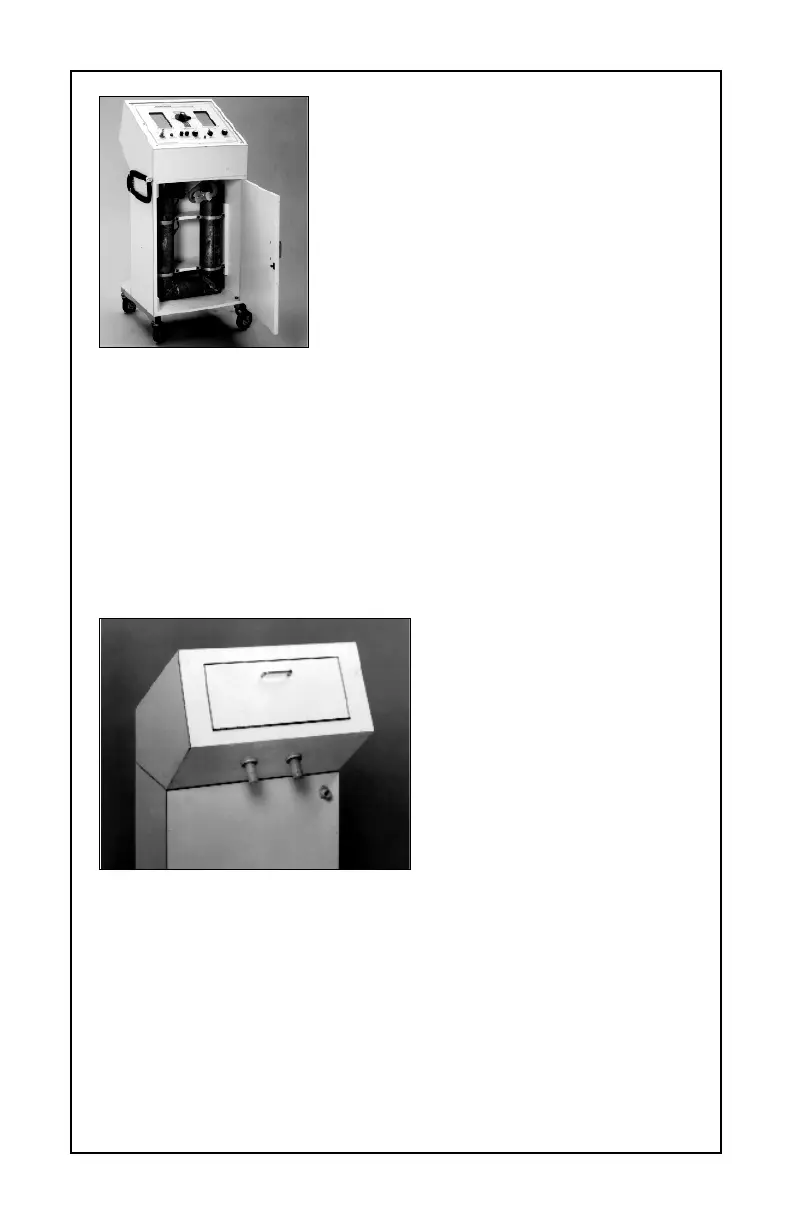
of loading the empty plastic cartridge to one-
third full with loose Drierite
(catalog #139-101). Failure to change the
Drierite regularly will significantly shorten the
life span of the charcoal trap, therefore, it is
recommended that you change it after every
study.
Replace the empty plastic cartridge, locat-
ed in the top compartment, with the white
Soda-Lime cartridge. This cartridge is pre-
filled for single-use and is included with the
Xenon Disposable Convenience Kit sample.
It serves as a carbon dioxide trap. The dis-
posable white cartridge stops the breakdown
of Soda-Lime granules that may possibly clog the 10-way valve and hinder
patient air flow. It also eliminates the alternative of loading the empty plastic
cartridge one-third full with loose Soda-Lime (catalog #130-019). Failure to
change the Soda-Lime regularly will cause the patient to hyperventilate,
therefore, it is recommended that you change it after every study.
NOTE: The flow arrow on the pre-filled Soda-Lime cartridge should point
to the right when looking into the upper cabinet through the door.
Bring the unit to the area of operation. Make sure the timer is on “0” and
plug into a nearby electrical outlet.
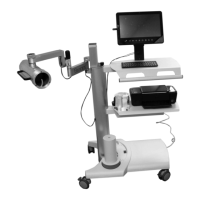
At the rear of the unit, there
are two white hose connections
positioned side by side. (See
Figure 3.) Attach the 1-1/8"
clear bore hose and Hans
Rudolph Valve assembly to the
white hose connectors so that
air flows in on the left and out
on the right. Connect bacteria
filter directly to the Hans
Rudolph Valve. Attach either a
face mask or mouthpiece.
NOTE: Keep the breathing
tubes as short as possible. For supine patients, bring the system as close
as possible to the bedside.
It is advisable to use hose clamps to tightly fasten the breathing hoses
to the hose connections. As a safety precaution you can connect a hose
from your room vent to the exhaust port located just below the overhang
on the patient side of the Pulmonex.
CAUTION: Some patients are sensitive to oxygen. Consult a physician
before using oxygen. If the physician prefers, substitute room air for oxygen.
– 5–
Figure 2
Figure 3


 To Next Page