INTRODUCTION
TEST
EQUIPMENT
In
order
to
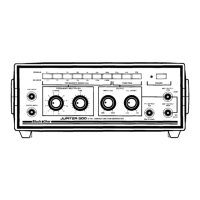
fully test and calibrate the J2000 function
generator the following test equipment
is
required .
1.
Dual beam 20MHz oscilloscope
with
x10 probes.
2. 4 ½ digit
mult
imeter
with
a resolution
of
10uV.
3.
A general purpose
co
unter/tim
er
with
both
fr
e-
quency and period functions.
4.
Distort
io
n analyser
wi
th
1 % full scale r
ange-.
DISMANTLING
THE
INSTRUMENT
WARNING!
High voltages are present inside this instrument. Dis-
connect all voltage sources before opening the case.
If
adjustments are required
wi
th
power applied
to
the
instrument
th
ese should only be carried
out
by
suitably qualified persons
who
are aware
of
the
hazards.
1. Invert the instrument and remove the metal leg
by
firmly pushing inwards
on
one side.
2.
Remove the 4 screws recessed in the feet.
3.
Carefully remove the
lower
case half
by
pulling
upwards.
4.
If
only calibration
is
required then further dismant-
ling is
not
necessary.
5.
If
component replaceme
nt
is
necessary
th
en
pro
-
ceed as follows.
6.
Remove the
two
side expansion pieces.
7. De-solder the
four
screened cables
from
the
front
panel B.N.C. connectors.
8.
Remove the ribbon
ca
ble assembly
from
the
socket on the main p.c.b., taking care
to
avoid
damage
to
the
co
nnector pins.
9.
De-solder the earth wire and the three trans-
former secondary wires from the rear
of
the main
p.c.b.
10. Remove
th
e
four
screws securing the main
p.c.b.
to
the case.
N.B.
Do
not
lose the four fibre washers
located under the screw heads.
11.
The main
p.c.b.
front
and rear panels
may
now
be
removed
from
the case.
RE
-ASSEMBLY
To re-assemble the unit
follow
the above procedure in
reverse order.
FUNCTIONAL
DESCRIPTION
Referring
to
the Block Diagram on page
10.
The summing amplifier adds the voltage
from
the Fre-
quency control
to
the voltage (if any) at the sweep
inp
ut
. The
output
from
the summing
amp
is
used to
co
ntrol the current level in the
two
cur
rent, sourc
es
I+
and I - .
The
di
ode gate under the control
of
the comparator
o
utput
steers current into and
out
of
the range
ca
pacitors. Current
from
the I + source charges the
range capacitor
when
the comparator
output
is
high
producing a positive going linear ramp.
When
the
comparator
output
is
low
the range capacitor charges
linearly in the opposite direction producing a negative
going ramp. The repetitive charging and discharging
of
the range capacitors produce a triangle wave.
The buffer amplifier
is
a
unit
gain amplifier
with
a very
high input
imp
ed
ance,
to
avoid loading the triangle
wave, and a
low
output
impedance
to
drive the com-
parator and sine converter circuits.
The
comparator
is
used
to
define the peak
to
peak
amplitude
of
the triangle _wave. The comparator thres-
holds are adjusted
to
give a triangle amplitude
of
1V p-
p. The comparator has
two
outputs, one
of
which
is
used
to
control the diode gate, the other is used
for
driv
ing the squarewave shaper and the
TTL
circuit.
The capacitance multiplier increases the effective
ca
p-
acitance
of
the 10Hz range capacitor
by
a factor
of
10
to
provide the 1
Hz
frequency range.
The sine shaper utilises ·the logarithmic relationship
between Vbe and collector current
of
transistors
to
co
nvert the triangle wave
from
the
buffer
amplifier
to
a i,inewave.
The three waveforms are fed via the
funct
ion selector
sw
itch
to
the amplitude control and then
to
the
output
amp
lifier. The
output
amplifier adds the
d.c.
offset
vo
ltage
to
the
output
signal and amplifies the result
to
20V p-p
to
drive the 50!2 and 600!2 attenuators. The
two
output
attenuators provide attenuation
of
Oqb,
- 20db and - 40c!B.
The
power supply circuitry provides the ± 15V,
± 10V, + 5Vaux and + 5Vttl supplies.
3


 To Next Page
 Loading...