Need help?
Do you have a question about the Black Trail and is the answer not in the manual?
Important safety precautions to follow when handling and using the electric bike battery.
Safety measures and guidelines for using the electric bike charger correctly.
Steps to diagnose and resolve issues when the bike's motor does not provide assistance.
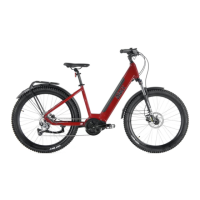
This manual describes the "Black Electric Bike," available in "Trail" and "City" models, providing comprehensive instructions for its operation, maintenance, and troubleshooting. The document emphasizes safety, proper usage, and regular care to ensure optimal performance and longevity of the electric bicycle.
The Black Electric Bike is designed to provide pedal-assisted cycling, enhancing the rider's effort with an electric motor. Both the Trail and City models feature a battery, a motor (rear hub motor), a display for controlling assistance levels and monitoring battery charge, and standard bicycle components such as handlebars, saddle, pedals, brakes, and a derailleur. The electric assistance makes cycling easier, especially on inclines or over longer distances. The bike is equipped with a display that allows the rider to turn the bike on/off, adjust the level of motor assistance, and monitor the battery charge. It also includes a "Walk Mode" for easy pushing of the bike at a slow, even speed.
Before each ride, users are instructed to perform several checks, including tire pressure, brake functionality, battery charge, and the tightness of the handlebar, seat post, and wheel hub nuts. The manual provides specific tire pressure ranges for both the City and Trail models.
The bike's display is central to its operation. To turn the bike on or off, the "M" button must be held for 2 seconds. The display automatically turns off after 10 minutes of inactivity to conserve battery. Assistance levels can be increased or decreased using the Plus (+) and Minus (-) buttons, offering 5 levels of power assistance. Riders are advised to start slowly and gradually increase speed, ensuring it's appropriate for the riding conditions.
The "Walk Mode" is a convenient feature for pushing the bike. By pressing and holding the Minus (-) button for 2-3 seconds, the bike will maintain an even speed of 6km/h. This mode is specifically for pushing the bike and should not be used while riding. The display indicates "P" when in Walk Mode.
The battery charge indicator on the display shows five segments when fully charged. The last segment flashes to warn of low voltage and imminent power loss, prompting immediate charging to prolong battery life. Error codes are indicated by flashing headlight and low voltage lights, signifying an electrical malfunction that requires dealer inspection.
Adjustments for rider comfort and safety are detailed. The handlebar position can be adjusted by loosening and tightening screws on the stem, ensuring it is perpendicular to the front wheel. The saddle position can be adjusted for height, inclination, and fore-aft position. Saddle height is correct when the rider's leg is not fully extended at the bottom of the pedal stroke and they can touch the ground with their toe. The quick-release lever for saddle height adjustment must be closed with noticeable back pressure and the seat post inserted at least to the safety mark.
The front wheel's quick-release skewer mechanism is explained, detailing how to open and close it, and adjust the clamping force for secure wheel mounting.
Derailleur adjustment is covered, with a strong recommendation to seek professional service if unfamiliar with the process to avoid damage. Instructions include adjusting the lower and upper adjustment screws to align the guide pulley with the smallest and largest sprockets, respectively, and then fine-tuning cable tension for smooth gear operation.
Regular maintenance is crucial for the Black Electric Bike. The manual outlines several key areas for inspection and care, recommending checks every 1-2 months. These include verifying the correct torque of handlebar, stem, saddle, pedal, crank, and freewheel mounting bolts. The seat post's correct insertion and tightness, wheel hub nut tightness, and the condition of wheel rims and spokes should also be checked. Tires need to be inspected for wear, cuts, and correct inflation. Brake operation, cable greasing, and brake pad condition are also part of the routine checks. Frame welds should be inspected for corrosion or oxidation. Users are explicitly warned not to open the motor casing if a malfunction occurs, but to contact their dealer.
Brake maintenance involves ensuring rotors are true and clean, free from grease or oil, which can cause squealing and reduced braking grip. If squealing persists after cleaning, checking bolt tightness, and adjusting cable tension, professional service is recommended.
Battery charging instructions are provided, allowing for direct charging through a port on the bike or by removing the battery. When removing the battery, the rear wheel may need to be lifted or the bike turned upside down. After charging, the battery must be securely locked back into the frame.
Battery and charger maintenance guidelines are extensive. Only the supplied charger should be used, and charging from an outlet with a surge protector is recommended. Initial charges should be at least 12 hours, followed by two more 12-hour charges. For extended storage, the battery should be kept at around 50% charge in a dry, well-ventilated area and recharged for 2-3 hours every two months to prevent complete discharge. Batteries prefer frequent charging, ideally staying between 20-80% charged. The bike and charger should be kept clean, dry, and away from extreme temperatures, corrosive substances, and direct sunlight. The charger must always be disconnected when not charging.
Battery precautions include never short-circuiting or discharging it, keeping it away from fire and excessive heat, and protecting it from physical shock, vibration, impact, water, and moisture. The battery should never be disassembled, and any signs of damage warrant immediate return to the dealer.
Charger precautions advise keeping the charger at least 1m away from electronic appliances, using only the supplied charger, connecting it to the battery and wall socket before switching on, and disconnecting from the wall first after charging. The charger should be kept out of reach of children, never disassembled, and used in a well-ventilated area without anything placed on it. The battery output should not be disconnected while charging. The bike should not be switched on while charging, and the battery should never be left on charge unattended.
Regular cleaning is encouraged as a way to notice problems early. Painted and plastic parts can be cleaned with a soft, damp cloth and neutral solution, then dried. Electrical components should not be cleaned with water or pressure washers. Greasy cloths should not be used on electrical connectors, brake pads, wheels, tires, or plastic parts. The bike should always be dried after riding in rain.
Lubrication is a key aspect of maintenance, with specific recommendations for different components and frequencies. Front fork attachment, front and back axles, middle axle, and pedal axle should be lightly coated with lithium base grease once a year. The chain requires light oil every two weeks. The interior of the freewheel and brake handle need light oil once a month. The manual notes that lubrication frequency depends on usage conditions (kms ridden, dry/wet/dusty environment) and storage, advising consultation with a dealer for specific advice and service intervals. The axles, bottom bracket, freewheel, and headset should not be hosed with water but gently cleaned. Specific transmission lubricant should be used for the chain, freewheel, and gears monthly. Brake pads, wheel rims, tires, or plastic parts should not be lubricated. A general anti-corrosion lubricant can be applied to other steel parts. Environmentally friendly cleaners and lubricants are recommended where possible.
 General
| Motor | 500W |
|---|---|
| Max Load | 120 kg |
| Foldable | Yes |
| Category | Scooter |
| Top Speed | 25 km/h |
| Brakes | Disc |
| Tires | 10 inch |

 To Next Page