Need help?
Do you have a question about the Blaze BLZ-42-VHOOD and is the answer not in the manual?
California warning about chemical exposure from the product.
Key measurements for hood installation clearances.
Explains fan speed and light control functions.
Guidelines for proper hood mounting height and venting.
Lists the essential tools required for installation.
Details the components provided with the range hood.
Illustrates vertical roof and direct wall venting configurations.
Steps for securing the hood to different wall types.
Guides on installing grease trays and baffle filters.
Detailed steps for rotating the motor for horizontal venting.
Instructions for maintaining stainless steel surfaces.
Guidance on cleaning baffle filters, including dishwasher use.
Schematic illustrating the electrical connections of the hood.
Addresses problems like no power, lights not working, vibration, and weak airflow.
Details coverage for manufacturing defects and exclusions.
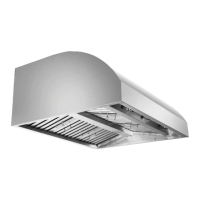
This document outlines the features, installation, and maintenance of a Blaze Outdoor Products range hood, specifically model BLZ-42-VHOOD. This range hood is designed to provide ventilation for outdoor cooking areas, effectively removing smoke, grease, and odors to maintain a comfortable and clean environment.
The Blaze outdoor range hood serves as a crucial component in an outdoor kitchen setup, designed to extract cooking byproducts from the air. It features a powerful ventilation system with two motors, each offering four-speed settings, allowing users to adjust the fan speed according to their cooking needs. The hood also incorporates lighting to illuminate the cooking surface, enhancing visibility during use. Its primary function is to ensure efficient air circulation and purification, making outdoor grilling and cooking more enjoyable and safer by preventing the accumulation of smoke and grease.
The range hood is equipped with a user-friendly control panel that allows for easy operation of its various functions. The main switch controls the overall power to the motors and lights. For ventilation, there are separate controls for the left and right fans. Each fan knob can be turned clockwise to increase the speed from the lowest to the highest setting, and counter-clockwise to decrease speed and eventually turn off the motor. This independent control allows for precise management of airflow, catering to different cooking intensities. The lighting system is also controlled by a dedicated knob; turning it clockwise once activates the lights, and turning it again or counter-clockwise will turn them off.
The hood's design emphasizes user convenience and safety. It is crucial to operate the blower(s) whenever the appliance is in use to prevent overheating and component failure. The minimum vertical distance between the cooking surface and the exterior part of the hood must be no less than 36 inches, though this distance may vary depending on the specific range or cooktop being used. This ensures optimal performance and safety, preventing heat damage and fire hazards. The hood is designed to vent hazardous or explosive materials or vapors, but users are explicitly warned against using it for such purposes.
For optimal performance, the manual recommends specific installation practices. It suggests venting through a sidewall if direct overhead venting is not possible and using completely straight runs of pipe with as few 90-degree elbows as possible. Each elbow in the ducting reduces airflow and the hood's performance. A minimum of 24 inches of straight vent between any elbows is recommended. All joints in the vent system should be sealed with silver or duct tape, and exterior openings around the cap should be sealed with caulking. Only metal or aluminum ducts should be used for maximum airflow, and the duct should always be kept clean. The hood comes with two vent outlets, each designed to accept an 8-inch pipe. It is advised to maintain these dual exhaust paths rather than combining them into a single pipe, as combining can create competition between the motors, leading to poor performance.
The hood is powered by a 110V GFI protected outlet, wired to a 10 AMP breaker, and comes with a 3-foot cord for connection. Prior to installation, users are instructed to plug in and test the controls (lights, fan) to ensure everything is functioning correctly.
Maintaining the Blaze outdoor range hood involves regular cleaning and occasional inspection to ensure its longevity and optimal performance. The hood is constructed with stainless steel baffle filters and grease trays, which are designed for easy removal and cleaning.
For cleaning the exterior surfaces, regular care is recommended to preserve the appearance of the stainless steel. Users should always wipe stainless steel surfaces with the grain to avoid scratches. Periodic cleaning with hot soapy water and a clean cotton cloth is advised. For heavier soil, a liquid degreaser such as 409™ or Fantastic™ can be used. If the hood appears splotchy, a stainless steel cleaner can be applied and promptly removed with a soft towel or wipe. After cleaning, a non-abrasive stainless steel polish (like 3M™ or ZEP™) can be used to buff out the stainless luster, always scrubbing lightly and with a clean cotton cloth.
It is crucial to avoid using corrosive or abrasive detergents, steel wool, or scouring pads, as these can scratch and damage the stainless steel surface. Cleaning solutions should not leak onto or into the control panel, and deposits should not be allowed to accumulate on the hood. Salt solutions, disinfectants, bleaches, or cleaning compounds should not remain in contact with the stainless steel for extended periods.
The stainless steel baffle filters and grease trays are key components for grease collection. They should be inspected periodically for grease accumulation. Both the baffle filters and grease channels are dishwasher safe, making cleaning convenient. Alternatively, they can be washed in a sink with hot, soapy water. Thorough drying is essential before re-installing them. The manual provides a visual guide for removing the filters: slide the filter forward off the rear lip, lower the filter rear, then slide the filter front out. This process should be repeated for all filters on the front and back of the hood.
The motor rotation instructions are provided for situations where the venting configuration needs to be changed from vertical to horizontal discharge. This involves a multi-step process:
Regular cleaning of the ventilating fans is also important, as grease should not be allowed to accumulate on the fan or filter. This ensures efficient operation and reduces fire risk. In case of any issues, the troubleshooting section provides guidance for common problems such as the hood not working, lights not turning on, hood vibrating, or the blower system seeming weak. These solutions often involve checking power connections, wiring, ducting, and fan settings.
 General
| Brand | Blaze |
|---|---|
| Model | BLZ-42-VHOOD |
| Type | Wall Mount |
| Width | 42 inches |
| Material | Stainless Steel |
| Ventilation Type | Ducted |
| Lighting | LED |
| Noise Level | 65 dB |

 To Next Page