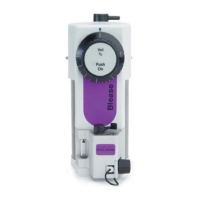
8500 Ventilator
Training Manual
Future Improvements
In the 8500s ventilator there is a monitor that measures the fresh gas flow of the anaes-
thetic machine. The 10 LPM gas flow from the Flow valves in 1 above is an arbitrary fig-
ure that has been arrived at empirically. This flow can be reduced substantially at low fresh
gas flow rates. It only requires high drive gas flows with high fresh gas flows to maintain
PEEP. This could obviously save gas which would be helpful when using cylinders for sup-
ply.
Volume Control ventilation (CMV)
Volume Control ventilation is a mechanical mode that delivers a tidal volume set by the
user into the patient tubing. This delivered volume is to be independent of the compression
losses in the absorber, bellows and associated tubing. It will also be independent of any
small leaks that may be present. Fresh gas flowing into the breathing system will not
cause a permanent change in the delivered volume. If a change in fresh gas flow rate oc-
curs during ventilation the ventilator will re-adjust the delivered tidal volume to be correct
within the next 4 breaths.
8500s Ventilator Fresh Gas and Compliance Compensation
Fresh Gas
Fresh gas flow adds to the delivered Tidal Volume during the inspiratory period. To com-
pensate for this, a reduction in the delivered volume needs to be made. This reduction is :-
FG Flow rate ml / M x Insp Time (sec)
60
Take FG = 5 LPM TV 600 ml 10 BPM I:E 1:2.0
5000 x 2 seconds = 166 ml
60
New Effective TV is now 600 - 166 = 434 ml
Compliance
The effect of the gas being compressed in the dead space within the breathing system is to
reduce the Volume (TV) that is delivered to the patient. In an ideal ventilator the Set TV
would the volume of gas that is delivered to the patients lungs. This can only be partly
achieved because the anatomy of the patient is unknown, what can be done is the set TV
can be made to be accurately delivered from the catheter mount. Thus reducing set TV er-
rors to a minimum.



 To Next Page