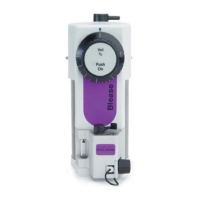
8500 Ventilator
Training Manual
To calculate the effect of Breathing System compliance on the delivered TV it is necessary
to measure what the capacity or compliance of the system is (C
s
). This can only be done
by some form of pre-use check procedure. In essence it is necessary to have the ability to
first of all select “Compliance Compensation” from a menu. It is then necessary to lead the
user through the process of measuring the dead space within the particular breathing sys-
tem for that period of use. It is obvious that should the system be re-configured the test
will need to be repeated.
A possible process is to allow the ventilator to prompt the user to :-
1. Reduce the FG flow to minimum (but Allow for it as above)
2. Occlude the catheter mount. This can be a 15 mm male taper on the gas machine.
3. The ventilator then delivers a breath to pressurize the system to 10 cmH
2
O.
4. The ventilator records the volume required to achieve this pressure and verifies that
a leak is not present.
The dead space is now calculated as follows :-
Volume in ml = Dead space compliance C
s
Pressure
This figure is stored until the ventilator is switched off or a re-test is asked for by the user.
The ventilator is then set to use on a patient and when the ventilation is stable measure
the total compliance of system and patient C
t
. An adjustment can the be made to the TV
that will be increased to compensate for the lost volume due to compression within the
breathing system. :-
Increase in TV = Set TV x 1 + C
s
= new TV
C
t
- C
s
eg.
System test Measurement using 200 ml gave 25 cmH
2
O pressure rise.
80 ml = C
s
= 8
10 cmH
2
O
Running the ventilator on a patient with a set 500 ml TV gave 20 cmH
2
O peak pressure .
500 ml = C
t
= 25
20 cmH
2
O
So to calculate the TV increase :-
500 x 1 + 8 = 735 ml
25 - 8



 To Next Page