
 Need help?
Do you have a question about the Blichmann Engineering HERMS and is the answer not in the manual?
Explains the meaning of Warning, Caution, and Important labels for user safety and product performance.
Details on using the HERMS coil in the HLT to improve heat transfer and reduce strike water temperature differences.
Covers limited warranty, limitations of warranty, liability, and local law provisions for the product.
The Blichmann Engineering HERMS Coil is a brewing accessory designed to enhance the efficiency and control of the mashing process in homebrewing. Its primary function is to maintain a constant mash temperature by recirculating wort through a heated hot liquor tank (HLT). This method, known as a Heat Exchanger Recirculating Mash System (HERMS), allows brewers to achieve precise temperature control, which is crucial for enzyme activity during mashing and ultimately impacts the fermentability and flavor profile of the beer.
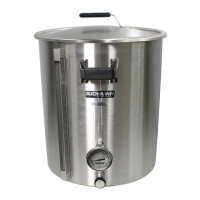
The HERMS Coil is installed within a brewing kettle, typically a BoilerMaker™ kettle, and is designed for integration into a larger HERMS setup. The manual provides detailed instructions for preparing the kettle for installation, including marking and drilling holes. This process involves precise measurements to ensure optimal placement of the coil, taking into account other kettle accessories like the BoilCoil™. Brewers are guided to use an automatic center punch to indent the drill locations, followed by a 3/16" drill bit for pilot holes and then a step drill or knockout punch to enlarge the holes to 13/16". Safety precautions for using hand and power tools are emphasized during this step. Once the holes are prepared, the HERMS Coil is installed using an adjustable wrench, with a clear warning against overtightening to prevent damage. Two 1/2" QuickConnect™ Elbows are included for connecting the coil to the recirculation system.
In terms of usage, the HERMS Coil operates by continuously circulating wort from the mash tun through the coil, which is submerged in the heated HLT. As the wort passes through the coil, it absorbs heat from the HLT, returning to the mash tun at the desired temperature. This recirculation ensures uniform temperature distribution throughout the mash bed, preventing hot or cold spots that can lead to inconsistent enzyme activity. A key feature highlighted in the manual is the recommendation to use a whirlpool in the HLT. This technique significantly improves heat transfer to the HERMS Coil, leading to faster strike temperature achievement and reduced HLT-Mash Tun temperature differentials. The manual includes comprehensive charts detailing HERMS heating times for various kettle sizes (7.5 to 55 gallons) and HLT volumes, both with and without the use of a whirlpool. These charts provide valuable data on the time required to reach and maintain target strike temperatures, allowing brewers to plan their brewing day more effectively. Additionally, flow rate and pressure drop data for both "Large HERMS" and "Small HERMS" coils are provided, which can help brewers select appropriate pumps and understand system performance. The ability to maintain a constant temperature throughout the mash is a significant advantage, as it allows for multi-step mashes and precise control over saccharification, leading to more consistent and repeatable brewing results.
Maintenance of the HERMS Coil focuses on cleaning to ensure hygiene and prevent off-flavors in subsequent brews. The recommended cleaning procedure involves several steps. First, any liquid remaining in the coil should be drained, followed by a thorough rinse with water. Next, a Powdered Brewery Wash (PBW) solution is circulated through the coil to break down any organic residues and sanitize the internal surfaces. After circulating the PBW, the coil is rinsed again with water, and then the water is drained, allowing the coil to air dry. For the exterior of the coil, PBW and a brush are used to clean any external grime or buildup, followed by a final rinse and drying. This systematic cleaning process is crucial for preventing bacterial growth and maintaining the longevity and performance of the HERMS Coil. The manual underscores the importance of proper cleaning and maintenance as part of the overall brewing process, contributing to the production of high-quality beer. The design of the coil, being made of stainless steel, inherently supports easy cleaning and sanitation, which is a critical aspect for any brewing equipment.
 General
| Category | Home Brewing Equipment |
|---|---|
| Material | Stainless Steel |
| Coil Diameter | 0.5 in |
| Connections | 1/2 in NPT |
| Compatibility | Standard homebrewing kettles and systems |
| Type | Heat Exchanger Recirculating Mash System (HERMS) |

 To Next Page