507787B02Issue 2336Page 18 of 22
Checkout Procedures
NOTE: Refer to outdoor unit installation instructions for
system start-up instructions and refrigerant charging
instructions.
Pre-Start-Up Checks
• Is the air handler properly and securely installed?
• If horizontally congured, is the unit sloped up to 5/8
inch toward drain lines?
• Will the unit be accessible for servicing?
• Has an auxiliary pan been provided under the unit
with separate drain for units installed above a nished
ceiling or in any installation where condensate overow
could cause damage?
• Have ALL unused drain pan ports been properly
plugged?
• Has the condensate line been properly sized, run,
trapped, pitched, and tested?
• Is the duct system correctly sized, run, sealed, and
insulated?
• Have all cabinet openings and wiring been sealed?
• Is the indoor coil factory-installed TXV or RFC properly
sized for the outdoor unit being used?
• Have all unused parts and packaging been disposed
of?
• Is the lter clean, in place, and of adequate size?
• Is the wiring neat, correct, and in accordance with the
wiring diagram?
• Is the unit properly grounded and protected (fused)?
• Is the thermostat correctly wired and in a good
location?
• Are all access panels in place and secure?
Check Blower Operation
1. Set thermostat to FAN ON. The indoor blower should
come on.
Check Cooling Operation
1. Set thermostat to force a call for cooling (approximately
5ºF lower than the indoor ambient temperature).
2. The outdoor unit should come on immediately and the
indoor blower should start between 30 - 60 seconds
later.
3. Check the air ow from a register to conrm that the
system is moving cooled air.
4. Set the thermostat 5ºF higher than the indoor
temperature. The indoor blower and outdoor unit
should cycle o.
Check Electric Heat (If Used)
1. Set thermostat to call for auxiliary heat (approximately
5°F above ambient temperature). The indoor blower
and auxiliary heat should come on together. Allow a
minimum of 3 minutes for all sequencers to cycle on.
2. Set the thermostat so that it does not call for heat.
Allow up to 5 minutes for all sequencers to cycle o.
Operation
Time Delay Relay
NOTE: There is no time delay relay on -048 and -060 units.
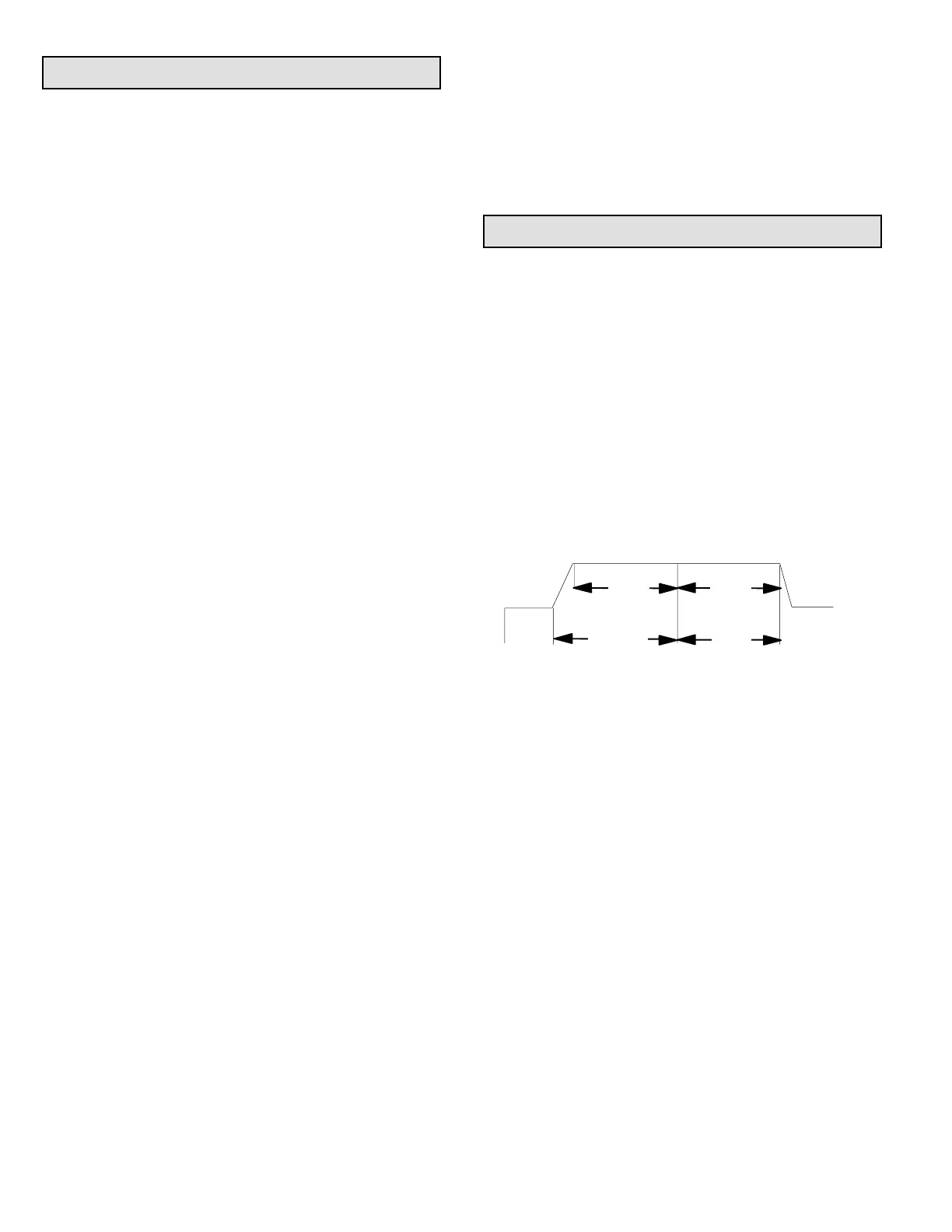
Blower time delay operation:
1. When cooling demand is initiated, there is a 1 second
motor-on delay.
2. After the motor-on delay expires, motor ramps up
to 100% and runs at 100% until cooling demand is
satised.
3. Once demand is met, motor runs at 100% for 45
seconds.
4. Motor ramps down to stop.
1
SECOND
DELAY
OFF
100%
CFM
100%
CFM
45
COOLING
DEMAND
1
2
Figure 19. Blower Time Delay
Cooling (Cooling Only or Heat Pump)
When the thermostat calls for cooling, 24 volts is put on
the blower time-delay relay coil and then the indoor blower
relay energizes. The normally open contacts close, causing
the indoor blower motor to operate. The circuit between R
and Y is completed, closing the circuit to the contactor in
the outdoor unit, starting the compressor and outdoor fan
motor.
On heat pumps, circuit R and O energizes the reversing
valve, switching the valve to the cooling position. (The
reversing valve remains energized as long as the
thermostat selector switch is in the COOL position.)
At the completion of the cooling demand the indoor blower
and outdoor unit should cycle o. Air handler should cycle
o 45 seconds after the outdoor unit shuts o.


 To Next Page