
 Need help?
Do you have a question about the BMS Cavalier 150 and is the answer not in the manual?
Emphasizes the manual as a permanent part of the vehicle and the need for operator training.
Outlines the 90-day warranty, its terms, and conditions that void it.
Explains WARNING, CAUTION, and NOTE symbols and their meanings.
Stresses the importance of wearing protective gear and being visible to others.
Advises riding within personal limits and considering road conditions.
Highlights the importance of pre-ride inspections and timely maintenance for safety.
Explains the impact of passenger and cargo weight on handling and safety.
Encourages familiarization with the manual for a better riding experience.
Notes that 'NOTICE' information helps avoid damage to scooter, body, property, and environment.
Provides essential safety advice for operating a scooter, including visibility and protective gear.
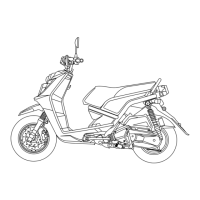
Identifies and illustrates the main parts of the scooter.
Explains the functions of the main switch and how to use the steering lock.
Details the operation of dimmer, turning light, horn, and starter switches.
Describes how to open/close the fuel tank cap and operate the seat lock.
Instructs on how to use the front and rear brake levers.
Describes the location and capacity of the rear storage compartment.
Explains the function of the side stand kill switch for engine operation.
Lists essential checks to perform before operating the scooter.
Details checks for brake fluid, free play, and system integrity.
Covers inspection of throttle grip operation and engine oil level.
Outlines procedures for checking tire pressure, wear, and sidewall condition.
Covers inspection of chassis fittings, lights, signals, switches, and fuel level.
Provides step-by-step instructions for starting the scooter's engine.
Guides the user on how to safely begin riding after starting the engine.
Explains how to control speed using the throttle grip.
Details the correct procedure for parking and shutting down the engine.
Advises on proper engine break-in procedures for the first 1,000 miles.
Presents a chart outlining periodic maintenance tasks based on riding distance.
Details how to check and replace engine oil, including recommended intervals.
Explains the procedure and intervals for replacing gear oil.
Provides instructions on cleaning the air filter, especially for dusty/wet conditions.
Covers inspecting the spark plug for condition and adjusting its gap.
Details how to check brake fluid level and related precautions.
Explains how to adjust the free play in the brake levers.
Covers inspecting and lubricating control cables.
Details lubrication for center and side stand pivoting joints.
Outlines visual and operational checks for the front fork.
Covers inspection of steering for looseness or wear in bearings.
Explains how to replace a blown fuse and the importance of correct amperage.
Provides guidance on battery care, charging, and cleaning its terminals.
Presents the scooter's electrical wiring diagram.
Lists key technical specifications for the scooter, including dimensions and weight.
Details engine displacement, power, torque, and speed ratings.
Specifies fuel capacity, oil types, and battery/fuse ratings.
 General
| Cooling | Air-cooled |
|---|---|
| Fuel System | Carburetor |
| Transmission | 5-speed manual |
| Starting System | Electric and kick start |
| Front Suspension | Telescopic forks |
| Rear Suspension | Dual shock absorbers |
| Front Brake | Disc |
| Rear Brake | Drum |
| Wheelbase | 1320 mm |
| Ground Clearance | 160 mm |
| Seat Height | 800 mm |
| Engine | single-cylinder, 4-stroke |
| Maximum Power | 12.5 hp |
| Maximum Torque | 11.5 Nm |

 To Next Page