ing two jump leads. Only use jump leads with
fully insulated terminal clamps.
Vehicles with hybrid drive cannot provide starting
aid.
Safety notes
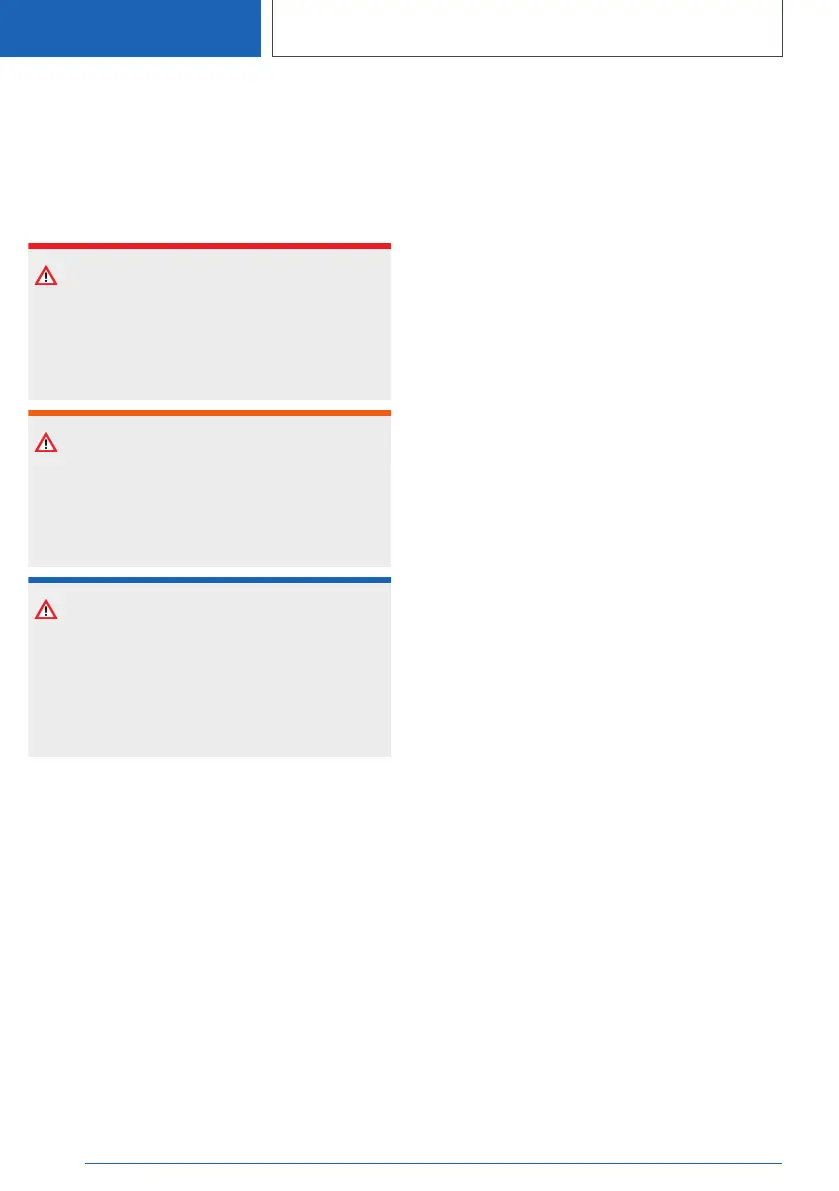
DANGER
Touching live components can result in an
electric shock. There is a risk of injury or even
death. Do not touch any components that
could be live.
WARNING
Connecting the jump leads in the wrong se‐
quence can cause sparks. There is a risk of in‐
jury. Please comply with the correct sequence
when connecting.
NOTE
Contact between the bodywork of the two ve‐
hicles can result in a short circuit during starting
aid. There is a risk of material damage. Make
sure there is no contact between the body‐
work.
Preparations
1.
Check whether the battery in the other vehi‐
cle shows 12 volts. Information about the
voltage is provided on the battery.
2. Switch off the engine of the other vehicle.
3. Switch off any power consumers in both ve‐
hicles.
Jump-starting connections
The jump-starting connection in the engine
compartment serves as the positive battery ter‐
minal.
A special connection on the body serves as the
negative battery terminal in the engine compart‐
ment.
For further information:
Overview of the engine compartment, see
page 393.
Open the lid of the positive battery terminal.
Connecting the cables
Before starting, switch off all unnecessary power
consumers, for example the radio, on both vehi‐
cles.
1.
Open the cover of the jump-starting connec‐
tion.
2. Connect a terminal clamp on the positive/+
jump lead to the positive terminal of the bat‐
tery or the corresponding jump-starting con‐
nection on the other vehicle.
3. Connect the second terminal clamp to the
battery's positive terminal or to the corre‐
sponding jump-starting connection on the
vehicle being started.
4. Connect a terminal clamp on the negative/–
jump lead to the negative terminal of the bat‐
tery or the corresponding engine or body
earth connection on the other vehicle.
5. Connect the second terminal clamp to the
negative terminal of the battery or to a corre‐
sponding engine or body earth connection on
the vehicle being started.
Establishing drive-ready state
1.
Start the engine of the other vehicle and al‐
low it to run for a few minutes at a slightly
higher idle speed.
2. Establish drive-ready state in the normal way
in the vehicle to be started.
If an initial attempt to start the engine fails,
wait a few minutes before trying again to al‐
low the discharged battery to recharge.
3. Disconnect the jump leads in reverse order to
connection.
Seite 418
MOBILITY
Help in case of a breakdown
418
Online Edition for Part no. 01405A1EA53 - X/20



 To Next Page