ПШИК TPS
FO К BEGIN N ECS
ARE YOU A “BEGINNER”?
A beginner can be classified as som eone who has never touched a weight, m ay have lifted for a while,
but has taken a substantial am ount of tim e off, or has not consistently trained over the last six months.
If you happen to fall into any of these categories, pay close attention, because the follow ing information
will be detrimental to the start of your training program.
As a beginner, one of the most common mistakes is doing
too m uch. Because beginners often m ake good gains
quickly, m any fall into the trap of thinking that more is better
This m ay be true later in the training equation, but not for the
novice. Some of the most common injuries occur as a result
of taking on too much, too soon.
One of the questions most frequently asked is, “How much
weight should I use?” Determining the weight for each
exercise will vary from person to person. The weight for each
exercise will be lifted in sets and repetitions. Repetition
is defined as one execution of any exercise. A set is a
com bination of any num ber of repetitions of one exercise.
Experimentation at each exercise station is a good technique
for determ ining the starting weight for an individual. Take the
chest press exercise for exam ple. Performing this exercise
with a w eight that can be pressed 30 tim es with ease will
not help you achieve any particular goals. Adding the
appropriate amount of w eight that w ill allow you to perform
a maximum of 8 to 12 repetitions will help you obtain the
results you desire.
On the other hand, if you put too much weight on the press
bar and press it 4 or 5 times, then common sense will tell
you to reduce the weight, wait a few minutes, then try again.
Remember, never sacrifice perfect form just for the sake of
lifting heavier weight. This is a sure-fire, one-way trip down
the road to injury. Making muscles work hard, with proper
form is the name of the game.
Now that you understand how to test each station for your
starting amount of resistance, you should know which muscles
to train first. Training the large muscles groups first, such as your
chest, legs, and back, should be done before training your
small muscle groups like the arms, shoulders, and calves.
Starting with the large m uscle groups will help you achieve
and maintain quicker gains. The large m uscles groups will
require more stimulation and a higher intensity level than the
smaller m uscle groups. Training your arms with all-out
intensity and training your chest im m ediately afterw ards will
not leave you with enough energy necessary to properly
stim ulate the m u scle fibers in your chest. Moreover,
because the triceps are required in chest press movements,
your arm m uscles will fail much more q uickly than your
chest m uscles, which will also hold back your chest training.
As a beginner, you will find that your gains will come quickly.
The excitem ent and enthusiasm that comes with these gains
may cause you to spend even m ore tim e on your gym. Take
it easy! Remember, just as too little exercise w on’t stimulate
muscle growth...too m uch exercise w on’t either.
You need to give your body plenty of rest, especially if you’re
still sore from the last workout. This will keep you fresh and
growing stronger.
NEVER TRAIN A BODY PART THAT
IS STILL SORE FROM THE PREVIOUS WORKOUT.
Performing some flexibility exercises is a good way to keep
the blood flowing through the sore area, but do not train
these muscles again until you are feeling recovered.
Speaking of soreness, there is something else that you, as a
beginner, should be aware of: If you w ork out - your m uscles
wiH get sore. The majority of muscle soreness comes from
microtears and a build up of lactic acid in the muscle fibers.
This is the result of intense exercise. Muscle soreness can
becom e a problem when the body is pushed too fast and
too quickly. As a beginner, tendons, ligaments, joints and
tissues have not yet developed the ability necessary to
recover from high intensity exercise. A general warm up of
stretching and light calisthenics prior to exercise can
possibly reduce the am ount of post-exe rcise m uscle
soreness. A good cool down of stretching and cardio work
may also decrease m uscle soreness.
Now that we have laid a good foundation of the “do’s and
don’ts ” , let’s get into something a little more specific.
The Beginner’s Strength Training Program. One of the best
beginner’s programs is the three-days-a-week routine. For
example, do a w hole-body workout on Monday, W ednesday
and Friday. Use the other days for rest and recuperation. As
previously discussed, you want to start with the large
muscle groups first, then m ove on to the small muscle
groups. Perform one exercise per m uscle group that
consists of 2 or 3 sets of 8 to 12 repetitions. Follow this
routine for at least six to eight weeks in order for your body
to establish the proper stim ulation for growth.
One or two exercises per m uscle group m ay not sound like
enough to produce any results, but if you’re a beginer - it
most definitelty will. As you conitinue to train and your body
adapts to your exercise routine and recuperative dem ands
you place upon it, you’ll be able to add more sets and exer
cises to your routine.
Another point that is highly recom m ended is the assistance
of a personal trainer. Through the use of a personal trainer
you can learn the mechanics and techniques of exercise, how
to use proper form to avoid injury and details on proper
nutrition. A good trainer will also provide MOTIVATION.
When choosing a personal trainer, here are som e tips:
Choose an individual that is certified through an accredited
association. This is a good way to ensure that he or she is
qualified to give you what you need. Also, take a look
at what kind of shape they are in. If you want to be in
great shape, look for a trainer w ho is in great shape.
They will know what it takes to get results. Here are a few
recommended organizations:
• National Strength & Conditioning (719) 632-6722
• American College of Sports M edicine (317) 637-9200
• National Academ y of Sports Medicine (312) 929-5101
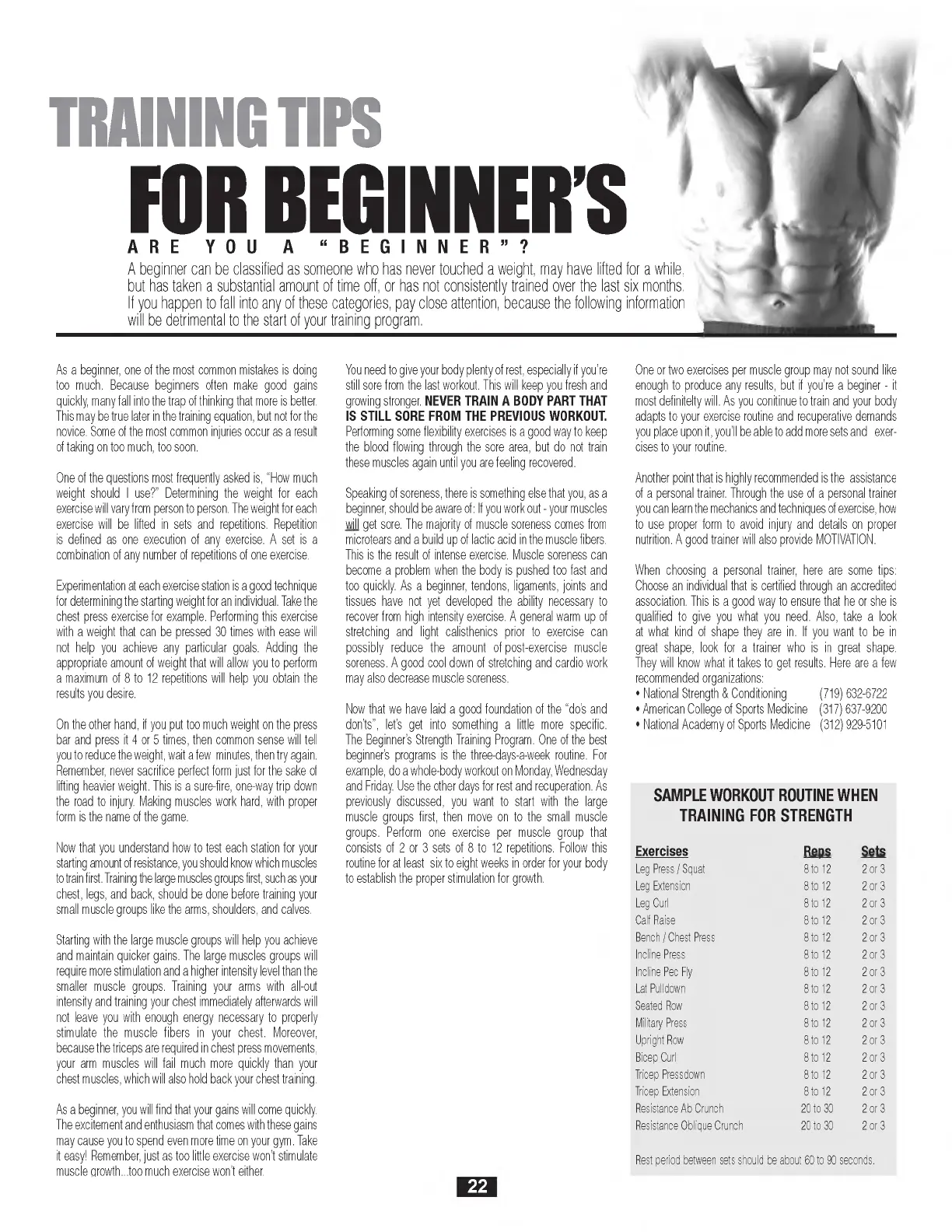
SAMPLE WORKOUT ROUTINE WHEN
TRAINING FOR STRENGTH
Exercises Reps Sets
Leg Press / S quat 8 to 12 2 or 3
Leg E xtension 8 to 12 2 or 3
Leg Curl 8 to 12 2 or 3
C alf R aise 8 to 12 2 or 3
B ench / C h est Press 8 to 12 2 or 3
In cline Press 8 to 12 2 or 3
In cline Pec Fly 8 to 12 2 or 3
Lat P u lldown 8 to 12 2 o r 3
S eated Row 8 to 12 2 or 3
M ilita ry Press 8 to 12 2 or 3
U prig h t R ow 8 to 12 2 or 3
B ic e p C url 8 to 12 2 or 3
Tricep Pre ssdown 8 to 12 2 or 3
Tricep Extension 8 to 12 2 or 3
R esista n ce A b C runch 20 to 30 2 or 3
R esista n ce O b liq u e C runch 20 to 30 2 or 3
Rest perio d betw een sets should be a b o u t 60 to 90 se c onds.
22


 To Next Page
 Loading...