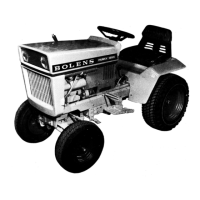
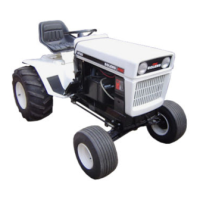
The Bolens Husky 1476 Hydrostatic Tractor is a robust and versatile piece of equipment designed for various lawn and garden tasks, as well as light agricultural work. This operator's manual provides comprehensive instructions for its safe operation, maintenance, and troubleshooting.
Function Description
The Husky 1476 is a hydrostatic tractor, meaning it uses a hydraulic system for power transmission, offering infinitely variable speeds. It is equipped with a Power Take-Off (P.T.O.) system that allows it to drive front, center, or rear attachments, making it highly adaptable for different implements like mowers, snow casters, and other powered tools. The hydraulic lift system with a visual depth gauge enables precise control over attached implements, allowing the operator to raise, lower, or float them to follow ground contours. Electric starting ensures ease of use, and a range of safety features, including interlock switches, prevent accidental starts and ensure safe operation.
Important Technical Specifications
- Engine: 33.1 cu. inch Wisconsin, 4-cycle, single-cylinder, air-cooled.
- Fuel Capacity: 5.3 gallons.
- Engine Oil Capacity: 2 quarts.
- Transmission Oil Capacity: 10 quarts.
- Air Cleaner: Dry type.
- Drive: Hydrostatic transmission.
- Speed: Infinitely variable, approximately 0-8 mph forward and 0-4 mph in reverse.
- Power to Attachments: Triple belt drive (P.T.O.) with universal joints and splined shaft.
- Tires:
- Front: 5.70/5.00-8 (standard). Optional high flotation (20 x 8.00-10) available.
- Rear: Standard agricultural (27 x 8.50-15) and lawn & garden (27 x 8.50-15) options, as well as Terra Tire (26 x 12.0-12) and Lawn & Garden Terra Tire (26 x 12.00-12) kits. Dual wheel kits (27 x 8.50-15) are also available.
- Dimensions:
- Height: 45 inches.
- Width: 38 inches.
- Length: 72 inches.
- Wheelbase: 49 inches.
- Turning Radius: 54 inches.
- Ground Clearance: 8-1/2 inches.
- Shipping Weight: 975 lbs.
- Standard Equipment: P.T.O. splined shaft, hydraulic lift system with visual depth gauging, electric starting, headlights and tail lights, full fenders, adjustable all-angle seat-spring suspension with foam, padded adjustable seat, 45 amp battery, selector lever for drive-neutral-park, interlock switches, tapered roller bearing front wheels, replaceable spindle bushings, automotive type muffler, compression release for easy starting, solid state ignition, three-unit regulator, ammeter, extra-heavy channel frame, tilting hood for access to engine.
Usage Features
The Husky 1476 is designed for user-friendly operation with clearly labeled controls.
- Controls: Key controls include a choke knob, ammeter, light switch, ignition-starter switch, throttle knob, foot brake, travel pedal (for forward and reverse motion), foot rest, depth indicator gauge, hydraulic lift lever, P.T.O. lever, and transmission lever.
- Starting: The engine will only start when the P.T.O. control lever is in the "OFF" position and the transmission lever is in "PARK" or "NEUTRAL." This safety interlock prevents accidental movement. The starting procedure involves pulling out the choke and throttle, turning the ignition key, and allowing the engine to warm up before adjusting the throttle to full RPM.
- Driving: The hydrostatic transmission allows for smooth, infinitely variable speed control using the travel pedal. Depressing the toe of the foot moves the tractor forward, while the heel moves it in reverse. The foot brake is used for towing, free-wheeling, or when shifting the transmission lever into "DRIVE."
- Attachment Operation: The hydraulic lift lever allows for raising and lowering attachments, with a "FLOAT" position for implements to follow ground contours. The P.T.O. lever engages and disengages power to attachments. The attachment switch system is designed for quick changes, requiring no belts or special tools.
- Safety Precautions: The manual emphasizes numerous safety precautions, including never operating the vehicle with children nearby, avoiding loose clothing, not fueling a hot engine, and always checking behind the tractor before reversing. It also warns against operating the engine without the cooling shroud and stresses the importance of understanding all controls before use.
Maintenance Features
Regular maintenance is crucial for the longevity and performance of the Husky 1476. The manual provides a detailed maintenance guide and record.
- Pre-Operational Checks: Before each use, operators should check the engine oil level, battery electrolyte, gasoline supply, air cleaner, flywheel screen, tire inflation (8-12 lbs.), and transmission fluid level. All nuts, screws, and parts should be visually inspected for damage or looseness.
- Engine Maintenance:
- Oil Level: Check every 8 hours.
- Oil Change: Drain and refill crankcase oil every 50 hours or more often under severe conditions.
- Cooling System: Check and clean the cooling air screen, fan, and engine cooling fins every 10 hours, or more frequently in dusty conditions, to prevent overheating.
- Air Cleaner: Service every 10 hours or more often in dusty conditions.
- Spark Plug: Clean and regap every 100 hours or annually.
- Fuel Strainer: Inspect frequently for dirt and water; clean as needed.
- Transmission Maintenance: Check transmission oil level with the engine idling and ensure the transmission cooling fins are clean.
- Battery Maintenance: Check battery charge every 60 days if stored, and recharge if necessary. Maintain electrolyte level and keep terminals clean.
- Lubrication: Lubrication points should be checked regularly according to the lubrication chart.
- General Checks: Inspect generator-starter mounting bolts and check for belt wear.
- Storage: For extended storage, the tractor should be thoroughly cleaned, especially engine fins and the flywheel screen. Rust preventative should be applied to metal parts. The gas tank and carburetor should be drained. The spark plug should be cleaned, and a small amount of oil added to the cylinder head. The battery should be fully charged and stored in a cool place, and the air cleaner sealed. Attachments should be lowered to the ground, and the P.T.O. lever in the "OFF" position.
The manual also includes a minor troubleshooting guide for common issues like the engine not starting, stalling, or overheating, and a wiring diagram for electrical system diagnosis. Bolens emphasizes that major repair work should be performed by an authorized dealer to maintain the factory warranty.

 Need help?

 To Next Page

 General