Macro- and microcinematography
Every day, scientists, businessmen, engineers-and countless amateur movie
makers-use micro- and macrofilming techniques for studies and research. The
movie camera has proved invaluable for recording actions and phenomena which
are normally impossible to observe.
Macrofilming is the filming of minute subjects, still or moving, at very short range.
This is achieved by increasing the distance between the film plane and the lens
seat with extension tubes placed between the camera and the lens. Bolex
produce a set of four extension tubes (see page 45) which increase the lens
seat/film plane distance from 5 mm to 75 mm. For maximum definition, the lens
focusing must be adjusted with extreme accuracy. Allowing for a continuous
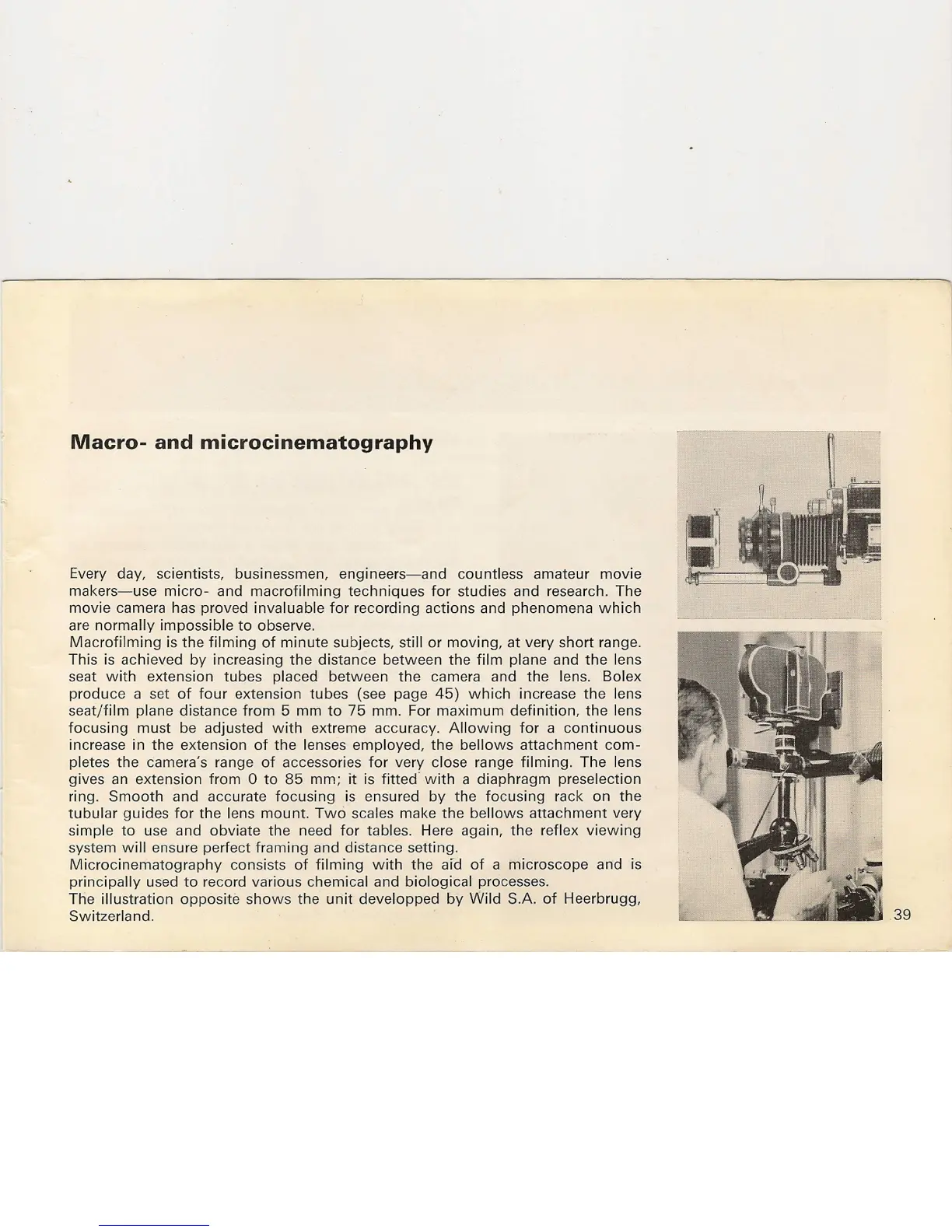
increase in the extension of the lenses employed, the bellows attachment com-
pletes the camera's range of accessories for very close range filming. The lens
gives an extension from 0 to 85 mm; it is fitted' with a diaphragm preselection
ring. Smooth and accurate focusing is ensured by the focusing rack on the
tubular guides for the lens mount. Two scales make the bellows attachment very
simple to use and obviate the need for tables. Here again, the reflex viewing
system will ensure perfect framing and distance setting.
Microcinematography consists of filming with the aid of a microscope and is
principally used to record various chemical and biological processes.
The illustration opposite shows the unit developped by Wild S.A. of Heerbrugg,
Switzerland.
.39



 To Next Page