Need help?
Do you have a question about the Bollhoff Portable C RIVSET and is the answer not in the manual?
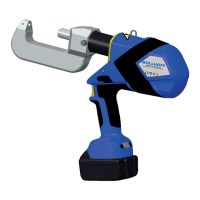
The Böllhoff Portable C RIVSET®/WELTAC® (10 - 50 kN) is an electric-hydraulic riveting tool designed for hand-held operation, offering a compact and ergonomic design for efficient and fatigue-proof work. It is suitable for both RIVSET® self-piercing rivets and WELTAC® flow-drill screws, with a force adjustment range of 10 to 50 kN.
The tool is primarily used for setting self-piercing rivets and flow-drill screws in various materials and sheet thicknesses. It features an automatic retraction mechanism that returns the piston to its starting position once the maximum operating pressure is reached. A manual retraction button is also available for emergency situations or faulty riveting cycles. The tool is equipped with a special brake that immediately stops the piston's forward motion when the trigger is released, enhancing safety. A double piston pump provides a rapid approach to the workpiece followed by a slower working speed for precise setting. The C-frame head can be rotated 350° around its longitudinal axis, allowing for improved access in tight corners and difficult working areas.
The device incorporates a microprocessor controller that indicates battery charge status, service intervals, and performs error diagnostics. A white LED illuminates the working area upon trigger activation and automatically switches off after 10 seconds, a feature that can be deactivated. For RIVSET® applications, the tool can be used with tape feed mechanisms (TF3 or TF5) for 3 mm or 5 mm rivets, respectively. For WELTAC® applications, it supports SNS3M (3 mm) and SNS5M (5 mm) fasteners. An optional USB adapter allows for generating work session reports on a PC, documenting the tool's proper function. The hydraulic oil used is environmentally friendly, "Blue Angel" certified, and suitable for low temperatures, offering excellent lubrication properties. All tool functions are controlled by a single trigger, simplifying operation and improving grip compared to two-button systems.
The tool is designed for hand-held use and should not be restrained in a vise or used in stationary applications. It is not intended for continuous operation; after 150-200 cycles, a 15-minute cool-down period is recommended to prevent overheating. Only specially trained personnel, at least 16 years old, should operate the tool and handle connecting materials. Proper eye protection is mandatory during operation and servicing. Loose clothing, jewelry, and long hair should be kept away from moving parts. The work area must be kept clean and organized to prevent accidents. Users should maintain proper footing and balance at all times.
Before operation, the battery charge level should be checked; a low charge is indicated by the red LED flashing for 20 seconds at the end of a riveting cycle. The appropriate tool kit (riveting dies and punches) must be selected based on the material and sheet thickness. It is crucial to always adjust the joining force according to the current application to avoid damaging the tool kit. The riveting process can be interrupted at any moment by releasing the trigger. The tool should never be operated without a workpiece or sheet metal to prevent damage to the dies and/or punch. Electric-hydraulic tools must not be used in heavy rain or underwater.
Regular maintenance is essential for the tool's longevity and safe operation. After each use, the tool should be cleaned and dried, and the battery cartridge and charging unit protected from humidity and dust. Moving parts should be checked for functionality, jamming, or breakage. The belt feed mechanism should be oiled regularly.
Before changing the head/tool kit, the battery must be removed to prevent unintended starts. The trigger should be in the off position before inserting the battery. When changing C-frames, care must be taken to prevent dust and dirt from entering the cylinder. The threads of the riveting head and cylinder area should be cleaned before assembly or head change.
Daily maintenance includes checking dies and punches for wear, especially the center 'pip' on upsetting dies, and removing metal deposits. A bent punch can damage the feeding mechanism and affect riveting quality, so punches should be checked for straightness and replaced if necessary. The feeding head should be removed by loosening the screw and pulling it off the shaft. The piston should be advanced approximately 25 mm by pressing the trigger, then cleaned of swarf or adhesive and re-greased. The nose piece of the tape feed mechanism should be cleaned inside and out, and the rubber rivet guide strips checked for presence and damage. Missing or worn guide strips can cause rivets to turn, damaging the feeding mechanism and affecting riveting quality.
The microprocessor controller will indicate when service is due (after 10,000 cycles or by a 20-second flashing LED after a work cycle). If service is due, the tool must be returned to an authorized service center to maintain warranty validity. Only dies and punches are customer-replaceable parts. Any other repairs should be performed by qualified experts to avoid injury or damage and to preserve the warranty. The seals of the tool should not be damaged, as this voids the warranty. Cleaning materials should not damage rivet guide strips, and the inside of the shaft should not be degreased. The cylinder area must be kept free of debris to prevent damage and leakages.
 General
| Brand | Bollhoff |
|---|---|
| Model | Portable C RIVSET |
| Category | Rivet Tools |
| Language | English |

 To Next Page