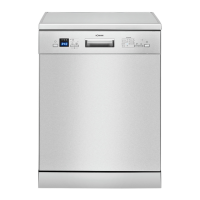
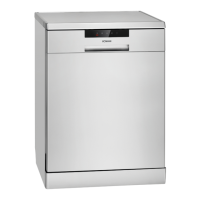
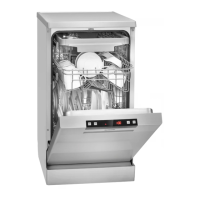
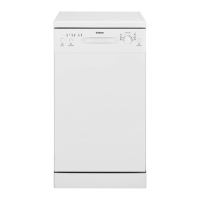
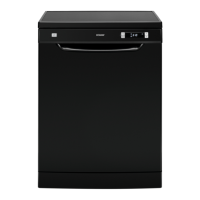
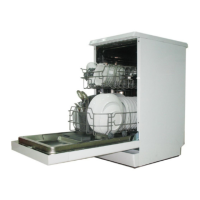
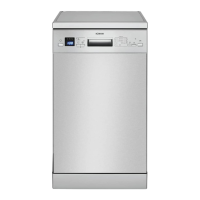
This document describes the BOMANN GSP 7411 IX Household Dishwasher, an appliance designed for private use to wash dishes.
Function Description
The BOMANN GSP 7411 IX is a household dishwasher that automates the process of cleaning dishes and cutlery. It is equipped with a water softener system to manage water hardness, a rinse aid dispenser for spot and streak-free drying, and a detergent dispenser. The appliance offers various wash programs tailored to different levels of soiling and types of dishes, including intensive, universal, ECO, glass, 90-minute, rapid, and soak programs. It also features a "½ Loading" function for smaller loads to reduce energy and water consumption, and an "Extra drying" function for enhanced drying.
The dishwasher operates by spraying water and detergent onto the dishes through spray arms, followed by rinsing cycles and a drying phase. The water is filtered through a three-part filter system to prevent food particles from recirculating. The appliance's control panel allows users to select programs, set a start delay (1-24 hours), activate/deactivate extra drying, and engage a child lock. It also provides visual indicators for rinse aid and salt levels, as well as water supply status and error codes.
Important Technical Specifications
- Model: GSP 7411 IX
- Place Settings: Maximum 9
- Water Pressure:
- Maximum permissible inlet water pressure: 1 Mpa
- Minimum permissible inlet water pressure: 0.04 Mpa
- Recommended water pressure: 0.04-1.0 MPa
- Water Inlet Hose: Approx. 1.5 m (extendable to max. 4 m)
- Water Drain Hose: Minimum diameter 40 mm, maximum height 1000 mm above rinsing floor
- Electrical Connection:
- Voltage: 220-240 V ~ / 50 Hz
- Rated power: 1760-2100 W
- Rated current: 10 A
- Dimensions (H x W x D): 84.5 x 44.8 x 60.0 cm
- Net Weight: Approx. 36.5 kg
- Inlet Hose Safety System: Art.-No. 8900 410 (optional, depending on model)
- ECO Program (EN50242/EN60436):
- Detergent: 27g (or Tab) / 17g (or Tab)
- Time: 235 Min
- Energy: 0.691 kWh / 0.704 kWh
- Water: 9.0 l
- Water Hardness Settings: H1 (0-5 °dH), H2 (6-11 °dH), H3 (12-17 °dH - factory setting), H4 (18-22 °dH), H5 (23-34 °dH), H6 (35-55 °dH)
- Rinse Aid Dosage Settings: Level 1 (min.) to Level 6 (max.), factory setting "4"
Usage Features
Installation:
The dishwasher should be placed on a solid, horizontal surface near water inlet/outlet and a grounded power socket. The appliance cover can be removed to reduce height for under-worktop installation. Water supply connection requires new hose sets, and the drain hose must be secured to prevent backflow. Electrical connection must comply with local standards and regulations, using a properly installed and earthed wall outlet.
First-Time Use:
Before first use, the salt container (water softener) must be filled with approximately 1.5 kg of salt and water. The rinse aid dispenser should be filled with about 110 ml of rinse aid. Detergent must also be added. The salt consumption can be adjusted based on local water hardness.
Loading the Dishwasher:
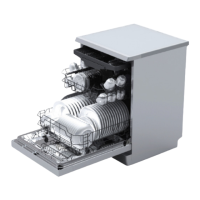
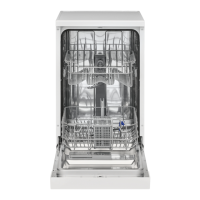
Dishes and cutlery should be arranged to allow free rotation of spray arms and proper water drainage. Sensitive items go in the upper basket, while heavily soiled items like pots and plates go in the lower basket. Knives and sharp utensils must be placed with points down in the cutlery basket or horizontally in the dishwasher basket. The upper basket height is adjustable. Rack shelves and cup shelves can be folded down or removed for bulky items. Overloading should be avoided for optimal cleaning.
Program Selection and Operation:
Users select a program based on the degree of soiling. The control panel allows for program selection, start delay setting, and activation of special functions like "½ Loading" and "Extra drying." The appliance starts automatically after the selected delay. A program can be changed shortly after starting, but not if detergent has already been released. Dishes can be added before the detergent dispenser opens.
Safety Features:
- Child lock function to prevent unintended operation.
- Inlet hose safety system (optional) to cut off water supply in case of inner hose leakage.
- Ventilation openings in the appliance bottom must not be clogged.
- Door should not be left open to avoid tripping hazards.
- Appliance is designed for use by children aged 8 and above, and persons with reduced capabilities, if supervised or instructed.
- Do not operate without supervision.
- Switch off and disconnect from power supply during cleaning, maintenance, or disruption.
- Regularly check for damage to the appliance and mains lead.
- Do not attempt self-repair; contact an authorized technician.
Maintenance Features
Cleaning and General Care:
- Always turn off the appliance and disconnect from power before cleaning.
- Allow the appliance to cool down before cleaning.
- Do not use steam cleaners, wire brushes, or abrasive items.
- Clean outer surfaces and door sealing with a soft, damp cloth and mild cleaning agent.
- For internal stains, use a dampened cloth with white vinegar or a special dishwasher detergent.
- Run a program with the highest rinse temperature and detergent (without dishware) if needed for internal cleaning.
- Dry outer surfaces thoroughly before restarting.
Filter System Maintenance:
The three-part filter system (main filter, coarse filter, micro filter) should be checked for residues after each rinse cycle.
- Turn the coarse filter counterclockwise and remove the entire filter system upwards.
- Separate the coarse and micro filters from the main filter.
- Remove leftover food and clean the filters under running water, using a soft brush if necessary.
- Reinstall the filter system in reverse order, tightening the filter unit clockwise.
- Never use the dishwasher without the filter.
- Do not knock out the filter to avoid deformation.
Spray Arm Maintenance:
Lime and impurities can block the nozzles and bearings of the spray arms.
- Unscrew the securing nut of the upper spray arm and pull it downwards.
- Pull off the lower spray arm upwards.
- Clean the arms under running water, using a soft brush for the nozzles if necessary.
- Insert the spray arms back until they click into place and tighten the nut of the upper spray arm.
Antifreeze Protection:
If the unit is exposed to temperatures below zero:
- Disconnect the mains plug.
- Close the water supply and remove the inlet hose from the water valve.
- Drain water from the inlet hose and water valve.
- Reconnect the inlet hose to the water valve.
- Turn off the lid of the salt container, remove the filter system, and remove any remaining water in the sump with an absorbent sponge.
Troubleshooting:
The manual provides a troubleshooting guide for common issues like the unit not starting, water not draining, noise, foaming, unclear tableware, spots/filming, cloudiness, black/grey marks, and stains on the inner surface. Error codes (E1, E3, E4, Ed) are also listed with their possible causes and actions. If problems persist, contact a distributor or authorized technician.
Disposal:
The appliance should not be disposed of with domestic waste. It must be returned to designated collection points for electrical equipment to support recycling and prevent environmental and health impacts. Existing snap and bolt locks should be removed or disabled when disposing of the unit.


 To Next Page
 General