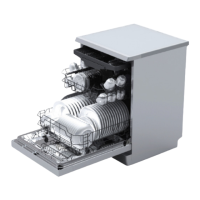
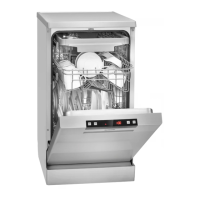
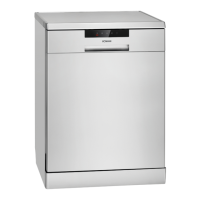
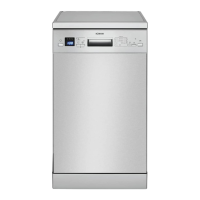
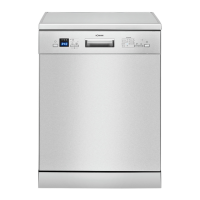
This document describes the Bomann GSP 854 Dishwasher, an appliance designed for private household use. It provides comprehensive instructions for installation, operation, and maintenance to ensure safe and efficient use.
The dishwasher is designed to wash up to 10 place settings. It is suitable for use in various domestic and similar settings, including staff kitchen areas in shops, offices, and other working environments, by clients in hotels, motels, and other residential-type environments, and in farmhouses. The appliance should be connected to the water mains using new hose sets, and old hose sets should not be reused. The maximum permissible inlet water pressure is 1 Mpa, and the minimum is 0.04 Mpa. Ventilation openings located at the bottom of the appliance (depending on the model) must not be clogged, for example, by carpet.
Usage Features:
The dishwasher features an upper and lower basket for loading dishes. Knives and other sharp utensils should be loaded with their points down in the cutlery basket or placed horizontally in the dishwasher basket to prevent injury. The door should not be left open to avoid tripping hazards.
Before first use, the dishwasher requires specific preparations:
- Filling salt into the salt container (water softener): The appliance is equipped with a water softener to remove lime and minerals from hard water. The water hardness varies regionally and can be adjusted on the appliance from H1 (0-5 °dH) to H6 (35-55 °dH) to optimize salt consumption. The salt container should be refilled when the salt warning lamp illuminates. Approximately 1.5 kg of salt should be added using the supplied funnel tube, and the container should be filled with water before the first use.
- Filling the rinse aid dispenser: Rinse aid is automatically added during the final rinse to ensure thorough rinsing and spot- and streak-free drying. The rinse aid warning lamp indicates when a refill is needed. The optical level indicator "C" next to the dispenser also shows the remaining amount. The dosage can be adjusted from level 1 (min.) to level 6 (max.) to prevent spots or whitish stains.
- Filling in detergent: Detergents are essential for removing dirt. New pulverized detergents are often phosphate-free, so salt should still be used even with moderately hard water (e.g., 6°dH) to prevent white spots. Detergent tablets may not fully dissolve in short programs with low water temperatures, so longer programs with higher water temperatures are recommended for complete residue removal. Detergent should be added just before starting the rinse cycle to prevent it from getting damp and not dissolving properly. The dispenser has two chambers: one for powder detergent for the main rinse and another for pre-rinse detergent or tablet detergent.
Loading the Dishwasher Baskets:
Only "dishwasher resistant" dishes and cutlery should be used. Gross food scraps and burnt leftovers should be removed, and pre-rinsing under running water is not necessary. The appliance should not be overloaded to ensure adequate cleaning and energy consumption. Very small items should not be rinsed in the appliance as they can fall out of the baskets.
- Upper Basket: Suitable for sensitive, light tableware items like glasses, coffee, and tea cups. The cup shelf can be folded down or removed if needed.
- Lower Basket: Designed for larger, heavily soiled items such as pots and plates, due to the intense cleaning action of the lower spray arm. Plate holders in the lower basket can be folded to accommodate bulky dishes.
- Cutlery Rack: Cutlery should be sorted with sharp points down and evenly distributed to allow water to drain. Extra-long or large parts should be placed in the middle. The cutlery rack can be adjusted to different positions (inclined or horizontal) based on loading requirements.
The height of the upper basket can be adjusted by placing its wheels on rails of different heights, creating more space in either the upper or lower basket.
Starting a Rinse Program:
- Open the water supply to maximum pressure.
- Load the dishwasher baskets and fill in detergent.
- Switch on the appliance using the power button.
- Select the desired rinse cycle using the program selection button.
- Set any available options, such as "Alternative wash" (choosing only upper or lower basket for water, energy, and time savings) or "Extra drying" (increases rinse temperature and extends drying phase for optimum drying of plastic ware).
- Press the start/pause button to begin the program.
The program start can be delayed by 1-24 hours. A program change should only be done shortly after starting the program, before detergent has been released. To add a forgotten dish during operation, press the start/pause button, wait for the spray arms to stop, open the door carefully, add the dish, close the door, and press start/pause again after about 10 seconds.
At the end of the program, a series of signals will sound, and the unit will enter standby mode. It is advisable to let the appliance cool down for about 15 minutes before opening to avoid steam damage to furniture. After switching off the appliance and closing the water supply, dishes should be removed after cooling. Leaving the door slightly open until the next rinse cycle helps prevent odors.
Energy Saving Tips:
- Operate the dishwasher when fully loaded.
- Do not pre-rinse dishes under running water.
- Use the most appropriate rinse program for each load type.
- Avoid pre-rinse cycles if not absolutely necessary.
- If available, connect the appliance to a hot water supply up to 60°C.
Maintenance Features:
Regular cleaning and maintenance are crucial for optimal performance.
- Always switch off the appliance and disconnect it from the power supply before cleaning.
- Allow the appliance to cool down sufficiently.
- Do not use steam cleaners, wire brushes, sharp, or abrasive items, or acidic/abrasive detergents.
- Clean outer surfaces and door sealing with a soft, damp cloth and mild cleaning agent.
- To remove internal stains, use a dampened cloth with white vinegar or a special dishwasher detergent. If necessary, run the appliance without dishware on the program with the highest rinse temperature after filling detergent.
Filter System:
The three-part filter system prevents food particles and other objects from entering the pump.
- Main filter: Pulverizes food and soil particles with a special jet on the lower spray arm.
- Coarse filter: Filters out larger items like bone pieces or glass shards.
- Micro filter: Filters dirt and food residues in the sump area.
The filter system should be checked for residues after each rinse. To clean, turn the coarse filter counterclockwise, remove the entire system, separate the coarse and micro filters from the main filter, clean them under running water with a soft brush if needed, and reassemble in reverse order, tightening the filter unit clockwise. The dishwasher must never be used without the filter.
Spray Arms:
Lime and impurities can block nozzles and bearings of the spray arms. Regularly check the outlet nozzles for blockages. To clean, unscrew the securing nut of the upper spray arm and pull it off. Pull off the lower spray arm. Clean both arms under running water, using a soft brush for the nozzles if necessary. Reinsert the spray arms until they click into place and tighten the nut of the upper spray arm.
Antifreeze Protection:
If the unit is exposed to temperatures below zero, disconnect it from the power supply, close the water supply, remove the inlet hose, drain water from the inlet hose and water valve, reconnect the inlet hose, turn off the salt container lid, remove the filter system, and remove remaining water in the sump with an absorbent sponge.



 To Next Page
 General