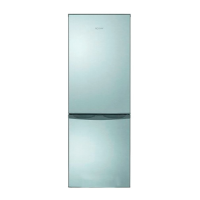
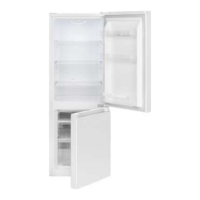
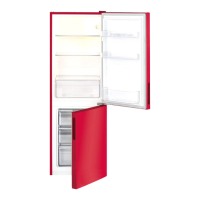
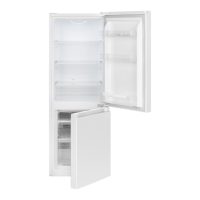
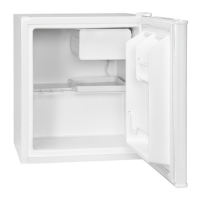
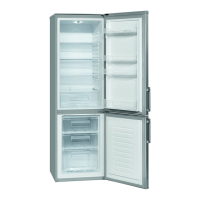
This document describes the Bomann KG 183, a household fridge-freezer combination appliance.
Function Description
The Bomann KG 183 is designed for private household use, offering both refrigeration and freezing capabilities. It allows for the storage of fresh food and drinks in the fridge compartment and frozen food in the freezer compartment. The appliance features an automatic defrosting system for the fridge and requires regular manual defrosting for the freezer to maintain optimal performance and energy efficiency. The door opening can be reversed from the right (supplied condition) to the left side, offering flexibility in placement.
Important Technical Specifications
- Model: KG 183
- Category: 7 (Refrigerator-freezer)
- Energy Efficiency Class: A+++ (highest efficiency)
- Annual Energy Consumption: 131 kWh/year (based on standard test results for 24h; actual consumption may vary based on usage and location)
- Net Capacity Cooling Total: 176 liters
- Net Capacity Freezing Total: 65 liters
- Start Rating: 4 stars (indicating a freezer temperature of -18°C or colder)
- Frost-free: No (for the freezer, manual defrosting is required)
- Temperature Rise Time: 15 hours
- Freezing Capacity: 3 kg/24h
- Climate Class: N-T (ambient temperature range of +16°C to +32°C for N, and +16°C to +43°C for T)
- Noise Level: 41 dB(A) re 1pW
- Design: Free standing
- Dimensions (H x W x D): 180.0 cm x 55.4 cm x 56.3 cm
- Net Weight: 59.0 kg
- Compressor Power: 60 W
- Connection Voltage: 220-240 V~, 50 Hz
- Refrigerant: Isobutane (R600a), a natural gas that is flammable and environmentally compatible.
Usage Features
Temperature Control:
The appliance features an adjustable thermostat located in the fridge interior. Setting "0" or "OFF" turns the device off. Turning the control clockwise from "1 MIN" to "7 MAX" regulates the internal temperature, with "1 MIN" being the warmest and "7 MAX" being the coldest setting. The interior lamp illuminates when the door is opened. For initial operation, it's recommended to set the control to the highest setting until the desired temperature is reached, then adjust to a medium setting for easier fine-tuning.
Food Storage (Fridge):
Food should always be stored covered or packed to prevent drying out and transfer of odors or tastes. Suitable packaging includes polyethylene plastic bags or foil, plastic containers with lids, special elasticated plastic covers, or aluminum foil. Fresh packed items and fruits/vegetables should be placed on glass shelves and in the vegetable box, respectively. Bottles can be stored in the door racks. Meat should be well-packed and stored for no more than 2-3 days, avoiding contact with cooked dishes. Warm food must be cooled down before being placed in the fridge.
Food Storage (Freezer):
The 4-star freezer compartment maintains a temperature of -18°C or below, suitable for storing frozen food for several months, making ice cubes, and freezing fresh goods. The freezer temperature is influenced by external factors like room temperature, placement, door opening frequency, and food quantity. For freezing fresh food, it's recommended to turn the temperature control to the maximum setting 24 hours prior and maintain it for a few hours after freezing. Fresh food should be frozen quickly to minimize ice crystal formation and preserve food structure. Frozen food should be stored in the lower compartments, keeping the upper compartment available for fresh food. A space should be maintained between items for air circulation. Packed frozen merchandise should be stored according to manufacturer data, ensuring it remains frozen after purchase. Storage duration can be up to three months, but packaging information should be consulted.
Safety Precautions for Storage:
Do not store carbonated drinks in the freezer to avoid explosion risk. Partially or completely defrosted products should be consumed quickly and not refrozen unless processed into a ready meal. In case of power failure, avoid opening the door; food should remain unaffected for up to 15 hours. Do not eat still-frozen food or allow children to eat ice cream directly from the freezer to prevent oral injuries. Avoid touching metal parts or frozen food with moist hands to prevent cold-related injuries. Freezer compartments feature stoppers but can be removed by pulling upwards.
Maintenance Features
Cleaning:
For hygienic reasons, the interior and accessory parts should be cleaned regularly. Before cleaning or user maintenance, the device must be turned off, and the plug disconnected or fuse removed. Steam cleaners should not be used, as moisture can damage electrical components and plastic parts. The device must be dry before restarting. Abrasive items, acidic or abrasive detergents, essential oils, organic solvents (e.g., lemon/orange juice, butanoic acid), or cleaning agents containing acetic acid should not be used, as they can damage plastic parts. Cooling coils should not be bent.
To clean, remove all food and store it in a cool place. Use warm water and a mild detergent for the interior (including the rear side and bottom). The water discharge opening should be carefully cleaned with a pipe cleaner or knitting needle. After thorough drying, the appliance can be restarted.
Defrosting:
The fridge has an automatic defrosting system where water drops drain to the rear side of the cooling chamber, collect in a container underneath the compressor, and evaporate. Ensure the water discharge opening is not clogged and clean it with a pipe cleaner or knitting needle. A light formation of ice on the rear side is normal.
The freezer requires regular defrosting to ensure efficient cooling and save energy. To defrost, turn the temperature control to "0 - OFF" and disconnect the plug. Remove food items and store them in a cool location. Once the ice has melted, drain the condensate and dry the interior before restarting the device. Metal objects (e.g., knives) should never be used to remove ice from the vaporizer, as this can cause serious damage. To speed up defrosting, a bowl of warm water (approx. 50°C) can be placed in the freezer chamber.
Energy Saving Tips:
- Disconnect the plug when not in use.
- Avoid installing near heat sources (stoves, heaters, direct sunlight) to prevent increased compressor operation.
- Ensure sufficient ventilation at the bottom and rear, and do not block ventilation openings.
- Allow warm dishes to cool before placing them in the device.
- Avoid opening the door longer than necessary.
- Do not set the temperature colder than needed; 7°C is ideal for the fridge.
- Ensure the freezer temperature does not exceed -18°C.
- Defrost the device regularly.
- Ensure the door sealing is in good condition for proper closing.
Repairs:
Repairs should only be carried out by an authorized specialist to prevent danger to the user. A damaged power cord must be replaced by a qualified electrician. The LED light cover should not be removed, and the LED light itself should only be replaced or repaired by an authorized specialist in case of failure or defect.
Troubleshooting:
The manual provides a troubleshooting guide for common issues like the device not working, cooling too much, food being too warm, loud noise, water on the bottom, light not working, or warm housing sides. Solutions include checking the plug, fuse, temperature setting, ambient temperature, door closure, food arrangement, and ventilation openings. For persistent problems, contact the distributor or an authorized technician.


 To Next Page
 General